
The Conversion Problem
Five reports this month — aerospace, cloud, technology transfer, lunar and cooling — keep finding one gap: the inputs are strong, but the mechanism that converts them into owned output is not. Just ~1.1% of public R&D projects become products.
The issue at a glance
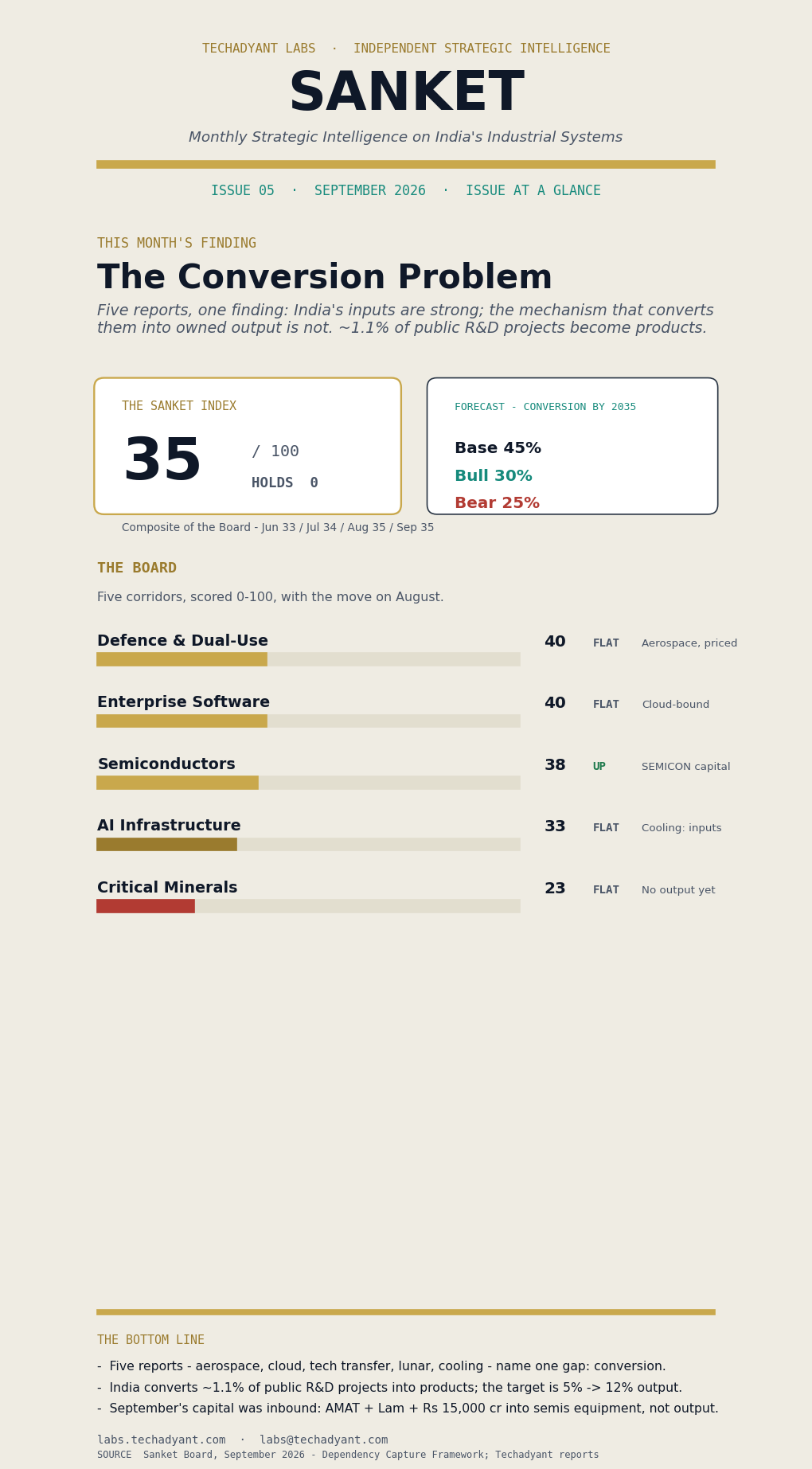
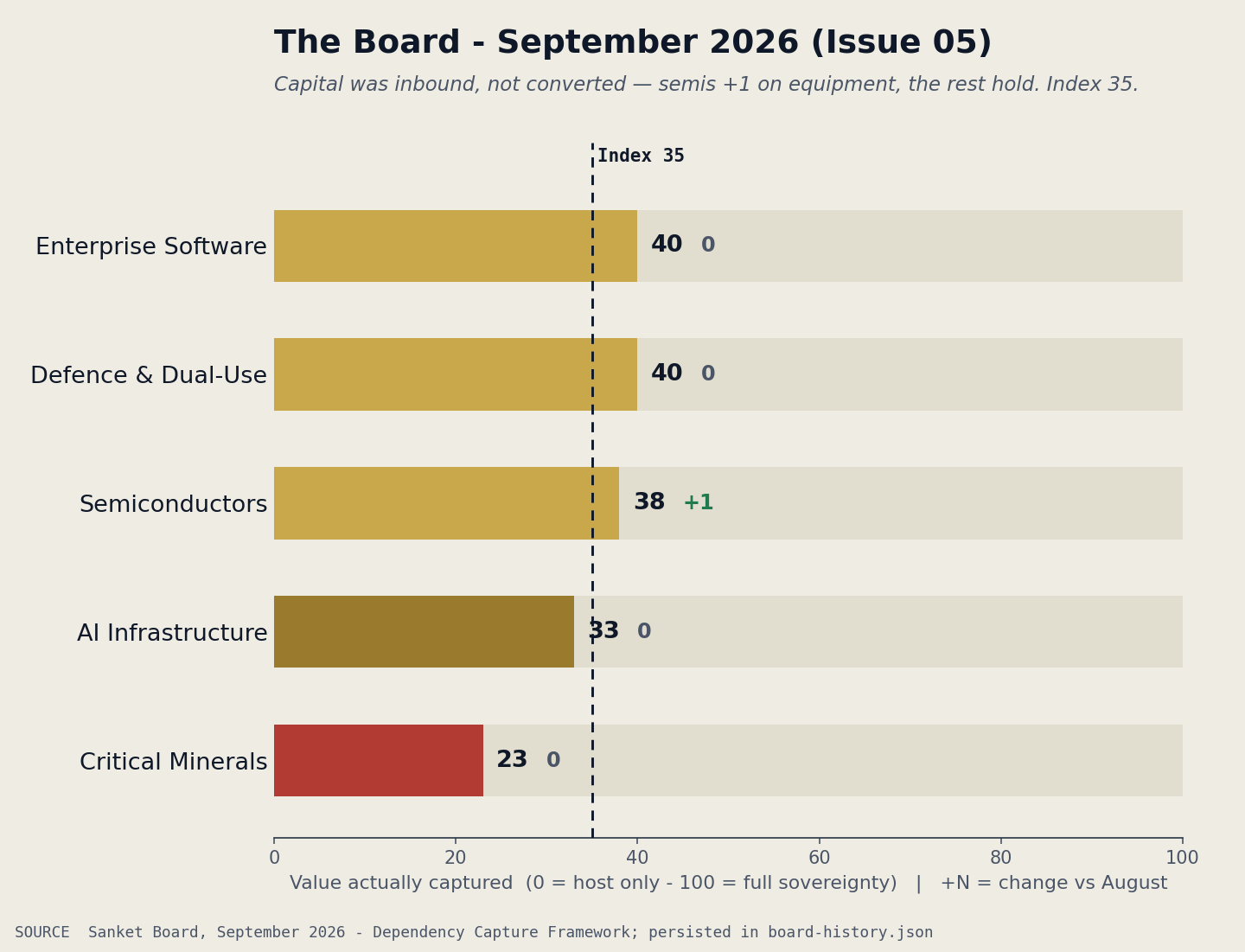
Five Corridors, Standing at 35
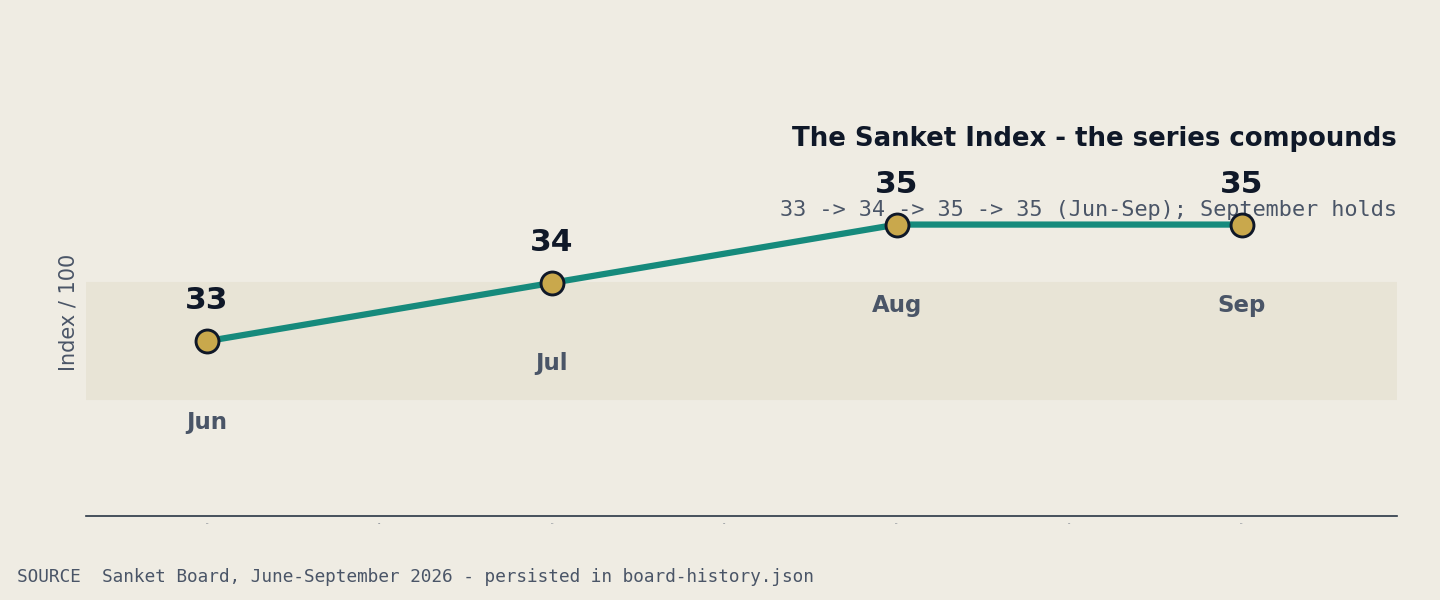
India’s industrial sovereignty, corridor by corridor, on the Dependency Capture Framework™ — how much of the value India captures, not how much it hosts. September’s capital was inbound, not converted, so only semiconductors move; the Index holds at 35.
- Five reports this month - aerospace, cloud, technology transfer, lunar and cooling - name one gap: not where the dependency is, but what converts inputs into owned output.
- The sharpest number is 1.1% - the share of India’s public R&D projects that become products. It is the most falsifiable sovereignty statistic of the year.
- September’s capital was inbound, not converted: Applied Materials, Lam and Karnataka committed over ₹15,000 cr to semiconductor equipment - the input layer, not output.
- Policy aimed at the same layer: Semicon 2.0’s Machines & Materials, Fabs and ATMP guidelines went live (16 Sep), funding the ₹1,27,500 cr scheme where India must own capability.
- The Board holds at 35; only semiconductors tick up (+1). The test now is whether the money converts.
The Conversion Problem
June named the problem - India assembles, but the value lives upstream. July priced the opportunity; August priced the gap, and put a number on what India does not make. September answers the question the scores left open, and it is a harder one: what actually converts inputs into owned output? Five reports this month - aerospace, cloud, technology transfer, the lunar economy, and the cooling layer beneath AI infrastructure - keep circling the same finding. India’s inputs are strong. The mechanism that converts them is not.
The technology-transfer report gives the mechanism a name. Across 52 DRDO labs, 37 CSIR labs, 23 IITs, IISc and nine defence PSUs, India converts only about 1.1% of public R&D projects into products. Its five-pillar reform agenda is an attempt to move India from roughly 5% to 12% of global deep-tech output - a conversion-rate target, not a spending target. Aerospace finds the same asymmetry in hardware (the platform is built at home, the enabling layers are not); the Cloud Question finds its mirror in software; the lunar report is explicit that the dominant prize is terrestrial industrial spillover, not lunar commerce.
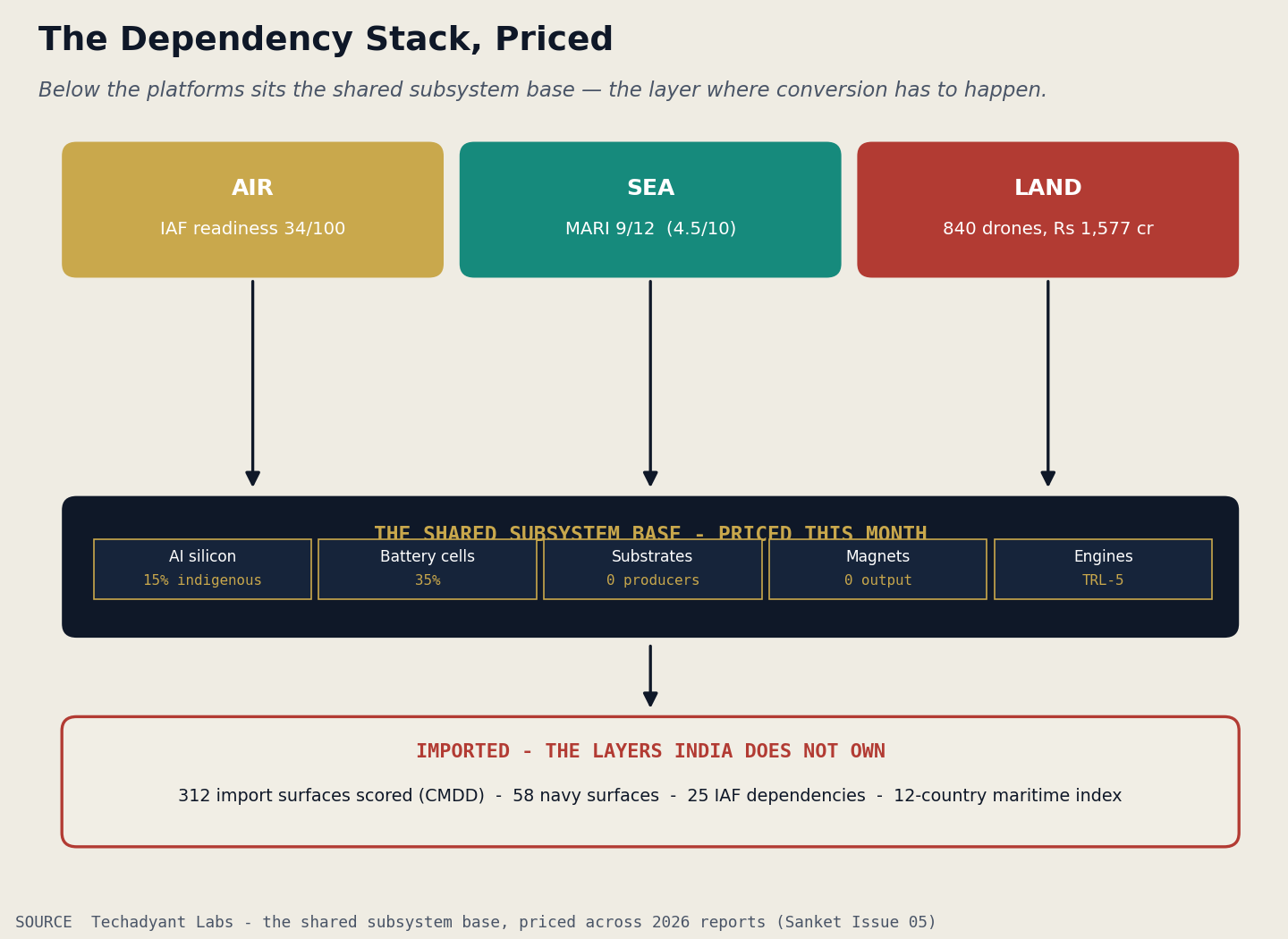
So the month’s through-line is not another gap. It is the set of mechanisms that close one - the lab-to-line transfer, the sovereign-cloud migration, the subsystem base beneath the platform, the cooling and power layer beneath the AI build-out, the spillover from a space programme. The decade’s question is no longer where the gap is. It is what turns a scored import surface into a made one.
1.1% - India’s R&D Conversion Rate
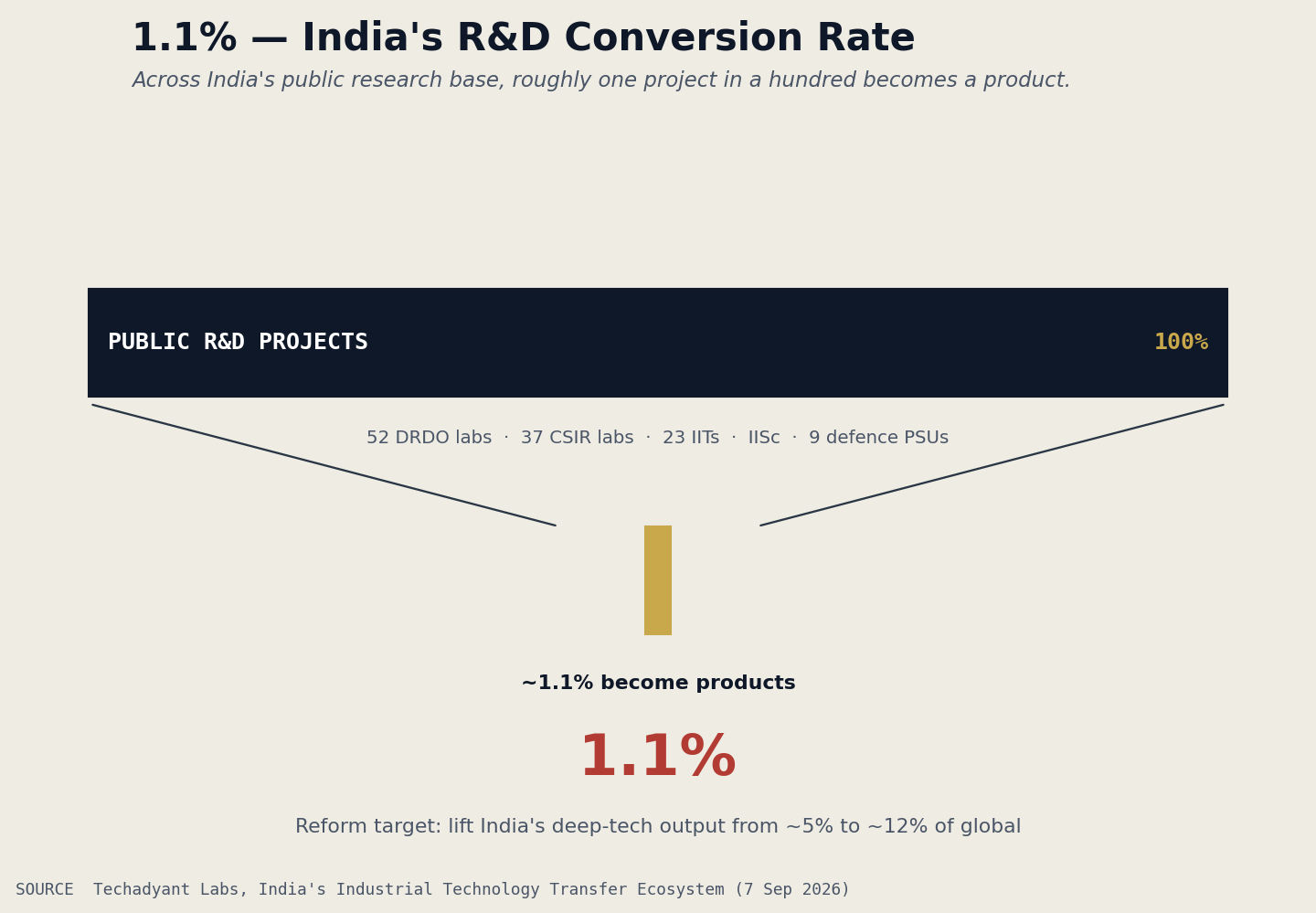
It is the most falsifiable sovereignty number of the year - and the sharpest measure of the conversion problem. A conversion rate is an output, and outputs are countable. The reform target is to lift India’s share of global deep-tech output from ~5% to ~12%.
What Actually Moved in September
The September Changelog
Atlas /research · Dependencies /dependencies · Corridors /corridors · Shape /shape
A Twelfth National Industrial Corridor Is Quietly Being Planned
India’s National Industrial Corridor programme has run on eleven corridors for years. A NICDC procurement this half - tender 187, for a consultant to prepare the Perspective Plan for a Dankuni-Surat Industrial Corridor (DSIC) - is the first documentary sign of a twelfth. It has not been announced, named in the official NICDP list, or reported anywhere. If it holds, DSIC would run east-west from West Bengal to Gujarat, stitching the two ends of India’s manufacturing base into one corridor.
The tell to watch: whether DPIIT names DSIC in the official NICDP corridor list, and whether a state SPV or a funding line follows the Perspective Plan tender. Until then we file it as an early signal, not a fact. SOURCE · NICDC tenders (procurement 187, 2026)
We assess that India’s binding constraint across all five corridors in 2026 is no longer demand, ambition or even capital, but conversion - the mechanism that turns a funded project, a hosted workload or an assembled platform into owned output. September’s money confirms it: capital arrived at exactly the layer August scored, yet the Board barely moved, because inputs are not output.
Principal risk: that measurement substitutes for making - the indices, roadmaps and schemes become the deliverable while orders keep flowing to imports. Confidence is capped by the 18-30 month lag before any new upstream capacity can produce.
The Dependency Stack, Priced
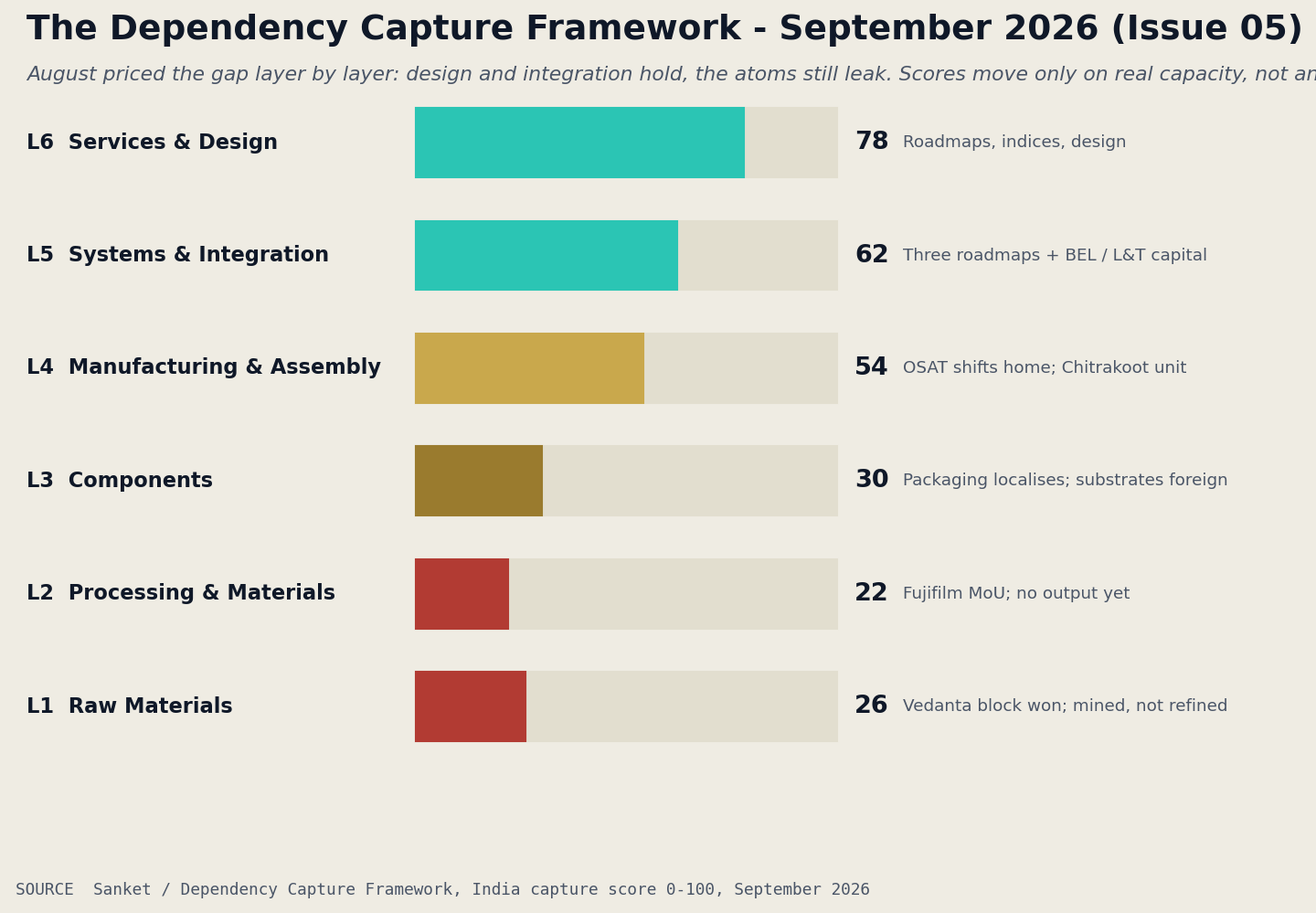
The Dependency Capture Framework™
Five Published This Month
September’s research, each in a line and a number - the conversion lens behind this month’s thesis.
- India’s Military Aerospace Manufacturing Ecosystem - from aircraft assembly to industrial sovereignty; propulsion, subsystems, IP and exports. 158 pp · ₹6,999 / ₹11,999.
- The Cloud Question - India’s dependence on foreign hyperscalers and the sovereign-cloud challenge. 119 pp · ₹6,999 / ₹11,999.
- India’s Industrial Technology Transfer Ecosystem - why public R&D converts ~1.1% of projects, and the 5%→12% agenda. 129 pp · ₹6,999 / ₹10,999.
- India and the Emerging Lunar Economy - a narrow 2026-2032 window; the dominant prize is terrestrial spillover. 127 pp · ₹11,900 / ₹16,900.
- India AI Data Centre Cooling 2026-2035 - the physical layer beneath the AI build-out; liquid cooling, chillers and the rack-density transition. 59 pp · ₹4,900.
Conversion Is a Slogan Too
“Conversion” risks becoming the new comfort word - invoked precisely so nothing has to be measured. The disciplined reading is narrower: a conversion rate is an output, and outputs are countable. The 1.1% figure is powerful because it is falsifiable.
Any conversion agenda that does not publish its own rate should be read with the same scepticism we applied to the indices last month.
Three Ways This Plays Out
One or two corridors convert capability into owned output by 2035 - packaging, cells or an aerospace subsystem line - but India stays import-dependent elsewhere. The Index moves in single digits.
Conversion holds: the equipment capital that arrived seeds real supplier clusters, and India owns a genuine chokepoint in at least one corridor. The 1.1% rate begins to climb.
Measurement becomes the deliverable; the indices, roadmaps and schemes multiply while orders keep flowing to imports - the gap priced, never closed.
Whether September’s conversion mechanisms start to move - whether the equipment capital that arrived turns into a domestic line, whether the technology-transfer agenda publishes its own rate, and where the first owned subsystem actually ships. No number yet; a genuine hook.
The question we hear most: if India already assembles at scale - phones, solar, drones, soon chips - why does “capture” matter? Isn’t assembly how every industrial power began?
Because assembly that never moves upstream is a destination, not a stage. Korea and Taiwan assembled first too - and used the assembly decade to buy, build and own the layers beneath. The test is not whether you assemble; it is whether value-add per unit rises. When it stalls, “Make in India” books the revenue while the margin and the dependency stay offshore - which is exactly what this month’s 1.1% figure measures. Send yours via Shape for next month’s Mailbag.
Citable, Every Number
Every load-bearing figure traces to a source. The Board is an analyst-set reading on the Dependency Capture Framework™ (0-100 = value captured, not hosted); the Sanket Index is the rounded mean of the five corridors, persisted in board-history.json.
- ~1.1% project-to-product conversion; 52 DRDO / 37 CSIR labs, 23 IITs, IISc, 9 PSUs; 5%→12% agenda - Techadyant Labs, India’s Industrial Technology Transfer Ecosystem (7 Sep 2026).
- Cooling as the physical layer beneath AI compute; 59 pp - Techadyant Labs, India AI Data Centre Cooling 2026-2035 (27 Sep 2026).
- Semicon 2.0 outlay ₹1,27,500 cr; Machines & Materials / Fabs / ATMP guidelines issued 16 Sep 2026 - PIB / India Semiconductor Mission.
- Board move (Semiconductors +1): SEMICON India equipment capital - AMAT ₹3,600 cr, Lam ₹10,000 cr, Karnataka over ₹15,000 cr - SEMICON India 2026; Digitimes; Karnataka Govt.
No sponsored coverage; no positions in what we analyse. Corrections to labs.techadyant.com/corrections.
Get Sanket first
Monthly strategic intelligence on India’s industrial systems — independent and infrequent.