
Clear research on how India builds its industries.
Techadyant Labs publishes independent research reports and interactive maps on India’s industrial economy — semiconductors, drones and defence, AI infrastructure and the national industrial corridors. We show who makes what, where supply chains still depend on imports, and where the real opportunities are. Written to be understood, not to sound clever.
Seven surfaces, one intelligence stack
Long-form research, living maps, dispatches and commissioned work — everything the lab produces, in one place.
Long-form research + executive summaries, one strategic question at a time.
Open →National corridors, node dossiers, satellite GIS maps and opportunity surfaces.
Open →A free interactive map of India’s industrial ecosystems, players and import layers.
Open →Import-dependent or nascent layers — what India still imports, ecosystem by ecosystem.
Open →Compact, information-dense dispatches on structural change as it happens.
Open →The monthly strategic-intelligence brief, distilled from the signal engine.
Open →Commissioned research, investment-grade DPRs, briefings and licensing.
Open →Which themes are moving? (last 30 days)
Live signals by domain, to 2026-10-06.
How far along are the nodes?
Deep-researched nodes by development stage.
The current edition
Our flagship long-form analysis — the systems, dependencies and beneficiaries behind a single strategic question.
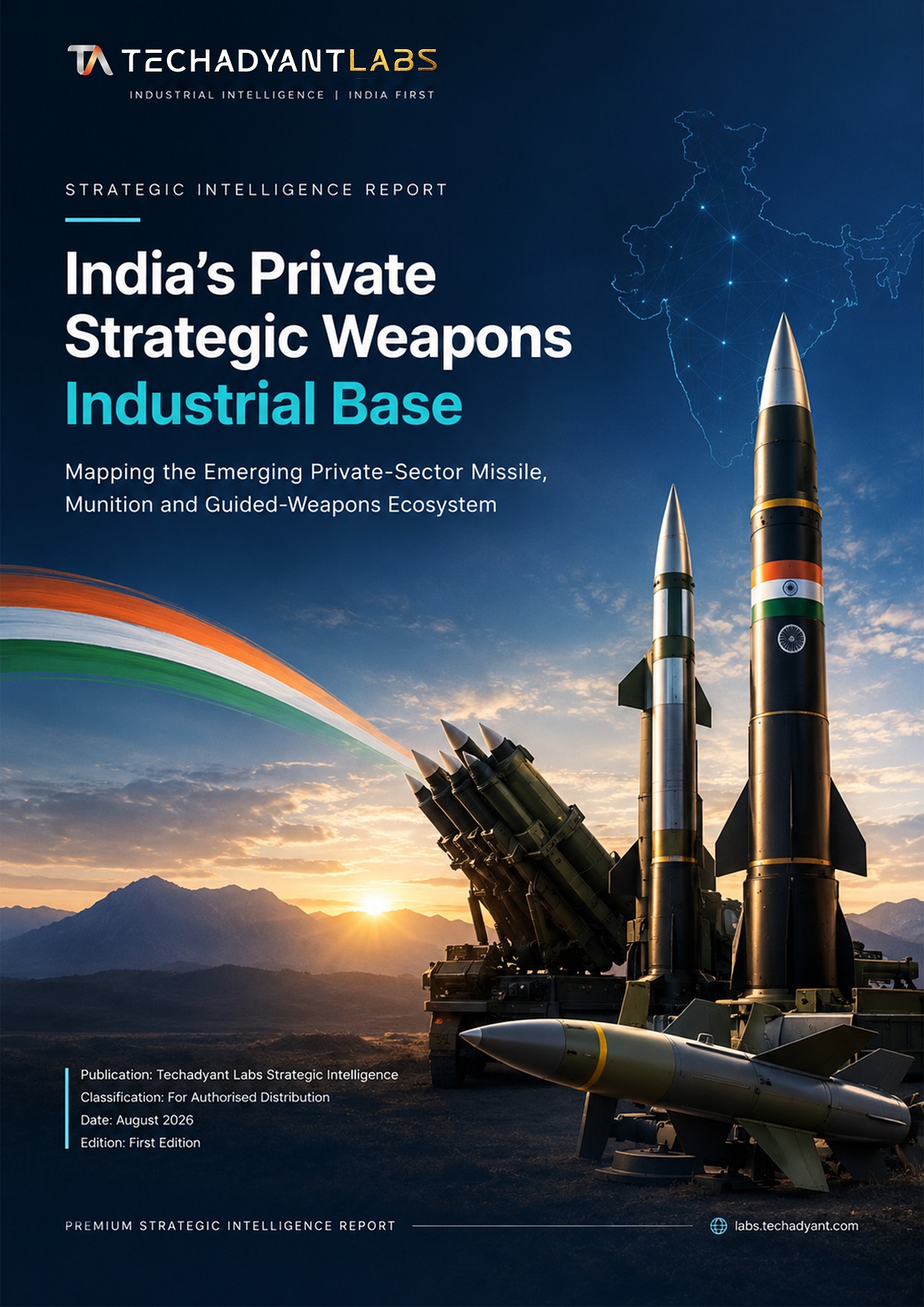
India’s Private Strategic Weapons Industrial Base
Market intelligence, technology sovereignty, and commercial capability across the missile, rocket, and precision-munitions ecosystem — 2026–2035.
India’s strategic weapons industrial base has shifted structurally from a state monopoly to a distributed public–private ecosystem. A ₹2.45 lakh crore decadal addressable market (2026–2035) and DRDO’s Development-cum-Production Partner (DcPP) framework have pulled private primes to 24% of national defence production, with five industrial houses — L&T, Tata Advanced Systems, Kalyani, Adani and Solar — now holding end-to-end integration or critical prime sub-assembly capability. The transition is real but uneven: an 85–90% import dependency for terminal missile seekers and zero private-sector dynamic testing ranges remain the chokepoints that decide how much of the opportunity Indian industry captures. This 78-page report maps the capability matrix, the localisation-gap and value-chain structure, the industrial-corridor and geographic build-out, and three 2030–2035 scenarios — every exhibit carrying a [V] / [V1] / [Modelled] verification label.
India’s industrial corridors, mapped to the node
What changed on the ground
The most recent node-level developments across the 11 national corridors, pulled straight from the corridor tracker’s timelines.
- Aug 2026NICDIT release reaches ₹405.46 cr (+₹198.37 cr since Nov 2025; 4 Aug 2026 Lok Sabha reply)— Khurpia IMC (Prag-Khurpia) · AKIC
- Aug 2026Still awaiting Supreme Court TTZ clearance per the 4 Aug Lok Sabha reply — the only one of the twelve Aug-2024 nodes without an EPC path; initial ₹2.50 cr equity released— Agra IMC · AKIC
- Aug 2026NICDIT release reaches ₹134.72 cr (+₹2.50 cr since Nov 2025; 4 Aug 2026 Lok Sabha reply)— Gaya IMC · AKIC
- Aug 2026Fresh AURIC Bidkin allotment round opens 24 August (applications close 4 September); Bidkin cumulative allotment at 91 plots / 2,570 ac— Shendra–Bidkin (AURIC) · DMIC
Node-level developments tracked from DPIIT/NICDC status reports and PIB releases · corridor tracker updated Aug 2026.
Intelligence dispatches
The Technology Development Board under DST has signed a Rs 130 crore agreement with Bengaluru's BigEndian Semiconductors for Project VeerAI, a Rs 260 crore camera-focused AI vision system-on-chip meant to move from TRL-5 to TRL-9. The first market is secure CCTV and surveillance. It is development funding, not production, and the process node and timeline were not disclosed.
On 6 October Defence Minister Rajnath Singh is to mark HAL Koraput's 2,000th aero-engine delivery and lay the foundation stone for a Rs 218 crore second production line for the Shakti helicopter engine. The line is planned, not built, and Shakti is a joint design with Safran, so it adds Indian capacity for a licensed engine rather than a fully indigenous one.
The National Supercomputing Mission now reports 40 deployed systems with a combined 68 petaflops as of September 2026, up from 37 systems and 40 petaflops reported in December 2025. Thirteen systems exceed one petaflop, and the mission is working towards 50 systems and over 123 petaflops, alongside indigenous servers, interconnects and cooling.
Noida-based IG Defence says it test-fired two solid rocket motors for JWALA, a private micro-missile meant as a lower-cost hard-kill layer against drones. It is a real propulsion step, but the company has shown no guided flight, intercept or user evaluation yet, and the performance figures in circulation are concept claims.
QNu Labs, BISAG-N and IIT Gandhinagar report a 5.56 km free-space quantum key distribution (QKD) link run on the night of 27-28 September, with an error rate below 5% and a secure key rate of 230-260 bits per second. The result was announced on 3 October and is described as India's first free-space QKD link. It is a short-range field trial; the performance figures come from the participants and a government statement.
Transporter-18 lifted off on 1 October (US time) with three Indian private-space payloads aboard: TakeMe2Space's orbital-computing satellite MOI-1A, SatLeo Labs' thermal-imaging CubeSat TAPAS-1 and Dhruva Space's LEAP-2 hosted-payload mission. The mix shows Indian firms moving into compute, sensing and mission integration, while the chips, star tracker and launcher are still foreign.
The layers India still imports
For each ecosystem the Atlas tracks, how many value-chain layers are import-dependent or nascent (scored 0–1). The bars are live data from the rollup — the longer the bar, the thinner India’s ownership.
India’s industrial systems, mapped
A living, free reference — the players in each ecosystem, what they make, and the value-chain layers India still imports.
Semiconductors
Fabs, packaging, materials and the equipment India cannot yet build.
Critical Minerals
Rare earths, lithium and the refining layer China still controls.
AI Infrastructure
Compute, power and the silicon every Indian data centre imports.
Defence
Indigenous platforms riding on foreign engines and electronics.
Enterprise Software
The software stack running Indian industry — and who owns each layer.
AI MedTech
India writes the medical AI; the imaging hardware that feeds it is imported.
Unmanned Systems
India flies and assembles more drones than it builds — the components still come from abroad.
Counter-UAS
India’s counter-drone shield — who detects, tracks and defeats the drone threat.
Military Aerospace
India assembles transport aircraft it does not design — the engines, avionics and actuators still come from abroad.
Space
India is moving from government missions to a private full-stack space economy — launch, satellites, propulsion and data still lean on imported components.
High-Altitude Defence
What it takes to operate above 12,000 ft — power, shelter, soldier physiology, thin-air UAS and logistics, from DRDO research needs to demonstrated capability.
Executive-ready analysis
The lab, commissioned
Market & ecosystem mapping, supply-chain dependency analysis, policy and beneficiary assessment — aimed at your decision.
Commission research →Investment- and approval-grade DPRs for technology, industrial and strategic projects — sourced, structured for lenders and government counterparts.
Commission a DPR →Executive strategic briefings on demand, plus licensing of the Atlas, corridor datasets and report content.
Engage the lab →The strategic-intelligence brief
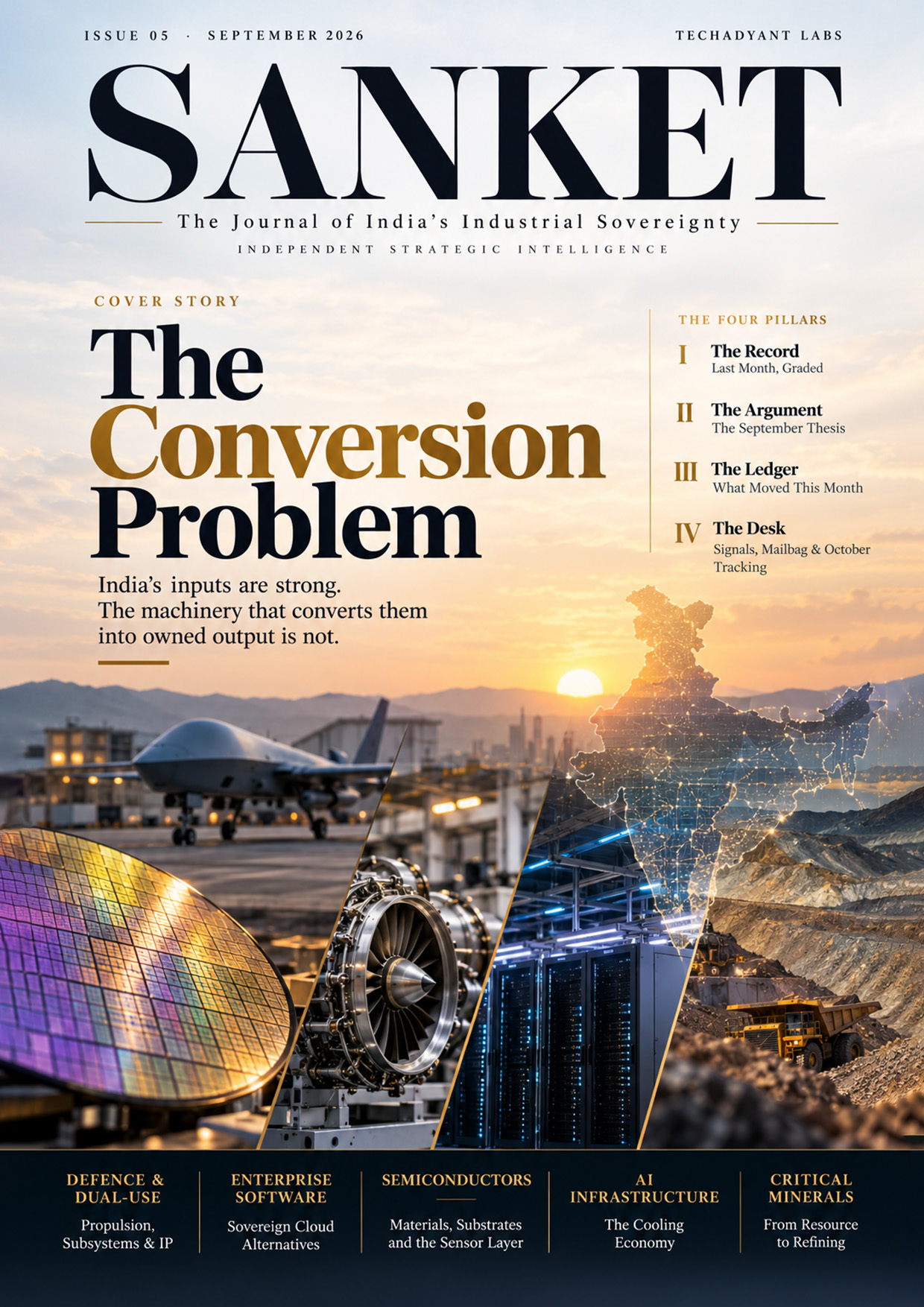 Issue 05 · September 2026 · 11-min readThe Conversion ProblemFive reports this month — aerospace, cloud, technology transfer, lunar and cooling — keep finding one gap: the inputs are strong, but the mechanism that converts them into owned output is not. Just ~1.1% of public R&D projects become products.Read the issue →
One issue a month. The few signals that move the board — semiconductors, AI infrastructure, critical minerals, defence.
An independent research lab
Techadyant Labs is an independent strategic intelligence platform focused on India’s industrial transformation, infrastructure systems and emerging strategic technologies.
We study industrial systems the way analysts study capital markets — as interdependent structures with hidden constraints, asymmetric beneficiaries and second-order effects. Our work begins where the press release ends.
The publication is reader-oriented and editorially independent, as the research unit of Techadyant. We carry no sponsored coverage and take no position in the companies and projects we analyse.
- IndependentEditorially independent of our parent, Techadyant. No sponsored coverage, no undisclosed interests.
- Systems-levelWe map dependencies, not just events.
- India-firstBuilt around India’s industrial and strategic context.
- Long-formDepth over frequency; analysis over aggregation.