
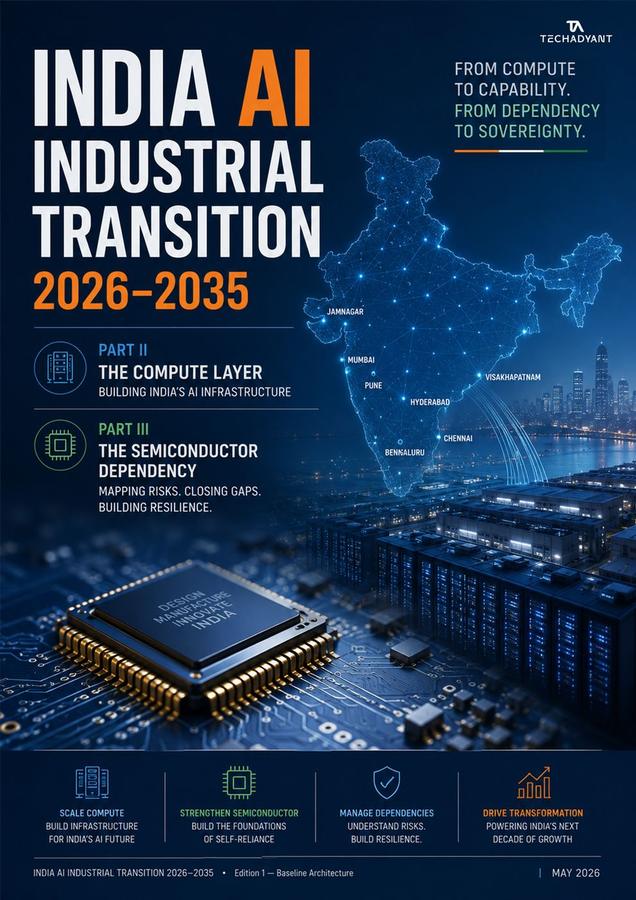
Between 2026 and 2035 India will multiply its compute capacity four-to-six times, construct its first credible mature-node semiconductor fab while remaining import-dependent for AI accelerators, expose its power and water systems to a new layer of demand concentrated in seven corridors, restructure its workforce around four functional layers rather than twenty career titles, and absorb capital flows of roughly USD 95 billion of data-centre capex alongside ₹1.65 lakh crore of semiconductor commitments. The transition is real, financed and underway. What it changes is the geography of Indian industrial capability, the dependency structure of Indian compute, the labour-market signal, the regional pattern of inequality, and the strategic posture of India in the global AI supply chain.
- The transition is decided at the infrastructure layer, not the application layer. The binding constraint is geographic — seven districts must solve local power-and-water — not financial.
- India’s semiconductor effort is a partial answer to a deeper dependency. Mature-node fab ≠ semiconductor sovereignty; advanced packaging is the missing layer.
- The cost of AI infrastructure is paid in megawatts and litres, not just rupees. The DC pipeline is densest where CGWB stress is highest.
- The unit of competition is the corridor, not the state. Visakhapatnam is the most important capital-allocation story of the 2026–2030 window.
- Second-order industrial effects dwarf the first-order AI effects. Indian-vendor opportunity through 2030 is roughly ₹80,000–150,000 crore; ₹28,000–60,000 crore of it is addressable to SMEs.
- The workforce transition is asymmetric, not catastrophic. 1–3 million displaced in routine-cognitive roles under the substitution scenario; absorbable through re-skilling at base case.
Every few months a new groundbreaking ceremony adds a node to the map of India’s AI industrial ambition. The coverage that follows tends to ask the same question: can India build its own AI? It is the wrong question — or at least an incomplete one. A data centre is not a building that happens to house GPUs; a fab is not a factory that happens to make chips. Each is the visible apex of a dense industrial system whose viability is decided by everything around it — by megawatts and litres and fibre and substrates and skilled labour — and by the corridors in which those layers happen to coincide.
This report takes the system, rather than the model or the chip, as its unit of analysis. It asks a different question: when India builds AI infrastructure at the scale already committed, which parts of the industrial stack actually capture the value, where do the binding constraints sit, and what second-order transformations follow in the regions that host it? The answer is given through nine analytical frameworks, thirty figures, six data tables, seven regional corridors and three scenario ranges. The instruments are designed to be portable: each can be detached from the report and applied as an analytical instrument against new data.
01 — FramingThe Reframe: AI as Industrial Infrastructure
The dominant framing of artificial intelligence in Indian public discourse over the past three years has been workforce-centric — about jobs displaced, salaries inflated, skills obsolesced. This framing is not wrong, but it is downstream. The underlying transition that produces those workforce effects is an industrial one, taking place at the layer of physical infrastructure: compute capacity, semiconductors, electrical power, water, fibre, real-estate and skilled labour. To understand the AI transition in India one must understand it the way one would the transition to thermal power in the 1960s, the green revolution in the 1970s, the IT-services build-out of the 1990s, or the highways programme of the 2000s — as a layered re-engineering of the physical economy.
The mechanism is simple to state. A modern AI model is trained on a cluster of accelerators (Nvidia H100, H200, B200, GB200, Google TPU, AMD MI300, Intel Gaudi) housed in a hyperscale data centre, drawing tens to hundreds of megawatts of electricity, cooled by water or liquid loops at rates the local utility did not historically design for, connected via tens to hundreds of terabits per second of fibre, and operated by a workforce that is small in headcount but specialised in trade. The same model, once trained, is deployed on inference infrastructure that is geographically distributed because latency matters, and that infrastructure draws power and water and fibre in turn. Every layer in this stack is a physical, capital-intensive, location-bound system. The economic question that determines whether India captures the value of AI is whether India can build, own and operate each of those layers — and where it cannot, whether the import dependency is manageable.
Once the question is framed this way, several observations follow. The unit of strategic competition is the corridor: a data centre is sited where power is plentiful and grid-firm, where water is available and water rights are clear, where fibre lands or transits, where land is buildable and zoned, where the regulatory environment is predictable, and where adjacent skilled labour exists. These conditions cluster in roughly seven Indian corridors — Mumbai, Chennai, Hyderabad, Bengaluru, Pune, Visakhapatnam, Noida–Sanand–Dholera. They do not cluster nationally. The binding constraint matters more than the headline number: India’s 1.26 GW (2024) to 1.5 GW (2025) installed DC capacity has a publicly stated pipeline to 4.5–9 GW by 2030, but reaching the upper bound depends not on capital but on whether power can be added, water sourced, fibre right-of-way cleared, and the DISCOM-level interconnection queue executed on time.
The semiconductor question is two questions, not one. The first is the manufacturing-capacity question: can India produce its own chips at scale? The honest answer is that the India Semiconductor Mission is producing real capacity at mature nodes (28–110 nm logic, DRAM/NAND packaging, mixed-signal, power electronics) but not at the bleeding edge, and certainly not in the advanced packaging substrate that AI accelerators require. The second is the dependency-management question: given that India will continue to import the AI-class chips that matter for the next decade, how does the import remain reliable, geographically diversified, and not held hostage to US export controls or Chinese specialty-input retaliation? That second question is the harder one.
The second-order industrial effects — automation in manufacturing, AI in pharma, AI in logistics, AI in MSMEs — are not separate stories but adjacent loops in the same system. Constructing a 100 MW data centre creates demand for industrial real-estate, high-tension transformers, industrial chillers, ultrapure water systems, fibre splicing, diesel back-up, skilled DCIM technicians, power-electronics engineers. Deploying AI in a Tata Motors plant or a Sun Pharma facility creates demand for industrial sensors, vision systems, connectivity, cloud compute, ML engineers, safety and governance professionals, and new regulatory categories. These second-order loops are where most of the GDP contribution of the AI transition will be realised, and they are where the inequality and labour-displacement risks will also be realised. The reframe of this report, therefore, is to treat AI in India as an industrial transition with seven layers: compute (Part II), semiconductor and packaging dependency (Part III), power-water-cooling (Part IV), regional corridors (Part V), industrial second-order effects (Part VI), workforce and talent (Part VII), and strategic outlook (Part VIII).
02 — Five forcesFive Forces Shaping India’s AI Transition (2026–2035)
Five forces structure the period this report covers. They are introduced here at the level of thesis; each is elaborated in the part where it operates.
The first force is the infrastructure-capital cycle. Hyperscaler investment commitments to India are at an inflection. AWS announced an additional USD 8.3 billion over Mumbai in January 2025, bringing cumulative India commitment to USD 12.7 billion through 2030. Microsoft announced USD 3 billion in January 2025 and a further USD 17.5 billion in December 2025, opening its India South Central region in Hyderabad in mid-2026 and expanding through Chennai, Pune and Bengaluru. Google’s Visakhapatnam AI hub, announced October 2025 with groundbreaking April 2026, is a USD 15 billion gigawatt-scale facility tied to subsea cable and renewable energy. Oracle launched Database@Google Cloud out of its Mumbai region in December 2025. Cumulative announced hyperscaler capex through 2030 exceeds USD 50 billion; CEEW’s roll-up of all DC-related capital commitments from 2019 onwards puts the figure at roughly USD 95 billion. The cycle is real, concentrated geographically, and the single most consequential force in the period.
The second force is the semiconductor sovereignty drive. The India Semiconductor Mission began with a ₹76,000 crore outlay in December 2021. By May 2026, twelve projects had been approved with cumulative announced capex of roughly ₹1.64 lakh crore, including the Tata–PSMC fab at Dholera (₹91,000 crore, 50,000 wafers per month at 28–110 nm), the Tata-TSAT OSAT in Assam (₹27,120 crore, 48 million chips per day at ramp), the Micron OSAT at Sanand (USD 2.75 billion), and four other OSAT facilities at Sanand and Surat. ISM 2.0 was announced in Union Budget 2026-27 with a ₹1,000 crore FY26-27 allocation focused on equipment, materials and full-stack IP. The drive is real, the centrepiece fab is under construction, and the strategic question — whether mature-node fab plus mid-tier OSAT closes India’s actual AI dependency — is the subject of Part III.
The third force is the grid-and-water constraint. India’s DC electricity demand is on a trajectory from ~13 TWh in 2024 (about 0.8% of national consumption) to ~57 TWh by 2030 (~2.6%) on CEEW and S&P Global numbers. CEA peak-demand projections place India at 289 GW peak in 2026-27 rising to 459 GW by 2035-36, against a non-fossil capacity target of 500 GW by 2030. The aggregate numbers are accommodating; the geographic concentration is not. Mumbai (61 DCs), Hyderabad (33), Delhi NCR (31), Bengaluru (31) and Chennai (30) represent the binding constraint. The water position is more acute: CGWB classifies Bengaluru and Hyderabad as over-exploited, with Bengaluru Rural at 169% of permissible extraction; Chennai was on Day Zero in 2019. The DC pipeline is densest precisely where the water position is most stressed.
The fourth force is the regional capital re-allocation. The states that have actively built AI-corridor policy frameworks — Karnataka’s GCC Policy 2024-29, Tamil Nadu’s Semiconductor and Advanced Electronics Policy 2024, Telangana’s Data Centres Policy 2024, Maharashtra’s GCC Policy 2025, Gujarat’s Semiconductor Policy 2022-27, Andhra Pradesh’s Electronics Manufacturing Policy 4.0 — are now competing for hyperscaler capital and PLI capex with explicit subsidy structures. State-level outcomes will diverge sharply because endowments diverge sharply. Part V maps the divergence.
The fifth force is the workforce re-stratification. The Indian IT-BPM workforce is large in aggregate (about 5 million on NASSCOM’s working figure) but Tier-1 services headcount declined by more than 42,000 over the two years to early 2026. Net growth is concentrated in GCCs (1,700+ today; NASSCOM working target 2,100+ by 2030; EY aspirational 5,000), in mid-tier services, in engineering R&D, and in the semiconductor and AI-infrastructure workforce that does not yet exist at the scale required. The talent gap is real: NASSCOM-Deloitte 2024 identifies a 1.25-million AI talent demand by 2027 against a 51% role-unfilled rate today; industry roll-ups place the semiconductor talent gap at 250,000–300,000 by 2027. These five forces interact, and the report’s parts follow their interactions in order.

03 — Framework 1The India AI Infrastructure Readiness Matrix
The first framework of this report is the India AI Infrastructure Readiness Matrix — a six-axis scoring system designed to compare corridors against each other on the dimensions that determine whether an AI data centre, semiconductor facility, or industrial-AI deployment is technically and economically viable in that geography. The six axes are: compute capacity (installed and pipeline), power availability and reliability, water availability and stress, fibre and submarine-cable proximity, semiconductor and electronics-manufacturing adjacency, and talent concentration. Each axis is scored on a 1–5 scale relative to other Indian corridors, not against a global benchmark.
The matrix is explicitly comparative within India, because the question it is designed to answer is not “is Indian infrastructure ready?” but “which Indian corridor is readier for which workload?” A 500 MW AI training cluster has different requirements from a 50 MW inference farm, which has different requirements from an electronics-manufacturing PLI facility with embedded AI. The matrix surfaces those differences. Applied to the seven principal corridors, the matrix produces structural patterns: Karnataka / Bengaluru is highest on talent and compute pipeline, lowest on water; Telangana / Hyderabad is highest on hyperscaler magnetism; Tamil Nadu / Chennai is highest on electronics manufacturing and coastal-fibre; Maharashtra / Navi Mumbai is highest on existing compute (44% of national DC mass) and submarine-cable density (eight CLS at Mumbai); Gujarat / Sanand-Dholera is highest on semiconductor adjacency; NCR / Noida-Jewar is mid-range with a recent semiconductor step-up; Andhra Pradesh / Visakhapatnam is rising fastest of any corridor on compute.
What the matrix makes visible is that no Indian corridor is strong on all six axes. Every regional bet involves a trade-off: services talent against water, semiconductor capacity against AI-services depth, hyperscaler magnetism against grid reliability, coastal fibre against industrial real-estate availability. The corollary is that capital allocation across Indian corridors is not a single bet but a portfolio choice, and the binding constraint in each corridor is different. The matrix is the instrument for naming that constraint, and it is meant to be re-scored annually.

04 — ComputeIndia’s Compute Build-Out: From 1.5 GW to 9 GW
The single number that organises this part is data-centre installed IT load, measured in megawatts. India’s installed capacity grew from approximately 1.26 GW in 2024 (the Colliers benchmark) to approximately 1.5 GW in 2025 (the CEEW benchmark), with the operational figure entering 2026 between 1.5 and 1.7 GW depending on the cooling-and-reservation convention. JLL India’s Data Centre Dynamics projects 1.8 GW by 2027. Cushman & Wakefield’s pipeline read for end-2028 is 3.29 GW (1.03 GW under construction plus 1.29 GW planned). Colliers’ 2030 base-case projection is 4.5 GW, CEEW’s projection is 6.5 GW, and S&P Global’s AI-accelerated scenario takes the number to 8–9 GW. The variance in those projections is itself the data: the path from 1.5 GW to 4.5–9 GW will be decided by infrastructure debottlenecking, not capital availability.
The structure of the existing base is concentrated. Mumbai and Navi Mumbai host approximately 44% of national capacity — about 289 MW operational in Navi Mumbai alone — driven by submarine-cable landings, MIDC industrial zoning, and Maharashtra’s 2023 IT-ITES policy commitments on 24×7 supply and renewable-energy access. Chennai is the second pole at approximately 200 MW operational, with the Ambattur and Siruseri-SIPCOT clusters drawing on the Chennai cable landing station and Tamil Nadu’s 2021 Data Centre Policy concessions. Hyderabad is the third pole — and here the data is genuinely disputed: state government communications cite operational capacity of 859 MW (2025), while Cushman-aggregated and trade-press sources put operational capacity at 152 MW with the rest planned or under construction. The disagreement is not noise; it reflects whether one counts sanctioned-and-permitted capacity (the larger number) or commissioned-and-energised capacity (the smaller).
Bengaluru is the fourth pole, with disputed capacity estimates (107 MW per Mordor, 182 MW per Cushman, 79 MW on the alternative installed-IT-load convention). The KIADB-approved Bengaluru data park (500 MW capacity near Hoskote, fed by Pavagada solar and 60 MLD of treated water from BWSSB) is the dominant pipeline addition. NTT’s Bengaluru 4 announcement of December 2025 (₹2,400 crore, 100 MW facility load / 67.2 MW IT load on 8.5 acres) is the largest single new commitment. The pattern in Karnataka is that the policy framework is sophisticated but the water profile is degrading; the Bengaluru DC growth will be constrained by water, not by capital or policy. Delhi NCR is the fifth pole, with approximately 31 DCs across Greater Noida, Manesar, and the Yamuna Expressway corridor. Andhra Pradesh / Visakhapatnam, the dark-horse third coastal node, will move sharply once the Google-Adani 1 GW campus (groundbreaking April 2026) commissions. The operator picture is consolidating: the late-2025 market-share snapshot from trade-press aggregation puts NTT GDC at about 20%, Sify and ST Telemedia at 19% each, Airtel Nxtra and CtrlS at 15% each, Yotta at 5%, and AdaniConneX at 1% — with the AdaniConneX share understating its forward pipeline.
The capital question is settled enough to be uninteresting. The geographic-and-physical question — power, water, fibre right-of-way, zoning, interconnection queue management — is the actual constraint, and is the subject of Sections 14–17.

05 — IndiaAI MissionThe IndiaAI Mission: Design, Delivery, Gaps
The IndiaAI Mission is the Union government’s principal public investment in domestic AI compute. The Cabinet approved the mission on 7 March 2024 with a five-year outlay of ₹10,371.92 crore (PIB PRID 2012375). Its seven pillars are: Compute (the subsidised GPU layer), the Innovation Centre, the AIKosha Dataset Platform (launched 6 March 2025), Application Development, FutureSkills, Startup Financing, and Safe & Trusted AI. The headline output is the GPU procurement programme.
The procurement programme has, by May 2026, substantially exceeded its original target. The Cabinet approval cited a 10,000-GPU goal. Through three tenders the cumulative onboarded count rose to 18,000-class units in the first round, 34,333 GPUs by the second round, and approximately 38,231 GPUs across all rounds by March 2026 — verified through PIB PRID 2132817 and the IndiaAI Compute Portal. The tender mix is heterogeneous: the third round includes Locuz with 1,300 Nvidia H100s, Sify with 2,500 units in a mix of Google Trillium TPUs, H200s and L4s, and Ishan with 50 Trillium TPUs. The subsidised availability rate is ₹65 per GPU-hour at base, rising to ₹92 per GPU-hour for H100s — a substantial discount on the unsubsidised market rate.
The mechanism is consequential and is often misunderstood. The IndiaAI Mission does not own the GPUs. It empanels private providers for a 36-month period (extensible by 12 months) and subsidises the per-GPU-hour rate at which qualified Indian users — startups, researchers, students, government agencies — can rent the compute. The reported fund-flow data is consistent with this design but is itself a source of concern: per MediaNama’s analysis of the parliamentary reply of February 2026, only ₹21.79 crore was released in FY24-25, and ₹379.15 crore through 9 February of FY25-26 — a cumulative release of approximately ₹400 crore against the ₹10,372 crore five-year outlay, or under 4%. The FY25-26 Budget allocation of ₹2,000 crore was revised down to ₹800 crore at the revised-estimates stage. The interpretation of this gap is more interesting than the gap itself: the subsidy model shifts capex risk to providers; the providers have invested ahead of government release; the government’s actual outflow will rise as utilisation rises. Alternative readings — under-demand for H100-class workloads, or price discovery below cost-of-capital — are also plausible.
What the IndiaAI Mission does well is to establish India as a country whose government has stated, paid for and partly delivered on a sovereign-AI-compute capability at meaningful scale. The 38,000-GPU figure is large in international comparison and is a credible foundation. What the mission does not address — and was not designed to address — is the dependency on imported accelerators (every Nvidia H100, H200 and Trillium TPU in the empanelled fleet is imported under HS 8542 or 8473), the dependency on imported wafer-equipment for the OSAT-and-fab capacity that might one day produce domestic accelerators, and the dependency on imported HBM and CoWoS-class packaging that no current Indian facility can provide. Those dependencies are the subject of Part III.


06 — HyperscalersHyperscaler Commitments and the Geography of Capital
The hyperscaler commitment to India has, between 2024 and 2026, moved from incremental to transformative. AWS has the largest cumulative commitment — the January 2025 announcement raised cumulative India spend through 2030 to USD 12.7 billion, centred on Mumbai and Hyderabad. Microsoft has the largest fresh commitment of the cycle — January 2025’s USD 3 billion was followed by December 2025’s USD 17.5 billion (cumulative USD 20.5 billion). The India South Central region in Hyderabad goes live in mid-2026, expanding through Chennai, Pune and Bengaluru. Microsoft’s 1.1 million-square-foot Gachibowli campus, ₹15,000 crore committed with 4,800 incremental hires, is the largest Microsoft R&D site outside the United States.
Google has, since the October 2025 Visakhapatnam announcement, the highest-profile gigawatt-scale commitment: USD 15 billion over 2026–2030 for the AI hub, broken across three data-centre campuses on three tech-zone sites in Madhurawada, a gigawatt-scale electricity profile, a 100% renewable energy commitment, partner roles for AdaniConneX (200 MW initial scaling to 1 GW) and Airtel-Nxtra, and an associated subsea-cable and clean-energy commitment. Groundbreaking was April 2026. Reliance–NVIDIA Jamnagar is the largest Indian-led AI infrastructure commitment: announced 25 October 2024, a 1 GW AI data centre expandable to multi-GW (some sources cite 2 GW), supplied with Nvidia Blackwell GPUs (B200 and GB200), sited at Jamnagar — co-located with Reliance’s existing 2.4 GW captive power plant — eliminating the grid-interconnection bottleneck. Oracle announced a smaller but strategically important step in December 2025, going live with Oracle Database@Google Cloud out of its Mumbai region — making India a launch geography for a flagship multicloud offering.
CEEW’s roll-up of all DC-related capital commitments from 2019 onwards puts cumulative committed investment at approximately USD 95 billion. The gap between USD 50 billion (announced hyperscaler commitments 2024–2026) and USD 95 billion (cumulative since 2019) is filled by domestic operators (AdaniConneX, Yotta, NTT, Sify, CtrlS, Reliance), other foreign operators (Equinix, Digital Realty, ST Telemedia, Digital Edge), and Indian conglomerates building captive AI capacity. The geography of this capital is the determinant of the geography of Indian AI capability through 2030: Mumbai-Navi Mumbai (established hub), Hyderabad (hyperscaler magnet), Chennai (coastal-cable hub), Bengaluru (talent hub), Visakhapatnam (rising third coastal node), Pune (emerging hyperscaler destination), and Jewar-Noida (second OSAT/AI cluster). The capital is not moving to inland Tier-2 cities, or to the agricultural states, or to the Northeast.


07 — Framework 2The GPU Dependency Stack
The framework introduced in this section is the GPU Dependency Stack, designed to map every Indian AI accelerator deployment to its upstream supply chain. The stack has six layers, read from end product to raw input. Layer one is the AI accelerator itself: an H100, H200, B100, B200, GB200, MI300, Trillium TPU, Gaudi 3 or equivalent. In India, every accelerator currently in commercial operation is imported. Layer two is the HBM (high-bandwidth memory) stack that sits beside or atop the accelerator die. HBM is produced by SK Hynix, Samsung and Micron at the leading edge; HBM3E is fully allocated through 2026 (per TrendForce and SemiAnalysis as of late 2025). No India facility produces HBM.
Layer three is advanced packaging — the 2.5D and 3D interposers, silicon bridges and TSV-based assembly methods that integrate the GPU die with the HBM stacks and the substrate. TSMC’s CoWoS is the dominant process; capacity is oversubscribed through 2026 and remains the binding constraint on global AI accelerator production. Alternative packaging from ASE (CoWoP), Amkor and emerging OSAT-led variants is stepping up in the second half of 2026. No India OSAT has announced CoWoS-class 2.5D/3D advanced packaging capability as of May 2026. Tata’s Integrated System Packaging in Assam is system-in-package level, not chiplet/HBM-class. This is the single most consequential gap in India’s semiconductor stack for AI purposes.
Layer four is leading-edge logic — the 3 nm, 4 nm and 5 nm processes on which AI accelerators are fabricated. TSMC, Samsung Foundry and (at lower volume) Intel Foundry produce these wafers. The Tata–PSMC fab at Dholera targets 28 to 110 nm, several nodes behind the AI-accelerator requirement. India will not produce leading-edge logic wafers in the period of this report. Layer five is specialty materials and gases — ultrapure silane, EUV photoresists, special carbon-based chemicals, sputtering targets, photomask blanks. Most are sourced from Japan, South Korea, Germany and the United States; some are produced by Linde and Inox Air Products in India. Layer six is wafer-fabrication equipment (WFE) — ASML lithography scanners, Applied Materials and Lam Research deposition and etch tools, Tokyo Electron coater-developer tracks, KLA inspection systems. The Big Five hold roughly 70% of WFE market share. India does not manufacture any of these.
When the stack is laid out this way, two observations follow. India’s AI accelerator supply is dependent on a six-layer global chain, of which India today participates meaningfully only at the lowest two layers (specialty gases via Linde and Inox; assembly of standard-node chips via Tata OSAT, Micron, CG Semi, Kaynes and HCL-Foxconn). The binding global constraints on AI accelerator supply — HBM allocation, CoWoS capacity, leading-edge wafer slots — are precisely the constraints over which India has no agency. The strategic implication is that the most consequential next investment in the India semiconductor stack is not another mature-node fab. It is a credible advanced-packaging facility, ideally co-located with the Tata Assam OSAT or the HCL-Foxconn Jewar OSAT, with a path to OSAT-led 2.5D packaging within a four-to-five year window.

08 — Coastal-AIEdge AI, Submarine Cables, and the Coastal-AI Thesis
The geography of AI inference is decided by latency. Below approximately 50 milliseconds end-to-end, the difference is imperceptible for typical conversational or recommendation workloads; above 100 ms it becomes noticeable; above 200 ms real-time agentic workflows degrade. The latency budget is set by physics — fibre signal propagation at roughly two-thirds the speed of light — and routing. The implication for India is that AI inference geography is coastal-and-network-adjacent geography.
India operates 17 international submarine cables landing at 16-17 cable landing stations. Mumbai hosts eight CLS, Chennai four, and Kochi and other locations the remainder. Total capacity at end-2024 was approximately 193 Tbps with 148 Tbps activated. The major capacity additions of 2024-2026 are the Reliance Jio India-Asia Xpress (IAX), India-Europe Xpress (IEX, >200 Tbps, operational March 2025), the NTT MIST cable (Mumbai and Chennai, >200 Tbps, announced February 2023), and the 2Africa cable live since October 2024. The Telecommunications (Authorisation for Captive Telecom Services) Rules 2025 and the TRAI two-tier CLS framework, finalised in early 2026, are the regulatory backbone for the next wave.
The 71% concentration of CLS capacity at Mumbai and Chennai forces AI inference geography toward those two cities. Both are already grid-constrained and water-constrained. The strategic opening is Visakhapatnam: the Sify-led Open CLS proposal positions Andhra Pradesh as a third coastal node, and the Google-Adani USD 15 billion commitment provides the demand-side anchor that justifies the cable-side investment. By 2030, Visakhapatnam could plausibly hold 8–12% of national CLS capacity, materially diversifying the coastal-fibre concentration. Edge AI — inference performed close to the end user — extends this geography. The economic case for edge AI is concentrated in three workload categories: real-time computer-vision, real-time speech-and-translation, and real-time decisioning in latency-sensitive industries (HFT at GIFT City, telecoms RAN AI, smart-grid balancing). Each requires inference compute within 10–25 ms of the user.
The coastal-AI thesis can be stated cleanly. By 2030, India’s AI inference capacity will be split roughly 70–75% across five coastal-or-adjacent hubs (Mumbai-Navi Mumbai, Chennai, Visakhapatnam, Hyderabad-via-coastal-cable-from-Vizag, and the Bengaluru-Chennai twin), and 25–30% across inland Tier-1 metros (Delhi NCR, Pune, Ahmedabad, Indore, Lucknow). The coastal share is the binding consequence of submarine-cable geography. The strategic policy lever is whether the Visakhapatnam third coastal node materialises on schedule — that single project does more to reduce single-point-of-failure risk in Indian AI infrastructure than any other action available in the 2026–2030 window.

09 — ISMThe India Semiconductor Mission: What Is Approved, What Is Real
The India Semiconductor Mission is the most ambitious industrial-policy programme of independent India outside the petrochemical and steel build-outs of the 1960s–1970s. Its scope is genuinely transformative if it delivers; its execution is genuinely uncertain. The original ₹76,000 crore outlay was approved in December 2021 under the Semicon India Programme. By May 2026 — the cut-off for this report — the Mission had approved twelve projects with cumulative announced capex of approximately ₹1.64 lakh crore across six states (PIB PRID 2258119, 5 May 2026).
The Tata Electronics–PSMC fab at Dholera is the centrepiece. Approved 29 February 2024, the project has ₹91,000 crore (approximately USD 11 billion) total capex with 50% pari-passu fiscal support from the Centre and Gujarat. The fab targets 50,000 wafers per month on 300 mm wafers at 28, 40, 55, 90 and 110 nm nodes for logic and analog applications. ASML signed a strategic supply partnership in May 2026 for DUV-i lithography tools. Linde is setting up the gases plant at Dholera. The fab is expected to create more than 20,000 direct jobs and is now under construction. The Tata Semiconductor Assembly and Test (TSAT) facility at Jagiroad, Assam (₹27,120 crore, 48 million chips per day at ramp) produces wire-bond, flip-chip and Tata’s Integrated System Packaging (ISP). The Micron OSAT at Sanand (USD 2.75 billion, 500,000 sq ft cleanroom, DRAM/NAND assembly and test) was Phase-1 commissioned February 2025.
The CG Power–Renesas–Stars Microelectronics OSAT at Sanand has ₹7,600 crore capex with 15 million units per day at ramp; pilot line went live in 2025. Kaynes Semicon at Sanand (₹3,307 crore, 6 million chips per day) reached commercial production in March 2026 and made its first commercial shipment — 900,000 MCM units — to Alpha & Omega Semiconductor in October 2025. HCL–Foxconn OSAT at Jewar/YEIDA (₹3,706 crore, 20,000 WSPM front-end / 36 million units per month design output, technology focus on display driver ICs) was approved 14 May 2025. Suchi Semicon at Surat, Crystal Matrix at Dholera (GaN epitaxy and mini/micro-LED), ASIP Technologies in Andhra Pradesh, and the parallel non-ISM SCL Mohali modernisation (₹4,500 crore upgrade with NVM and GaN-on-Si capability) complete the twelve-project portfolio.
ISM 2.0, announced in the Union Budget 2026-27 (PIB PRID 2221522), has an FY26-27 allocation of ₹1,000 crore. ISM 2.0’s stated scope is equipment and materials manufacturing, full-stack Indian IP, and industry-led research and training centres. It is not a replacement for ISM 1.0 but an additional vertical layered on top. India has, in five years, moved from zero approved semiconductor projects to twelve, from zero fab approvals to one large 50,000 WSPM facility under construction, and from no major foreign OSAT presence to a Micron facility commissioned and ramping. The constraint, as the next sections argue, is that the build-out is not pointed at the part of the semiconductor supply chain that matters most for AI.


10 — Capex pieThe Fab Capex Pie: Who Actually Captures the Money
The Tata–PSMC Dholera fab is a ₹91,000 crore investment. The strategic question is: where does the money go? The answer determines whether the fab is an industrial-development success for India or a partial subsidy to global equipment OEMs. A leading-edge 300 mm fab — and Dholera, while not leading-edge in node terms, is leading-edge in wafer size and tool generation — has a capex split that is consistent across global benchmarks. Wafer-fabrication equipment accounts for 65–75% of total fab capex. Lithography alone is 20–25%, with each ASML DUV-i scanner of the 1980i or 2000i class costing USD 80–110 million. Facility shell construction is 20–30%. Specialty gases, ultrapure water, chemicals and abatement are embedded in the facility capex and the operating cost; ultrapure water systems alone consume 4 million litres per day at a 300 mm fab.
Applied to the Tata–PSMC ₹91,000 crore total capex, the wafer-equipment share is roughly ₹60,000 crore. The five companies that capture this — ASML (Netherlands), Applied Materials (US), Lam Research (US), Tokyo Electron (Japan), KLA (US) — hold approximately 70% of the global WFE market. None is Indian. The May 2026 ASML-Tata partnership confirms the lithography supplier; on global benchmarks the lithography spend at a 50,000 WSPM 28–110 nm fab would be approximately ₹12,000–18,000 crore. The remaining ₹40,000–50,000 crore of WFE flows to AMAT (deposition, etch, CMP, ion implant), LAM (etch, CVD), TEL (coater-developer tracks, etch, thermal), and KLA (process control and inspection).
The Indian-capture share is therefore not the headline ₹91,000 crore. It is closer to ₹20,000–30,000 crore, comprising: construction (L&T-class EPCs, civil and MEP contractors, ~₹15,000–20,000 crore at 20–30% facility-share basis); specialty gases (Linde India and Inox Air Products, with Inox’s ₹500 crore Electronic Specialty Gas Hub at Dholera the marquee India-side investment); ultrapure water systems (Tata Electronics’ ₹3,000 crore / ~USD 360 million spend on desalination and reverse-osmosis); logistics and hazardous-gas transport (Stolt Tank Containers, Aegis Logistics handling silane from Mundra port); and the operating-cost wage bill for the 20,000+ direct jobs.
The capture-share is not unfavourable. The ₹20,000–30,000 crore that lands in India is a serious industrial-development outcome — a domestic specialty-gases hub, a domestic ultrapure-water capability, a domestic civil-construction track record at fab scale, and a domestic operating workforce with fab experience. These are durable capabilities that will reduce capture-leakage on subsequent fabs. But the framing matters: the ₹91,000 crore is not the India number; the India number is roughly one-third of that, and growing as Indian-vendor depth improves. The same logic applies to the OSAT facilities. OSAT capex is more equipment-light (closer to 40–50% equipment vs 65–75% for fab), more construction-heavy, and substantially more labour-intensive in operating cost. The India-capture share of Micron, Tata Assam, CG Semi, Kaynes, and HCL-Foxconn is structurally higher than the fab’s — perhaps 50–60%. This is why OSAT investment is a higher-return industrial-policy bet per rupee of subsidy than fab investment.

11 — Packaging gapThe OSAT / ATMP Gap Against AI-Class Packaging
India has built or is building substantial OSAT and ATMP capacity. This section establishes why that capacity does not, today, solve India’s AI-chip dependency, and then maps the specific technology, capacity, capital and timeline frontier of the advanced-packaging build-out that would be required to close it. The chips that power AI training and inference — Nvidia H100, H200, B100, B200, GB200, AMD MI300, Intel Gaudi 3, Google TPU — share a structural feature. Each is built as a multi-die assembly: a logic die at the leading edge (3–5 nm) paired with three to eight HBM stacks, connected through a silicon interposer or a similar 2.5D / 3D advanced-packaging substrate. The packaging technology that integrates these elements — TSMC’s CoWoS variants (CoWoS-S, CoWoS-R, CoWoS-L); Intel’s EMIB and Foveros; ASE’s CoWoP; emerging OSAT-led variants — is the single binding global constraint on AI accelerator supply.
CoWoS capacity has been oversubscribed through at least 2026; HBM3E allocation is fully committed through 2026 per TrendForce and SemiAnalysis. The global capacity numbers are concentrated: TSMC operates approximately 75% of advanced 2.5D-packaging capacity at facilities in Taiwan and Arizona; ASE accounts for approximately 15%; Amkor for approximately 8%; Samsung Foundry’s I-Cube and Intel’s Foveros account for the residual. CoWoS revenue per wafer-equivalent rose from approximately USD 3,000 in 2022 to approximately USD 8,000 by mid-2025; the order-book extends 18–24 months forward.
India’s announced OSAT capacity does not address this. Tata-TSAT’s Integrated System Packaging at Jagiroad is system-in-package — adjacent dies on a substrate, often for power and analog applications, not chiplets-and-HBM on an interposer. Micron Sanand is DRAM and NAND assembly and test. CG Semi, Kaynes and HCL-Foxconn are commodity OSAT (wire-bond, flip-chip, DDIC). None has announced CoWoS-class capability. As of May 2026, India has no advanced-packaging capability for AI accelerators. The capability gap is technical (the equipment, materials and process know-how for 2.5D/3D packaging are tightly controlled by TSMC, Samsung, SK Hynix, ASE and Amkor) and commercial (the customer base is a small set of fabless designers who currently allocate all available capacity to TSMC and ASE).
A credible OSAT-led 2.5D packaging facility — the kind the report’s strategic recommendation argues for — has a definable capex envelope, equipment list and customer-development path. A first-generation Indian CoWoP-equivalent or CoWoS-equivalent facility producing approximately 5,000–10,000 wafer-equivalent units per month would require capex in the range of USD 3–6 billion (₹25,000–50,000 crore) at full-scale ramp — in the same range as the second-tier global competitors. Equipment required: Through-Silicon Via etch and deposition (Applied Materials, Lam Research), micro-bump and chip-on-wafer bonding (BESI, ASMPT, Hanmi), interposer-class lithography and inspection (Veeco, Onto Innovation), ultra-fine thermal compression bonders, high-throughput back-end-of-line inspection. None is currently manufactured in India; supply lead times in 2026 are 12–18 months for bonding tools and 18–24 months for TSV process tools. Customer qualification cycles from a fabless customer to a production order are 18–30 months. The realistic timeline for an Indian advanced-packaging facility to ship its first commercial AI-class package is therefore approximately 2030–2032 — five to six years from a credible 2026 commitment.
The strategic case for India to enter the advanced-packaging supply rests on three factors. First, global capacity is genuinely constrained — TrendForce projects CoWoS demand growing at approximately 50% CAGR through 2027 against capacity growth of approximately 35% CAGR, implying a persistent supply deficit. Second, the technology is difficult but is not on a critical-IP control list in the same way that EUV lithography is — the supply chain for equipment and materials remains open to credibly-financed and government-supported facilities in third countries. Third, India’s existing OSAT base provides a foundation of clean-room labour, process-engineering talent and supply-chain logistics that a greenfield project would have to build from scratch. The strategic recommendation that follows in Section 37 is that India’s next major semiconductor commitment should target advanced packaging: a ₹25,000–50,000 crore facility, co-located with the Tata Assam OSAT or the HCL-Foxconn Jewar OSAT, with a credible technology partnership (Amkor, ASE, or a tier-2 Taiwanese OSAT diversifying outside Taiwan and China), and a four-to-five year construction timeline.

12 — ImportsThe Import Dependency Map (HS 8542, 8471, 8473)
India’s monolithic IC imports (HS code 8542) were ₹1.05 lakh crore (approximately USD 12.6 billion) in FY 2023-24. The broader IC plus microprocessor category (Nexdigm/IMARC roll-up) was ₹1.87 lakh crore (approximately USD 22.3 billion). The Department of Commerce’s wider semiconductor-device category — covering diodes, transistors and similar devices — was more than USD 25 billion. Imports from China and Hong Kong combined were approximately 48.5% of the IC category in FY26-year-to-date (29.96% China, 18.51% Hong Kong, per Department of Commerce data analysed by Asia Business Outlook). Taiwan, South Korea, Singapore, Japan and Malaysia together account for most of the remaining 51%; the United States is approximately 6%.
AI accelerators flow under HS 8542.31 (processors and controllers), HS 8542.32 (memories, including HBM), HS 8471 (automatic data-processing machines / servers — covering Nvidia DGX-class systems) and HS 8473 (parts for 8471, including GPU boards and accelerator cards). DGCI&S does not publish AI-accelerator-specific value series; only the aggregate codes are available in primary government data. The strategic exposures, in order of decreasing severity: HBM allocation (SK Hynix and Samsung, both Korean; Micron the third source); CoWoS capacity (TSMC, Taiwanese); leading-edge logic wafers (TSMC and Samsung); commodity ICs imported via China (analog, power, mixed-signal, basic logic); and wafer-equipment supply feeding the Indian fab build-out.
A geopolitical shock to Taiwan affects three of the five — the most severe scenario in the AI Infrastructure Bottleneck Framework (Section 36). India’s IC market is projected by IMARC to grow from USD 29.3 billion in 2024 to USD 108 billion by 2033 (14.44% CAGR). If the import-share-of-consumption stays at roughly 75%, India’s IC import bill rises to roughly USD 80 billion by 2033 — the scale of the dependency, and the scale of the potential industrial-policy prize if even 25% import substitution materialises domestically.
13 — DesignDesign Ecosystem: DLI, C2S, Fabless
India’s design ecosystem is the part of the semiconductor stack where India already has structural depth. Approximately 20% of global chip-design talent works in India, primarily for foreign-headquartered captive design centres — the Intel Bengaluru and Hyderabad campuses, the Qualcomm Hyderabad campus, AMD India (USD 400 million five-year investment announced July 2023 primarily in Bengaluru), Texas Instruments Bengaluru, Synopsys and Cadence. India hosts approximately 60,000 semiconductor engineers across 55+ GCCs and 95 sites.
The Design-Linked Incentive (DLI) Scheme, implemented by C-DAC and listed at chips-dli.gov.in, has three components: Chip Design Infrastructure, Product-DLI, and Deployment-DLI. The Product-DLI subsidy provides up to 50% of eligible expenditure with a ceiling of ₹15 crore per application. By July 2025, 23 chip-design projects had been approved (later reports cite 24), spanning surveillance, drone detection, energy metering, microprocessors, satellite communications and IoT SoCs. Key India-headquartered fabless companies include Saankhya Labs (5G SoC, satcom), Mindgrove Technologies (RISC-V 700 MHz Secure IoT MCU, 28 nm MPW tape-out, India’s first commercial high-performance MCU), InCore Semiconductors (RISC-V IP, ₹3 million Peak XV Series A), Signalchip (4G LTE and 5G modem chips), Ceremorphic (AI compute on 5 nm, primary-source confirmation pending).
The Chips to Startup (C2S) programme, launched 2022 with a ₹250 crore outlay over five years, targets 85,000 industry-ready engineers, 25 startups and 10 technology transfers. By 2025, 46 academic institutions were participating; 122 chip designs had been submitted via six shared wafer runs at SCL Mohali on the 180 nm process; more than 1 lakh students had enrolled and approximately 67,000 had been trained. ISM 2.0 expands participating institutions from 315 to 500. The ChipIN Centre at C-DAC Bengaluru provides centralised EDA-tool access — 4,855 technical-support requests handled, 265+ industry-led training sessions, 270 universities equipped with EDA tools, approximately 1.2 crore tool-usage logs in 2025.
India’s design ecosystem is real and improving, but the centre of gravity is captive design centres for foreign IDMs and fabless companies. The next tier — India-headquartered fabless with multi-product portfolios at scale — is small. The combined headcount of all India-headquartered fabless companies is in the low thousands, against the 60,000+ semiconductor engineers working at foreign captives. The shift from “design talent in India” to “Indian design companies at scale” has not yet happened, and is the deeper strategic frontier than the fab itself.
14 — Framework 4The AI Power and Cooling Stress Index
The framework introduced in this section is the AI Power and Cooling Stress Index, designed to quantify the binding physical constraints on data-centre and AI infrastructure deployment at the district level. The index has four components: peak-grid headroom (the gap between current peak demand and approved generation-plus-transmission capacity in the local grid), water-stress classification (the CGWB Ground Water Resource Assessment category for the district, ranging from safe through semi-critical, critical and over-exploited), tariff burden (the effective industrial tariff after cross-subsidy surcharges, additional surcharges, ToD adjustments and applicable concessions), and renewable-PPA accessibility (whether captive solar or wind PPAs are practical under the state’s open-access regime). Each component is scored 1–5, with 5 indicating the most stressed; the aggregate is the sum across the four components.
Applied to the seven major DC districts, the index produces the following profile. Mumbai City and Mumbai Suburban score moderate-to-high on grid (peak summer headroom is tight under MSEDCL’s MYT order Case 217/2024), moderate on water, high on tariff (the HT industrial rate revised in July 2025 is ₹7.86/unit for 20 kW and ₹9.15/unit for higher loads, though MERC reduced HT cross-subsidy from 113% to 101% of ACoS), and moderate on RE accessibility — moderate-to-stressed net. Hyderabad/Rangareddy/Medak score moderate on grid (the Telangana Data Centres Policy 2024 mandates dual-grid and 100% renewable access), high on water (CGWB moved Hyderabad from critical to over-exploited in 2024), moderate-to-low on tariff, and moderate on RE — stressed on water, moderate on the rest.
Bengaluru Urban/Bengaluru Rural/Ramanagara score high across the board. Grid headroom under BESCOM is constrained, with the 2026 True-Up adding 56 paise/unit. Water is the most stressed of any major DC district: CGWB classifies Bengaluru Urban as over-exploited at approximately 100% of recharge in 2024, and Bengaluru Rural at 169% of permissible extraction. Net score is the highest of any major DC district. Chennai/Tiruvallur/Kanchipuram score moderate net (TANGEDCO has been de-stressing; Tamil Nadu’s DC policy waives 40–50% of cross-subsidy surcharge and the full additional surcharge for RE-sourced power; water is stressed but desalination capacity is rising). Gautam Buddha Nagar (Greater Noida and Yamuna Expressway) scores moderate net. Ahmedabad/Gandhinagar (Sanand and Dholera) scores the lowest of any major industrial-corridor district — Gujarat is the most accommodating environment for industrial AI infrastructure at this scale. Visakhapatnam Urban is the special case: rising-corridor district with the lowest net stress score, structurally why the Visakhapatnam pipeline is plausible. The index is meant to be re-scored annually.

15 — GridGrid Stress: From 13 TWh to 57 TWh
The aggregate numbers on Indian data-centre electricity demand are accommodating; the disaggregated numbers are not. CEEW and S&P Global estimate DC electricity demand at approximately 13 TWh in 2024 (0.8% of national consumption), rising to approximately 57 TWh by 2030 (2.6%). The CEA-aligned alternative (per Outlook Business) puts the 2030 figure at 40–45 TWh. CEA’s 20th Electric Power Survey places India’s all-India peak demand at 289 GW in 2026-27 and 459 GW by 2035-36. The non-fossil capacity target is 500 GW by 2030 under India’s Nationally Determined Contribution. Inter-regional transfer capacity is more than 120 GW.
The disaggregated reality is different. Five districts host 75% of the DC mass: Mumbai City, Hyderabad, Delhi NCR, Bengaluru and Chennai. A single 100 MW hyperscale DC is equivalent in load to a small aluminium smelter or approximately 100,000 households. Stacking 600 MW of new DC pipeline in Hyderabad over 36 months — roughly the scale of the AWS, Microsoft and CtrlS Chandan Valley commitments combined — is a load increment that requires substation upgrades, transmission line additions, and DISCOM-level capacity planning that does not happen automatically. The CEA has asked states and DISCOMs to explicitly incorporate DC demand into their resource adequacy plans; this is a necessary administrative step, but it does not by itself add transformer capacity, transmission lines or generation. The binding bottleneck in 2026–2030 will not be aggregate generation but local transmission and DISCOM-level execution.
The captive-renewable-PPA route is the principal mitigant. Most major DC operators in India now target 80%+ renewable sourcing through open-access solar and wind PPAs. Recent representative deals include the Equinix-CleanMax 33 MW captive arrangement (26.4 MWp solar plus 6.6 MW wind, commissioned November 2025 for the Mumbai IBX), and the Digital Edge-Hexa Climate 83 MW PPA (signed February 2026 for the 350 MW Mumbai BOM campus in Navi Mumbai). The Reliance-NVIDIA Jamnagar project is the extreme case: it sits adjacent to a 2.4 GW captive power plant and is therefore not grid-dependent at all for its base load. State cross-subsidy-surcharge waivers (Tamil Nadu 40–50%, Karnataka full above 30% RE, Maharashtra pipeline) have made the open-access RE economics increasingly favourable. What the captive-RE route does not solve is the night-time inference load and the firm-power back-up requirement — battery storage, pumped storage, captive thermal back-up, and grid-firm interconnection each carry non-trivial costs.

16 — Water paradoxThe Water-Stress Paradox: Why DC Capital Lands in Water-Scarce Hubs
The most under-reported feature of India’s AI infrastructure build-out is the water-stress paradox. The data-centre pipeline is densest precisely in the cities where CGWB ground-water status is most stressed. Bengaluru Urban: over-exploited. Bengaluru Rural: 169% of permissible extraction. Hyderabad: over-exploited (upgraded from critical in 2024). Chennai: critical (with the 2019 Day Zero as the historical reference). Greater Noida: critical. Sanand: semi-critical-to-critical. The paradox is structural, not accidental: the locational drivers of DC siting (fibre proximity, talent, industrial agglomeration, state policy depth) cluster in cities that are also water-stressed because they are population centres on stressed aquifers.
The water consumption of a data centre depends on cooling architecture. Karnataka’s IT Minister and CEEW researchers have estimated approximately 25–26 million litres per year per megawatt of IT load — equivalent to roughly 68,500 litres per day per megawatt. Net Sol Water’s industry estimate is 1.5–2.5 litres per kWh of IT load. The Squirrels and CEEW report a 100 MW hyperscale facility on evaporative cooling at approximately 800,000 litres per day — equivalent to 8,000 litres per day per megawatt. The 8× range is real, and reflects the cooling architecture. CEEW’s roll-up estimates total India DC water consumption at approximately 150 billion litres per year in 2025, projected to more than double to over 300 billion litres per year by 2030. Newslaundry’s April 2026 report on the Bengaluru DC cluster cites approximately 20 ML per day of DC water consumption, with the combined Bengaluru-and-Ramanagara DC permits at approximately 813 ML per year.
Mitigation strategies fall into four categories. The cooling-technology transition (from evaporative to liquid to immersion): CtrlS Chandan Valley uses both DLC and immersion; Digital Connexion’s Chennai MAA10 supports up to 70 kW per rack with liquid cooling. Treated-wastewater sourcing: the Bengaluru KIADB park’s 60 MLD secondary-treated water from BWSSB is the marquee example; Hyderabad HMWS&SB has explored similar arrangements. Captive desalination, viable only for coastal sites — Chennai DC operators draw on the Chennai Metro desalination plants; Visakhapatnam DCs will draw on the planned APIIC desalination capacity. Operator commitments to water-neutral or water-positive operations (AdaniConneX, Sify and others) — CEEW has flagged that these are not independently verified and have significant greenwash risk. The strategic implication is sharp: the Bengaluru DC pipeline, in particular, is exposed to a binding water constraint that current technology choices and treated-wastewater sourcing partially but not fully address. A Chennai-2019-style Day Zero event in Bengaluru in the 2027-2029 window is a non-trivial scenario, not a tail risk.

17 — Cooling & RECooling Technology Transition and Captive-RE Economics
The cooling architecture of an AI data centre is determined by the rack power density it must support. A traditional enterprise-IT rack consumes 5–15 kW and is air-cooled. A hyperscale colocation rack consumes 10–25 kW and uses contained-aisle air cooling. An AI training rack hosting Nvidia H100/H200/B200 nodes consumes 35–80 kW and requires direct-liquid cooling. An Nvidia GB200 NVL72 rack consumes approximately 120 kW and requires advanced liquid cooling with high-flow CDU loops. Future GB300-class racks are designed for 140+ kW. AI workloads push rack density up by a factor of 4–10× compared to traditional IT, and the cooling architecture must follow.
The implication is that the capacity numbers in this report (1.5 GW operational, 4.5–9 GW by 2030) understate the AI-relevant capacity. A 50 MW conventional-IT data centre with 10 kW per rack hosts 5,000 racks; a 50 MW AI-training data centre with 80 kW per rack hosts approximately 625 racks. Per megawatt, the AI-training facility houses one-eighth the rack count but six-to-eight times the GPU count, because each rack is densely populated. The financial-and-revenue comparison is therefore best done at per-MW economics, not per-rack economics; this is why hyperscaler capital is moving toward MW-denominated capacity announcements rather than rack-count announcements. The cooling-architecture transition is currently underway across most major Indian operators: Yotta’s NM1 has migrated from air to liquid for its NVIDIA H100/GH200 clusters; CtrlS Chandan Valley is designed with DLC and immersion provision from inception; the Reliance-NVIDIA Jamnagar facility uses Blackwell-class architecture which requires liquid cooling end-to-end.
The captive-renewable-PPA economics combine four elements: state cross-subsidy-surcharge waivers (Tamil Nadu 40–50%, Karnataka full above 30% RE, Maharashtra increasing, Andhra emerging, Telangana DC-policy provision for 100% RE access); open-access regulatory clarity; the cost-of-solar trajectory (Indian utility-scale solar PPAs settled at ₹2.50–3.50 per kWh in 2025 auctions, materially below industrial-tariff rates of ₹6–9 per kWh); and the cost-of-wind trajectory. A captive RE PPA at the scale of 100 MW IT load is now economically attractive against the grid alternative even before counting any carbon or ESG benefits. The combination — liquid cooling, captive RE, battery storage, treated-wastewater sourcing, dual-site redundancy with at least one coastal site — defines the design profile of the next-generation Indian AI data centre. Operators who execute on all five elements will dominate the 2027-2030 capacity addition; those who execute on only two or three will retain a colocation business but will lose AI-training and hyperscale-inference market share to integrated competitors.
18 — Framework 5The AI Regional Opportunity Corridors Framework
The framework introduced in this part is the AI Regional Opportunity Corridors — the unit of competitive analysis for India’s AI build-out. The seven principal corridors are: Bengaluru–Chennai (the services-and-electronics spine), Mumbai–Pune (the financial-and-data-centre core), Ahmedabad–Sanand–Dholera (the semiconductor corridor), Delhi–Jewar–Noida (the second OSAT pole and aviation-cargo hub), Hyderabad–Visakhapatnam (the hyperscaler-magnet plus rising coastal node), Coimbatore–Salem (the electronics Tier-2 cluster), and the GIFT-City–Surat corridor (financial-and-electronics dual track). The corridor is the right unit because the underlying economic relationships — supply chains, talent pools, fibre networks, port-and-airport access, state-policy regimes — operate at the multi-city level, not at the city level.

19 — KarnatakaKarnataka / Bengaluru: Services Capital, Water-Stressed
Karnataka’s policy framework is anchored by three documents: the Karnataka Industrial Policy 2025-30 (notified 8 February 2025), the Karnataka ESDM/Semiconductor Policy (10% capital subsidy and 20% subsidy on plant and machinery), and the Karnataka GCC Policy 2024-2029 — the first dedicated GCC policy of any Indian state. The GCC policy targets 500 new GCCs, USD 50 billion of economic output and 3.5 lakh jobs by 2029, with a ₹100 crore Innovation Fund, an AI Centre of Excellence in Bengaluru, and a “Beyond Bengaluru” thrust covering Mysuru, Hubballi-Dharwad, Belagavi, Kalaburagi, Tumakuru and Shivamogga.
The IT-and-services baseline is the largest in India. STPI-Bengaluru software exports were ₹4,53,593 crore (~USD 53 billion) in FY25, accounting for more than 45% of India’s total IT exports. Karnataka’s overall services-sector exports were ₹14,03,811 crore (~USD 159 billion) with 13.7% year-on-year growth. The GCC count in Karnataka — approximately 580 — is the highest of any state. Operational DC capacity in Bengaluru is disputed (107 MW Mordor, 182 MW Cushman, 79 MW on the alternative installed-IT-load convention). The dominant pipeline addition is the KIADB-approved 500 MW Bengaluru data park near Hoskote; the combined Karnataka data-park plan across Bengaluru, Mysuru and Mangaluru is 1,000 MW on approximately 350 acres at Baikampady. NTT’s Bengaluru 4 announcement of December 2025 (₹2,400 crore, 100 MW facility load / 67.2 MW IT load) is the largest single new commitment.
The power-and-water position is the binding constraint. CGWB classifies Bengaluru Urban as over-exploited at approximately 100% of recharge in 2024; Bengaluru Rural is at 169% of permissible extraction. KERC’s Combined Tariff Order 2025 governs power tariff, with BESCOM levying an additional 56 paise per unit FY25 True-Up from 1 May 2026. Talent concentration is the strongest of any Indian corridor — IISc, IIIT-B, IIM-B, the deepest GCC base in India, the largest concentration of AI-product startups, and the most mature venture-capital ecosystem for deep-tech. The strategic outlook is therefore a trade-off. Karnataka has the talent, the policy depth, the GCC magnetism and the services anchor. It does not have the water, and increasingly does not have the grid headroom for incremental DC mass beyond the 500 MW Hoskote pipeline. The most likely outcome is that Karnataka holds and grows its services-and-design centre of gravity, that the Mangaluru coastal DC node becomes the principal physical-capacity expansion, and that the Bengaluru DC base grows incrementally rather than transformatively. The “Beyond Bengaluru” strategy is a tacit acknowledgement of this constraint.
20 — TelanganaTelangana / Hyderabad: The Hyperscaler Magnet
Telangana has emerged in the 2024-2026 window as the principal hyperscaler magnet in India. The Telangana Data Centres Policy 2024 mandates dual-grid power, up to 100% renewable access and subsidised tariffs — a package designed to convert announced capacity into commissioned capacity faster than any other state. The hyperscaler commitments to Hyderabad are the most concentrated of any Indian city. AWS announced USD 7 billion over 14 years to expand its Hyderabad DC region. Microsoft’s Gachibowli campus — 1.1 million square feet, LEED-certified, announced February 2025 with ₹15,000 crore investment commitment and 4,800 incremental hires — is the largest Microsoft R&D site outside the United States, and the India South Central Azure region went live in mid-2026. The Yotta-GoT MoU of September 2024 commits a 50 MW AI cloud DC campus in Hyderabad AI City with 25,000 GPUs. CtrlS’s Chandan Valley facility — 40 acres, 612 MW total IT capacity at Rated-4, with 250 MW Phase 1 sanctioned and 900 MW GIS provision — is the largest single Indian DC commitment.
Operational data-centre capacity is disputed. The state government cites operational capacity that grew from 54 MW (2024) to 859 MW (2025); Cushman-aggregated sources cite 152 MW operational with the rest in planned or under-construction status. By the convention of this report, the operational figure is 152 MW with the residual treated as pipeline. The 2027 pipeline (Yotta, CtrlS Phase 1, AdaniConneX Hyderabad, NTT expansions) plausibly takes operational capacity to 500–700 MW. The IT-services baseline is large: Hyderabad’s IT exports were ₹2.68 lakh crore (~USD 32.2 billion) in FY24, with a workforce of 9.46 lakh growing at 11.2% year-on-year.
The water position is the principal constraint. CGWB upgraded Hyderabad from critical to over-exploited in 2024. Hyderabad’s current supply is approximately 650 MGD; the Godavari Phase II/III scheme (₹7,360 crore) will add 20 TMC over the medium term. The Telangana Godavari entitlement is 967.94 TMC, providing a structural source that Bengaluru does not have access to. The strategic outlook is that Hyderabad has become India’s principal hyperscaler destination through 2030, on the strength of its policy depth, its talent base, its lower-cost real estate compared to Bengaluru, and its central-Indian geography that gives it lower latency to the demographic centre of the country than the coastal hubs. The principal risk is water; the principal opportunity is to anchor not just hyperscale DCs but the AI-services and chip-design talent ecosystem that increasingly clusters around the GCC tenants.
21 — Tamil NaduTamil Nadu / Chennai–Coimbatore: Electronics Manufacturing Meets Coastal Compute
Tamil Nadu’s policy framework is anchored by the Tamil Nadu Semiconductor and Advanced Electronics Policy 2024 (released January 2024 at the Global Investors Meet, targeting a skilled talent pool of 200,000 by 2030), and the Tamil Nadu Electronics Hardware Manufacturing Policy 2020 (USD 100 billion output target by 2025). The Tamil Nadu GCC payroll-subsidy scheme (announced 19 February 2024, effective April 2024 through March 2027) provides 30%, 20% and 10% payroll subsidy in Years 1, 2 and 3 for roles exceeding ₹1 lakh per month at Forbes Global 2000 or Fortune 1000 firms with at least 200 employees.
The electronics-manufacturing baseline is the strongest of any Indian state. Tamil Nadu’s electronics exports were USD 14.65 billion in FY25 — the highest of any Indian state, ahead of Karnataka’s USD 7.8 billion and Uttar Pradesh’s USD 5.26 billion. Foxconn’s Sriperumbudur operations recorded revenue exceeding USD 20 billion (₹1.7 lakh crore) in FY25 alone, with iPhone exports to the US of USD 4.4 billion in the first five months of CY2025. Pegatron, Tata-Wistron and the Ola Electric facility complete the manufacturing cluster. (A note on a common misattribution: there is no Micron facility in Chengalpattu or anywhere else in Tamil Nadu. Micron’s India OSAT is exclusively at Sanand, Gujarat.)
The data-centre capacity in Chennai is the second-largest in India. The total Chennai DC market was approximately 202 MW operational in 2025 (Mordor estimate), projected to 551 MW by 2030 at a 22% CAGR. The Ambattur cluster hosts STT Chennai 2 (25.5 MW IT load), STT Chennai 3 (15 MW), NTT (34.8 MW), the Digital Connexion JV — Reliance, Brookfield and Digital Realty — with MAA10 at 100 MW campus capacity (20 MW Phase 1 live January 2024, supporting up to 70 kW per rack), Iron Mountain CHN-1 at 23 MW, and the Blackstone Lumina Cloud Infra facility at 216 MW initial. The Siruseri-SIPCOT cluster hosts STT Chennai 7, Sify hyperscale at 130+ MW, and the STT new campus at 50 MW. Coimbatore as the Tier-2 cluster has more than 50 GCCs, more than 11,000 GCC professionals, with approximately 60% focused on engineering R&D.
The water position is constrained — Chennai’s 2019 Day Zero remains the binding historical reference. The strategic outlook is that Tamil Nadu combines four advantages no other state matches: the highest electronics-manufacturing depth, coastal submarine-cable access at Chennai, a deep Tier-2 industrial R&D ecosystem in Coimbatore, and a policy framework that is both targeted (the GCC payroll subsidy) and broad (the 2024 semiconductor policy). Tamil Nadu’s most likely 2030 outcome is to be the second coastal compute hub (after Mumbai-Navi Mumbai) and the dominant electronics-manufacturing-plus-AI integration centre.
22 — MaharashtraMaharashtra / Mumbai–Pune–Navi Mumbai: India’s Largest DC Mass
Maharashtra holds approximately 44% of India’s data-centre capacity, concentrated in Navi Mumbai. The state’s policy framework is anchored by the Maharashtra IT-ITES Policy 2023 (assured 24×7 DISCOM supply, RE incentives, dedicated DC land zones) and the Maharashtra GCC Policy 2025 notified in November 2025. Navi Mumbai is the centre of mass — operational capacity is approximately 289 MW across 3.6 million square feet. Yotta’s NM1 (Panvel) at Tier IV has 7,000 racks and 52 MW operational, with a full park plan of five buildings, 30,000 racks and 160 MW; AdaniConneX Mumbai (Mahape) at 100 MW design; and NTT NAV2 Navi Mumbai at a 500 MW announcement scale. AWS’s Mumbai region was the original India region, with the USD 8.3 billion January 2025 expansion taking cumulative India spend to USD 12.7 billion through 2030.
Pune-Hinjewadi is the second pole. Rajiv Gandhi Infotech Park Hinjewadi covers 2,800 acres across Phases I–III and hosts more than 800 companies. Pune hosts approximately 24–25% of India’s GCCs (about 400 centres). The Pune GCC pipeline is 400+ new GCCs planned over five years, with approximately 55% of Pune office leasing being GCC-led in FY26. Aurangabad-Sambhajinagar — a Delhi-Mumbai Industrial Corridor node — is the third pole. AURIC (Shendra-Bidkin Industrial City) has cumulative investment of approximately ₹6,500 crore with expected employment of 7.5 lakh.
The power tariff position is governed by MERC’s MYT Order Case 217/2024 for the FY26-FY30 Fifth Control Period. The HT industrial tariff revised in July 2025 is ₹7.86/unit for 20 kW and ₹9.15/unit for higher loads. MERC reduced the HT cross-subsidy from 113% to 101% of ACoS in FY26, with a further 4% annual reduction through FY30 — a structural softening of the industrial-tariff burden. The strategic outlook is that Maharashtra has the largest installed DC base, the deepest submarine-cable connectivity at Mumbai (eight CLS), the most established financial-services concentration, and the strongest secondary GCC concentration at Pune. The pipeline through 2030 plausibly takes the state to 1,500+ MW of operational capacity. The likely 2030 share of national DC capacity remains in the 35–40% band — slightly lower than today as Hyderabad and Visakhapatnam grow — but in absolute terms the addition is large.
23 — GujaratGujarat: The Semiconductor State
Gujarat is the only Indian state with a major semiconductor fab. The Gujarat Semiconductor Policy 2022-27 layers a 40% additional state subsidy on top of the central capex assistance (effectively raising the total fiscal-support ratio to approximately 70%), with 100% stamp-duty reimbursement, a ₹2-per-unit power tariff subsidy for ten years, water at ₹12 per cubic metre for five years, and 50% land subsidy. The policy is the most aggressive in India for industrial-investment attraction, and the semiconductor cluster at Sanand-and-Dholera is the result. The Tata Electronics–PSMC fab at Dholera and the Sanand OSAT cluster (Micron USD 2.75 billion, CG Semi ₹7,600 crore, Kaynes ₹3,307 crore, Suchi Semicon, Crystal Matrix) represent the densest concentration of semiconductor manufacturing investment in India. Cumulative Gujarat-semi-cluster capex announced is approximately ₹1.25 lakh crore (USD 15 billion).
GIFT City has 1,034+ registered entities, 38 banks with USD 100.14 billion in assets, 150+ capital-markets intermediaries, 194 Fund Management Entities and 310 schemes as of 2025. Ports are a major economic anchor — Mundra recorded 17.6 million tonnes of cargo in Q1 FY25, with DP World Mundra handling 138,000 TEUs in January 2025 and a planned 8 million TEU capacity by 2026; Hazira handles approximately 27 million tonnes annually. The combination gives Gujarat the deepest port capacity of any Indian industrial state, operationally relevant because gases, chemicals, equipment and silicon wafers all transit through these ports. The strategic outlook is that Gujarat is the semiconductor state, the most accommodating industrial-investment environment in India, and an emerging logistics-and-port hub. The principal weakness is the absence of a major AI-services talent base. The base case is that Gujarat dominates Indian semiconductor manufacturing, supplies RE to the Mumbai DC cluster, and remains a junior partner in AI services through the period of this report.
24 — NCR / UPNCR / Uttar Pradesh: The Second OSAT Pole
The Uttar Pradesh and Delhi NCR corridor has transformed in the 2024-2026 window from an established electronics-manufacturing region to a serious semiconductor-and-data-centre destination. The HCL-Foxconn OSAT at Jewar/YEIDA — ₹3,706 crore, 20,000 WSPM front-end / 36 million units per month design output, focused on display driver ICs — approved 14 May 2025 is the sixth ISM unit and the first semiconductor unit in Uttar Pradesh. The Electronic Manufacturing Cluster (EMC 2.0) at Gautam Buddha Nagar/YEIDA has ₹417 crore project cost, 200 acres, expected to attract ₹2,500 crore investment with 15,000 jobs. Uttar Pradesh’s electronics exports were USD 5.26 billion in FY25, the third-highest among Indian states, with consumer electronics the dominant category (approximately ₹37,000 crore in FY24, making UP India’s largest consumer-electronics exporter).
The Jewar Noida International Airport — inaugurated by the Prime Minister on 28 March 2026 with DGCA aerodrome licence on 6 March 2026 — is the single largest infrastructure addition in the corridor. The AISATS cargo hub starts at 250,000 metric tonnes per year and is expandable to 1.8 million metric tonnes per year. The proximity to the HCL-Foxconn OSAT, to EMC 2.0, and to the existing Noida-Greater Noida-Yamuna Expressway electronics belt makes Jewar the logistics anchor for the corridor. Approximately 31 DCs operate today across Greater Noida, Manesar, and the Yamuna Expressway corridor. The talent base is large at aggregate scale but qualitatively different from Bengaluru-Chennai: NCR’s depth is in financial services, public-sector technology, ed-tech, e-commerce, and increasingly in fundamental AI research (IIT-Delhi’s Yardi School of AI, IIIT-Delhi, Ashoka University). The strategic outlook is that the NCR-UP corridor becomes the second OSAT pole, the principal e-commerce and fintech AI deployment cluster, and a logistics-anchor for the wider north-Indian industrial belt.
25 — VisakhapatnamAndhra Pradesh / Visakhapatnam: The Third Coastal Node
Andhra Pradesh is the dark-horse corridor of this report. The AP Electronics Manufacturing Policy 4.0 (2024-29) and the AP Semiconductor and Display Fab Policy 4.0 are in force. ASIP Technologies in Andhra Pradesh was approved on 12 August 2025 as part of a four-project ISM tranche worth ₹4,600 crore cumulative. The single most consequential commitment is the AdaniConneX Visakhapatnam project: initial scope is a 200 MW data-centre campus in Madhurawada (one of three planned tech zones), scaling to a 1 GW AI-ready capacity, with total Adani Group investment of approximately USD 10 billion (₹83,000 crore). The associated Google AI hub at Visakhapatnam — approximately USD 15 billion across 2026–2030, including gigawatt-scale DC, subsea cable and clean energy — was announced October 2025 with groundbreaking April 2026. A 100% renewable energy commitment is part of the park design.
The combination positions Visakhapatnam as India’s third coastal node for AI infrastructure. The strategic significance is geographic diversification: the current 71% concentration of submarine-cable capacity at Mumbai and Chennai is the single largest geographic risk to Indian AI infrastructure. Visakhapatnam shifts this concentration meaningfully. The Sify-led Open CLS at Visakhapatnam is the regulatory-and-physical foundation; the Google-Adani demand-side commitment is the economic foundation. The Sricity industrial cluster — a separate physical site in AP — adds an electronics-and-light-manufacturing layer, securing ₹11,750 crore at the 2025 CII Partnership Summit (cumulative ₹20,250 crore across 43 MoUs and approximately 1 lakh jobs).
The power-and-tariff position is favourable. APERC’s FY26 tariff order held rates flat for the year, with the Government of Andhra Pradesh providing a ₹12,632.40 crore subsidy. The water position is the most favourable of any rising-corridor district: Visakhapatnam is coastal, with potential for captive desalination; CGWB stress classifications are relatively benign. The strategic outlook is that AP/Visakhapatnam becomes the fastest-rising corridor in India for AI infrastructure through 2030. The bet is concentrated and binary — if the Google-Adani project executes on schedule, AP is transformed from a Tier-2 industrial state into a strategic AI-coastal hub; if the project slips, the trajectory is more incremental. The AP corridor is, in this report’s view, the single most important capital-allocation story of the 2026–2030 window for incremental India AI capacity.

26 — Framework 6The AI Industrial Dependency Map
The framework introduced in this section is the AI Industrial Dependency Map — a directional flow chart of upstream and downstream economic effects radiating outward from the AI infrastructure layer. The map distinguishes four concentric rings. The first ring is the direct supply chain of AI infrastructure construction and operation: data-centre civil construction (L&T-class EPCs, MEP specialists), high-tension transformers and switchgear (BHEL, Siemens India, ABB India), industrial chillers and cooling systems, ultrapure water systems, fibre and structured cabling, security and access systems, diesel back-up generators, battery storage systems, fire suppression. The second ring is the operational ecosystem: DCIM software and operations, security operations centres, network operations centres, hands-and-feet technician workforce, hardware refresh logistics, e-waste recycling, specialist legal and regulatory advisors.
The third ring is the application-layer demand created by AI deployment in Indian industry: industrial automation (Section 27), pharma and life sciences (Section 27), logistics (Section 28), real estate and construction (Section 29), MSME digitisation (Section 30), agriculture and retail. This is where the macroeconomic value-add is created. The compute layer makes the application layer possible; the application layer pays for the compute layer; the cycle scales. The fourth ring is the second-order labour and consumption multiplier: skilled-worker wages flowing back into housing, education, healthcare and consumer goods in the corridor cities; corporate-tax flowing back into state-level public investment. The multiplier coefficient in Indian metropolitan economies (3.0–4.5 by NIPFP and IMF estimates for high-skill services) is among the highest of any industrial activity.
The map is directional: capital flows inward through the first and second rings, value flows outward through the third and fourth rings, and the labour-and-tax loops close back to the corridor. Understanding this map is the key to seeing why the strategic competition between Indian states (Part V) is more consequential than national-aggregate analysis would suggest: the corridor that captures the second-and-third-ring depth captures most of the value, while the corridor that hosts only the first ring (the DC mass itself) captures meaningfully less.

27 — Industrial AIIndustrial AI in Manufacturing, Pharma, Auto
The CII-Protiviti AI Trends and Future Impact 2025 survey of approximately 300 senior leaders across healthcare, BFSI, manufacturing, automotive, transport, telecom and aviation reports that 59% of Indian enterprises consider themselves fully or moderately prepared to implement AI. The EY-CII report of November 2025 finds that 47% of Indian enterprises have multiple Generative AI use cases live in production and a further 23% in pilot. EY’s GCC Pulse Survey 2025 finds that 58% of Indian GCCs are investing in agentic AI, with 29% planning to do so in the next twelve months, and 83% scaling Generative AI deployment.
The automotive sector is the most visible. Tata Motors has publicly committed to using AI to compress vehicle-development cycles from 4.5 years to 26 months, with a target of reskilling more than 50% of the workforce in new-age automotive technologies over five years. TAL Manufacturing, a Tata-group robotics supplier, has supplied industrial robots to Tata Motors (2 units), Bosch (5 units) and Mahindra & Mahindra (15 units) for sealant application and machine-tending. The pharma sector has been moving more slowly but with sharper specific bets — Pharma 4.0 covers smart manufacturing, AI-assisted drug discovery, AI patient support, and AI-enabled regulatory and quality systems. Sun Pharma, Cipla, Dr Reddy’s Laboratories, Lupin, Aurobindo and Biocon are the named leaders. The PLI Bulk Drugs scheme launched Penicillin-G and Clavulanic Acid greenfield production in 2024 — the supporting process-control, quality and supply-chain layers are AI-instrumented from inception.
The manufacturing-broadly category is where the picture is most uneven. Tier-1 OEMs (auto, electronics, pharma, large engineering) have deployed AI in production-and-process; Tier-2 and Tier-3 suppliers have not. The CII Manufacturing Survey 2024 finds that approximately 45% of SMEs cite budget constraints as the primary barrier to smart-manufacturing technology. The aggregate AI deployment story in Indian industry is one of two-speed adoption: Tier-1 corporations and GCCs are in production-scale deployment; Tier-2 suppliers and MSMEs are in pilot-or-not-yet phases. The macroeconomic AI value-add in India through 2030 will come disproportionately from the first segment, with the second segment as the strategic opportunity for the second half of the decade.

28 — LogisticsLogistics Modernisation: Gati Shakti, KAVACH, DFC
The logistics modernisation programme is a separate but increasingly AI-instrumented industrial transformation. The principal anchors are the PM Gati Shakti National Master Plan, the Indian Railways KAVACH train collision-avoidance system, the Dedicated Freight Corridors, and the National Logistics Policy 2022. PM Gati Shakti has evaluated 352 projects worth ₹16.10 lakh crore through the Network Planning Group, with 201 sanctioned and 167 in implementation as of February 2026. The Union Budget 2025 opened selective private-player access to the Gati Shakti portal data with DPIIT framing secure-access rules.
KAVACH 4.0 has been commissioned on 1,452 route-kilometres of the Delhi-Mumbai and Delhi-Howrah corridors. Indian Railways has optimised KAVACH across more than 34,000 km, with a target of 44,000 km in five years. The infrastructure to date includes 8,570 km of optical fibre cable laid, 1,100 telecom towers, 6,776 route-kilometres of trackside equipment, 767 station data centres, and 4,154 locomotives equipped. KAVACH on the DFC covers a 931-km double-line section from New Boraki to Khurja to Bhaupur to Unchdih to Sonnagar. DFC traffic has grown from 247 trains per day in FY24 to 371 per day in February 2025. The National Logistics Policy 2022 targets a top-25 Logistics Performance Index ranking by 2030; India’s LPI rank improved from 44 (2018) to 38 (2023). ULIP had more than 30 systems integrated and 160+ crore digital transactions as of August 2025; the Logistics Data Bank has tracked 75 million+ EXIM containers across 101 inland container depots.
The AI overlay operates through three principal mechanisms. Route and asset optimisation at the operator level (Delhivery, BlueDart, Maersk India, DP World India, Adani Ports, Container Corporation of India). Predictive maintenance and safety (KAVACH and the DFCCIL AI safety system). Fraud-and-anomaly detection at customs and the GST layer. The logistics modernisation programme is the most institutionally-anchored AI-deployment programme in India, with substantial cross-ministry coordination, and is the area where AI’s contribution to Indian GDP can be most explicitly tracked.
29 — Real estateReal Estate and Construction Second-Order Demand
The construction of an AI data centre, semiconductor fab or OSAT facility creates demand for industrial real estate, construction labour, electrical and mechanical equipment, and supply-chain logistics that ripples through adjacent sectors. The CBRE India Data Centre Market Update places operational DC stock at approximately 1,530 MW / 23 million square feet as of 9M 2025, with 260 MW added during the year and approximately 475 MW under construction. Cumulative investment commitments from 2019 to 9M 2025 are approximately USD 94 billion. The Colliers projection takes India’s live DC capacity from 1,263 MW in 2024 to 4,500 MW by 2030, requiring approximately 50 million square feet of additional real estate, predominantly for AI-driven workloads.
The Knight Frank India Warehousing Report tracks broader industrial-and-warehousing leasing. CY2024 leasing was 56 million square feet (a 12% year-on-year increase across the top eight cities), with a Grade-A share of 62%. CY2025 transactions were 72.5 million square feet (a 29% year-on-year increase), with a Grade-A share of approximately 63%. Manufacturing absorbed approximately 47% of total warehousing in 2025 (around 34 million square feet, a 55% year-on-year increase). The shift toward Grade-A and toward manufacturing-anchor demand is a direct consequence of the PLI build-out, the GCC expansion, and the e-commerce-warehousing scale.
The combined real-estate-and-construction second-order demand from AI infrastructure through 2030 includes: approximately 50 million square feet of DC-specific real estate; approximately 200–300 million square feet of warehousing for the GCC-and-manufacturing-and-e-commerce ecosystem; approximately 30–50 million square feet of new GCC office absorption (Pune, Bengaluru, Hyderabad, Chennai); and the construction-labour intensity associated with each. The Indian construction sector employs approximately 70 million workers; the AI-and-industrial-build-out cycle is a meaningful demand driver for that workforce.
30 — MSMEsMSME Transformation: ONDC, Udyam, AI Adoption
The MSME segment is approximately 30% of India’s GDP and approximately 60% of India’s manufacturing employment. As of 28 February 2026, 7.83 crore enterprises were registered on the Udyam Portal and the Udyam Assist Platform, with employment of 34.63 crore. The cumulative growth has been steep: FY22 0.79 crore → FY23 1.64 crore → FY24 4.12 crore → FY25 6.19 crore → February 2026 7.83 crore. The 2.86 crore women-led MSMEs (as of 30 November 2025) are a substantial share. The MSME thresholds were revised effective 1 April 2025 (micro: investment ₹2.5 crore / turnover ₹10 crore; small: ₹25 crore / ₹100 crore; medium: ₹125 crore / ₹500 crore).
The Open Network for Digital Commerce (ONDC) is the principal AI-and-data infrastructure for MSME digital commerce. ONDC’s transaction layer has scaled materially through 2025-2026, and the underlying recommendation, search, fraud-prevention and matching layers are AI-driven. The MSE Team initiative within the Ministry of MSME has committed to onboarding 500,000 micro-and-small enterprises (including 250,000 women-owned MSEs) onto ONDC. The deployment of AI inside Indian MSMEs is at a much earlier stage. The constraint is the cost-of-deployment for capex-intensive automation, the absence of AI-skilled staff, and the digital infrastructure gap. No publication-grade national survey of MSME AI adoption exists at the level of granularity needed for policy targeting. This is a data gap.
The directional argument is that MSME AI deployment through 2030 will be platform-mediated rather than capex-led. The platform layer — ONDC for commerce, Udyam for identity, TReDS for finance, GSTIN for tax, DigiLocker for documents — provides the substrate on which AI services can be delivered to small businesses at zero or near-zero per-transaction cost. The companies that will dominate MSME AI delivery are the platform operators (NPCI, ONDC, Razorpay, Pine Labs, BharatPe), the GCCs of the major banks (HDFC, ICICI, SBI, Axis), and the new wave of small-business-SaaS providers (Zoho, Khatabook, OkCredit). The MSME segment is the principal channel through which the AI transition will reach the bottom half of the Indian distribution of households. The productivity uplift to MSMEs (1–3 percentage points of GDP over the decade) is the largest single channel through which AI improves Indian living standards if platform-mediated delivery scales as projected — and the segment where the productivity divide widens fastest if it underdelivers.
30A — Opportunity surfacesQuantified Opportunity Surfaces: The Industrial Markets AI Creates
This section converts the second-order industrial effects into quantified opportunity surfaces — the addressable Indian market sizes for the specific industrial segments AI infrastructure expansion creates. Industrial cooling and HVAC for AI infrastructure: cumulative addressable through 2030 is USD 0.9–4.3 billion (₹7,500–36,000 crore); Indian-vendor share (Voltas, Blue Star, Carrier-Midea India, Eureka Forbes Industrial, Thermax) plausibly 35–55% by 2030, implying ₹3,000–15,000 crore for Indian HVAC and chiller manufacturers. Semiconductor-grade specialty gases: by 2032, plausibly USD 600–900 million per year (₹5,000–7,500 crore) total India market, of which Indian-capture share (Linde India, Inox Air Products) is 40–55% — ₹2,000–4,000 crore per year by 2032.
Edge AI infrastructure deployment: 30–50 Tier-2 Indian cities hosting 1–5 MW edge AI points-of-presence by 2030, totalling 100–300 MW. Capex per MW is higher than hyperscale (USD 12–18 million per MW). Cumulative addressable USD 1.2–5.4 billion (₹10,000–45,000 crore) — the most accessible category to Indian system integrators and Tier-2-city MSP firms. AI-enabled industrial automation: Indian market was ~USD 4.5 billion in 2024 (CII / ISA / FICCI roll-ups), projected to USD 12–18 billion by 2030 at 17–22% CAGR. Indian-vendor share (TAL Manufacturing, Asteria Aerospace, Ati Motors, Addverb, GreyOrange, Forge Robotics) plausibly 25–40% — implied Indian supplier opportunity USD 3.0–7.2 billion (₹25,000–60,000 crore) cumulative through 2030.
Cleanroom systems and precision construction: cumulative Indian semiconductor cleanroom demand 2026–2032 is USD 2–4 billion; Indian system integrators (Praj Industries, L&T, Tata Projects, Macawber Beekay, Astha Cleantech) participate at 30–50% — ₹5,000–15,000 crore opportunity. Power conditioning and DC-side electrical equipment: cumulative USD 3–6 billion (₹25,000–50,000 crore), Indian capture 40–60% (BHEL, Crompton Greaves, Bharat Bijlee, ABB India, Siemens India, Schneider Electric India). Specialty industrial software and platforms: from ~USD 800 million (2024) to USD 3–5 billion by 2030; Indian-vendor capture ~50–65% (Tata Elxsi, Cyient, L&T Technology Services, Tech Mahindra Industrial, KPIT, Faclon Labs and others) — ₹12,000–25,000 crore opportunity. Fibre deployment and structured cabling: cumulative USD 2–4 billion (₹17,000–33,000 crore), Indian capture 70–85% (Sterlite Technologies, Aksh Optifibre, Polycab, KEI Industries, Vindhya Telelinks, Birla Cable).

The aggregate Indian-vendor opportunity from the second-order industrial AI infrastructure cycle through 2030 — the sum of the eight categories above — is approximately ₹80,000–150,000 crore (USD 10–18 billion) cumulative through 2030. This is approximately 0.6–1.0% of cumulative Indian industrial-sector capex over the same period, but is concentrated in a small number of vendor categories where the Indian competitive position is real and improving. The strategic implication for Indian industrial firms — particularly mid-tier and SME firms with the right adjacencies — is that the AI infrastructure cycle is the largest single addressable opportunity of the decade for industrial equipment and services. Where they sit in this opportunity stack is the subject of the SME Opportunity Stack (Tier 1 — Ready now, low capital, short cycle, ₹8,000–15,000 crore; Tier 2 — Build within 24 months, medium capital, ₹12,000–25,000 crore; Tier 3 — Build through partnership, high technology, multi-year cycle, ₹8,000–20,000 crore).
31 — Framework 8The Talent Stack: Design, Infrastructure, Application, Governance
The framework introduced in this section is the Talent Stack — a four-layer decomposition of the workforce an AI economy requires. The framework replaces the workforce-as-list-of-twenty-careers approach with a structural view of where talent is needed, what it does, and where India is in supplying it. Layer one is design talent: the workforce that designs AI accelerators (chip architects, RTL designers, verification engineers, physical-design engineers, EDA-tool specialists), AI models (ML researchers, model architects, LLM engineers, computer-vision specialists, RL specialists), and AI systems (compiler engineers, runtime engineers, distributed-systems specialists). India has approximately 60,000 semiconductor design engineers and approximately 100,000–150,000 ML/AI design engineers, concentrated in Bengaluru, Hyderabad, Noida, Pune, and Chennai.
Layer two is infrastructure talent: data-centre construction engineers, MEP specialists, ultrapure water specialists, power-electronics engineers, DCIM operations engineers, network engineers, cybersecurity specialists, MLOps engineers, AIOps engineers, platform-reliability engineers, cloud-native specialists. Current count: 200,000–300,000 across major operators; 2030 requirement: 700,000–1,000,000. Layer three is application talent: industrial-automation engineers, healthcare-AI specialists, fintech-and-banking AI specialists, retail-and-e-commerce ML practitioners, agricultural-AI specialists, edu-tech, legal-tech. Approximately 500,000–800,000 today; plausibly 2–3 million by 2030. The largest by headcount, the most distributed geographically, deployed wherever the underlying industries operate. Layer four is governance talent: AI ethicists, AI policy specialists, AI risk-and-governance officers, AI auditors, AI safety researchers, AI regulatory affairs specialists, legal-tech compliance specialists. The smallest today (in the low thousands), fastest-growing in percentage terms; demand by 2030 may be 100,000–200,000.
The framework is useful because the demand-supply dynamics at each layer are different, the educational requirements are different, the career-progression paths are different, and the policy interventions that scale supply are different. India is structurally strong at the design layer (the deep IIT-and-IISc graduate base, the captive design centres of foreign IDMs, the growing fabless ecosystem). India has a credible base at the infrastructure layer (the IT-services workforce can be re-skilled into MLOps and AIOps). India has the largest opportunity at the application layer (the breadth of Indian industry creates demand across automotive, pharma, financial services, retail, logistics, agriculture). India is weakest at the governance layer.

32 — GCCThe GCC Explosion as the New IT-Services
India hosts approximately 1,700 Global Capability Centres today, with approximately 2.5 million professionals and approximately USD 64.6 billion in annual revenue (NASSCOM India GCC Landscape Report). NASSCOM’s working target for 2030 is approximately 2,100+ GCCs. The aspirational EY and Deloitte commentary projects a 1,800-to-5,000 GCC range with 20–25 million jobs (5 million direct), GDP contribution of USD 470–600 billion, and a market size of USD 100 billion. The lower bound of the NASSCOM target is the credible policy benchmark; the EY-Deloitte vision is the upside case.
The 2024-2025 year added approximately 110 new GCCs to India. 58% of Indian GCCs are investing in agentic AI, 29% planning to do so in the next twelve months, and 83% scaling Generative AI deployment (EY GCC Pulse Survey 2025). 120,000+ AI/ML professionals work inside GCCs, with 185+ AI/ML Centres of Excellence. The largest individual GCCs are not in technology firms but in financial services. JPMorgan Chase’s India GCC has more than 55,000 employees — the largest GCC employer in India. Wells Fargo India has approximately 37,000 professionals. Goldman Sachs India has approximately 9,000 employees across Bengaluru and Hyderabad. Accenture’s global headcount of 779,000 in FY25 includes a large India component.
The state-level GCC policies are diverging. Karnataka’s GCC Policy 2024-29 targets 500 new GCCs, 350,000 jobs, USD 50 billion output, with 50% stipend reimbursement, 20% skilling reimbursement, and a “Beyond Bengaluru” thrust. Tamil Nadu’s GCC payroll subsidy provides 30%, 20% and 10% payroll subsidy in Years 1, 2 and 3. Maharashtra’s GCC Policy 2025 reserves 10% of MIDC new estates for GCC units through FY29-30. The strategic significance is that the GCC explosion is the principal channel through which Indian high-skill employment is growing while traditional IT-services employment shrinks. Combined Tier-1 IT-services headcount (TCS, Infosys, Wipro, HCLTech) declined by more than 42,000 over the two years to early 2026. By 2030 the GCC segment will plausibly be the larger employer of Indian high-skill tech talent in absolute headcount terms.

33 — Skill gapHigher-Education Capacity and the Skill-Gap Arithmetic
The headline gap is real. The NASSCOM-Deloitte 2024 report projects India’s AI talent demand at 1.25 million+ by 2027, with approximately 51% of AI/ML roles currently unfilled and demand-supply gaps of 60–73% in specific roles (ML Engineer, Data Scientist, DevOps Engineer, Data Architect). The NASSCOM-BCG 2024 report projects AI talent demand CAGR of approximately 15% to 2027, with AI/ML job postings up 40% year-on-year and AI Engineer roles growing 67% year-on-year. The India AI market is projected at USD 17 billion by 2027 (25–35% CAGR). India already has approximately 3× the AI-skilled talent of peer countries.
The semiconductor talent gap is similarly large. Industry roll-ups point to a 250,000–300,000 shortage of qualified semiconductor professionals by 2027 across R&D, design, fab and packaging. The global semi-talent gap is projected at more than 1 million by 2030; approximately 20% of global chip-design talent is already in India. India targets a design pool of 275,000 by 2032. The ChipIN Centre is supporting 270 universities equipped with EDA tools, with 1.2 crore tool-usages in 2025. IIT Madras founded the Wadhwani School of Data Science and AI (WSAI) in 2024 with a ₹110 crore endowment, 15 full-time faculty, and the framing as the largest AI department across all 23 IITs. IIT Bombay leads the BharatGen consortium launched 30 September 2024 with a ₹988 crore grant — 2B-parameter Hindi-and-English models are live; 5B-parameter models for 13 Indian languages in development. The Chips to Startup (C2S) programme has trained approximately 67,000 out of more than 1 lakh enrolled. ISM 2.0 expands participating institutions from 315 to 500. FutureSkills PRIME had 18.56 lakh+ sign-ups and 3.37 lakh+ course completions as of August 2024 — the largest mass-skilling programme for AI in India.
Skill-gap arithmetic. AI-services workforce: India demand 1.25 million+ by 2027 against a current AI-skilled base of 300,000–500,000; annual supply addition ~100,000–150,000 from formal higher-education AI programmes plus 200,000–300,000 from re-skilling. The gap is structurally manageable if the supply continues to scale through 2030. Semiconductor workforce: current 60,000 designers against a 2027 target of 300,000+; supply addition 30,000–50,000 per year. The gap is wider; the scale-up is later in the cycle. The picture is that India’s higher-education and skilling infrastructure is being scaled in parallel with the demand. The aggregate scale-up is approximately on track for the application and infrastructure layers; somewhat behind on the design layer (particularly chip-design and AI-systems-design); significantly behind on the governance layer.

34 — LabourThe Labour-Displacement Scenario Range
The labour-market consequences of the AI transition are the most discussed and least precisely measurable. The Periodic Labour Force Survey 2023-24 reports an unemployment rate of 3.2% for the 15+ population (principal-status-plus-subsidiary-status basis), with labour-force participation at 60.1% (rural 63.7%, urban 52.0%). The India Employment Report 2024 finds that youth (15–24) constitute 83% of total unemployed; 65.7% of unemployed youth are educated; 18.4% of secondary-educated and 29.1% of college-educated youth were unemployed in 2022. India adds 7–8 million youth per year to the labour force; the demographic dividend window extends to at least 2036. Approximately 90% of the Indian workforce is informal, meaning automation shocks are visible as informalisation and wage suppression rather than as unemployment.
The McKinsey 2023 estimate cited in the IER 2024 places 280 million Indian workers as exposed to automation by 2030. An IIM Ahmedabad 2024 survey found 68% of Indian white-collar employees expect AI to partially or fully automate their jobs in the next five years. India’s AI skill penetration is approximately 2.5× the global average — suggestive that the country’s relative position is favourable for augmentation rather than displacement.
Three scenarios bound the labour-market impact through 2030. Scenario A (augmentation-dominant) — the base case — projects AI deployed as an augmentation layer across white-collar work, increasing productivity 15–25% and freeing workers to deliver higher-value services. Net job impact is small in either direction. 2030 unemployment rate is in the 3–4% band, similar to 2024. Scenario B (substitution-dominant for routine cognitive work) — substantial automation of routine cognitive tasks. Net displacement 1–3 million in 2027–2030, concentrated in entry-level IT-BPM, customer service and back-office. Re-skilling pipelines partly absorb the displaced; absorption is uneven by gender (women in BPM over-represented) and region (Tier-2 BPM hubs more exposed). 2030 unemployment rate 4–5%. Scenario C (acceleration-and-bifurcation) — faster substitution with the second-order industrial-AI deployment lagging 2–3 years. 3–5 million displaced in 2027–2029 followed by recovery. The labour-displacement risk is not uniform — concentrated by occupation (routine cognitive), by sector (IT-BPM, customer service), by city (Tier-2 services hubs more exposed than Tier-1), and by demographic (women in routine roles, younger workers in entry-level positions). The policy response that addresses these at the occupational and geographic level can substantially soften the transition.

35 — ScenariosThree Scenarios for 2030 and 2035
This report consistently uses scenario ranges rather than point forecasts because the underlying primary-source variance is wide. Scenario A — On-Trajectory (base case, probability ~50%). Hyperscaler capital flows execute substantially as announced; AWS, Microsoft, Google and Reliance-NVIDIA each deliver their committed capacity through 2030. India’s DC installed capacity reaches 4.5–6.5 GW by 2030, with the Google-Adani Visakhapatnam project commissioning on schedule. The Tata-PSMC fab at Dholera begins commercial production in late 2027, with phased ramp to full 50,000 WSPM capacity by 2030. The OSAT cluster at Sanand executes. ISM 2.0 absorbs an additional ₹10,000–20,000 crore through 2030 across equipment, materials and advanced packaging. Hyperscaler GPU deployment in India totals 200,000–300,000 H100/H200/B200-equivalent accelerators by 2030. Indian AI services revenue is in USD 50–80 billion range; GCC count is 2,100–2,500. 2035 picture extends linearly: 8–10 GW DC capacity, full Tata-PSMC ramp plus a second mature-node fab approval, the first credible Indian advanced-packaging facility under construction.
Scenario B — Acceleration (upside case, probability ~25%). Hyperscaler capex commitments exceeded on stronger AI demand from Indian enterprises and GCCs. The Visakhapatnam corridor scales beyond initial Google-Adani commitment; a second hyperscaler commits a USD 5–10 billion gigawatt-class facility at Vizag or Kakinada-Sricity. The Tata-PSMC fab ramps faster than planned; a second fab approval granted. ISM 2.0 absorbs ₹30,000–50,000 crore through 2030, with an advanced-packaging facility approved at ₹25,000+ crore scale. Hyperscaler GPU deployment in India reaches 400,000–500,000 by 2030. Indian AI services revenue USD 80–120 billion band; GCCs approach EY-aspirational 3,000 mark. 2035 picture sees India approaching 12–15 GW DC capacity, two operational fabs, a credible advanced-packaging cluster, and beginnings of indigenous AI accelerator design at meaningful scale.
Scenario C — Constraint-Bound (downside case, probability ~25%). The binding constraints — power, water, fibre right-of-way, talent — bind harder than projected. The Visakhapatnam project slips 12–24 months due to transmission, port or regulatory delays. Bengaluru experiences a water-stress event in 2027-2029 forcing sudden DC pipeline relocation. The Tata-PSMC fab faces yield-ramp or technology-transfer delays. Hyperscaler GPU deployment in India is 100,000–150,000 range by 2030. Indian AI services revenue USD 30–50 billion band. 2035 sees India at 6–8 GW DC capacity, one operational fab, and substantial unresolved dependencies on imported AI accelerators and advanced packaging. Across all three scenarios, the structural geography (five-corridor concentration, coastal-vs-inland split, semiconductor-versus-services state divergence) is largely preserved. What varies is magnitude and pace, not pattern.

36 — Framework 9The AI Infrastructure Bottleneck Framework
The framework introduced in this section is the AI Infrastructure Bottleneck Framework — a structured taxonomy of the binding constraints on India’s AI industrial transition through 2030. Five bottlenecks are identified, in order of severity for the period of this report.
Bottleneck 1: Advanced Packaging. India has no announced CoWoS-class or HBM-stacking capability as of May 2026. The single most consequential gap in India’s semiconductor stack for AI purposes. Global supply of advanced packaging is structurally constrained (TSMC CoWoS oversubscribed through 2026; HBM3E fully allocated). Mitigation: the recommendation in Section 37 — a ₹25,000–50,000 crore advanced-packaging facility under ISM 2.0. Bottleneck 2: Power-and-Water at Corridor Level. The Bengaluru-and-Hyderabad water position is the binding constraint on current corridor deployment. CGWB over-exploitation classifications, Bengaluru Rural’s 169% extraction stage, Hyderabad’s 2024 over-exploited upgrade, and Chennai’s history of stress events. Mitigations — liquid cooling, treated-wastewater, desalination, captive RE plus pumped storage — are technical answers to a partly structural problem.
Bottleneck 3: Local Transmission and DISCOM Execution. Aggregate grid capacity is sufficient through 2030; local transmission and DISCOM-level execution is not. The DISCOMs in the principal DC corridors must process 600+ MW of incremental DC load over 36 months while continuing to serve existing peak demand. The execution risk is principally at substation, transmission-line and feeder level. Bottleneck 4: Talent at the Design and Governance Layers. Infrastructure-and-application-layer talent supply is on track. Design-layer supply (chip designers, AI-systems designers, ML researchers) is moderately behind demand. Governance-layer supply (AI policy, ethics, safety, regulatory affairs) is significantly behind. Targeted policy interventions are at the post-graduate and PhD level. Bottleneck 5: Geopolitical Supply-Chain Risk.India’s AI accelerator supply is dependent on Taiwanese fab capacity (TSMC), Korean memory and packaging (Samsung, SK Hynix), and US technology controls (BIS rules, export-control discretion). The Biden-era AI Diffusion Rule was rescinded May 2025. Re-imposition under a different US administration, a Taiwan-Strait incident, or a Korean export-control episode would each affect the Indian AI pipeline. Mitigation is supplier-and-geography diversification.

37 — RecommendationsStrategic Recommendations: Capital, Policy, Capability
Recommendation 1: Make advanced packaging the centrepiece of ISM 2.0. The strategic gap in India’s semiconductor stack for AI purposes is not the fab (the Tata-PSMC Dholera fab is sufficient at the mature-node layer) but the advanced packaging that bridges the leading-edge logic die and the HBM stacks. A ₹25,000–50,000 crore advanced-packaging facility, co-located with the Tata Assam OSAT or the HCL-Foxconn Jewar OSAT, with a credible technology partnership (Amkor, ASE, or a tier-2 Taiwanese OSAT diversifying outside Taiwan and China), is the highest-impact incremental investment available to ISM 2.0 in the 2026–2030 window. The fiscal cost is comparable to one additional mature-node fab; the strategic-payoff is asymmetrically higher because the global packaging supply is structurally constrained.
Recommendation 2: Build the corridor-level data infrastructure for water, power and talent. Principal data gaps that limit institutional capital allocation are CGWB block-level water-stress data for DC-segregated consumption, CEA DC-segregated electricity-demand projections, DISCOM-level interconnection-queue transparency, and AICTE district-level talent-supply data. Each gap can be closed at a fiscal cost of less than ₹100 crore (probably ₹25–50 crore each) but unlocks much larger private capital flows because investors currently underinvest in geographies where the data is poor. The cost-benefit ratio is unusually favourable.
Recommendation 3: Open the captive-RE and treated-wastewater regulatory regime.Economics of liquid-cooled, captive-RE-supplied, treated-wastewater-fed AI data centres is favourable; constraints are regulatory rather than technical. Targeted reforms: simplification of the open-access regulatory framework across principal DC states; harmonisation of cross-subsidy-surcharge and additional-surcharge waivers for RE-supplied DCs across states; explicit treated-wastewater allocation rights for DCs from urban local bodies with state guarantees; a uniform inter-state pumped-storage power-purchase framework. Recommendation 4: Pivot the talent strategy from horizontal IT-services to vertical four-layer stack. The current FutureSkills PRIME, NEAT, NPTEL, AICTE and IIT-driven talent infrastructure was designed for the horizontal IT-services era. The four-layer talent stack (design, infrastructure, application, governance) requires explicit pipeline targets and corresponding programmatic investments for each layer. A fifth recommendation, addressed to private operators and investors: invest in coastal-AI infrastructure ahead of inland. Capital that lands in inland corridors before the coastal corridors are saturated is, in this report’s view, sub-optimally allocated.
37A — The Strategic Opportunity Matrix · Techadyant Labs signature framework
The framework introduced in this section is the Strategic Opportunity Matrix — the report’s signature analytical instrument. The matrix has two axes: strategic importance (low to high) vs time-to-execution (0–24 months to 60+ months). The combination produces four quadrants: Quick Wins, Strategic Bets, Tactical Wins, Watch-and-Wait. The matrix is populated with twenty-four specific opportunity surfaces.
Quick Wins (high importance, 0–24 months execution). Where capital should move first: (1) AI-class GPU and accelerator cluster deployment at hyperscaler and large operator scale — Indian addressable ₹60,000–100,000 crore through 2030; (2) Captive RE PPA structuring — ₹25,000–50,000 crore; (3) Treated-wastewater allocation policy for inland DCs (Bengaluru, Hyderabad, Greater Noida) — capex addressable ₹5,000–10,000 crore; (4) Industrial AI services delivery through GCCs and mid-tier services firms — ₹80,000–150,000 crore revenue opportunity through 2030; (5) Edge AI infrastructure deployment in 30–50 Tier-2 Indian cities — ₹10,000–45,000 crore capex; (6) High-density cooling and liquid-cooling retrofit market — ₹7,500–36,000 crore through 2030.
Strategic Bets (high importance, 24–60 months). The long-cycle commitments that will define India’s structural position: (7) Advanced packaging facility (CoWoS-class) — ₹25,000–50,000 crore, 4–5 year build; (8) Visakhapatnam coastal hub at gigawatt scale — ₹80,000–100,000 crore cumulative through 2030; (9) HBM stacking partnership with Korean or US OEM — ₹15,000–25,000 crore investment, 4–6 year build; (10) Semiconductor specialty-gases hub beyond Inox-Dholera — ₹5,000–10,000 crore; (11) National foundation-model programme at scale (BharatGen-2 / sovereign-LLM cluster) — ₹5,000–10,000 crore; (12) Tier-2 OSAT-led 2.5D packaging at HCL-Foxconn / Tata-TSAT — ₹10,000–20,000 crore; (13) Inter-state water-rights modernisation for DC siting — policy-led with downstream capex of ₹20,000–40,000 crore; (14) Tier-2 GCC anchor-city development outside Bengaluru-Hyderabad-Mumbai-Pune — ₹30,000–60,000 crore cumulative.
Tactical Wins (moderate importance, 0–24 months). Smaller but still meaningful opportunities accessible to mid-tier firms: (15) DCIM and operations software localisation; (16) Precision-piping and ultrapure-water specialist services; (17) Industrial-sensor and edge-IoT device manufacture; (18) Cleanroom certification and standards bodies; (19) Submarine-cable landing-station infrastructure; (20) DC InvIT and REIT structuring services. Watch-and-Wait (currently moderate importance, longer execution): (21) Leading-edge logic fab (3–5 nm) — premature, requires advanced-packaging-first sequencing; (22) Indigenous AI accelerator design at scale — premature; (23) Quantum computing infrastructure — early-stage; (24) Brain-computer interface and post-classical AI hardware — speculative. The single most important entry in the matrix is the advanced-packaging facility (entry 7, Strategic Bets) — the binding constraint on every layer of the AI accelerator value chain that India currently does not participate in.

37B — Likely Winners of India’s AI Industrial Transition
Winning states: Karnataka (services anchor), Tamil Nadu (electronics manufacturing), Andhra Pradesh (rising coastal node), Gujarat (semiconductor cluster). Mid-tier: Telangana, Maharashtra, Uttar Pradesh. Winning industrial sectors: BFSI / financial services (highest AI absorption); Auto / OEMs (Tata Motors, Mahindra, Maruti as production-AI leaders); Pharma (Sun, Cipla, Dr Reddy’s, Lupin); GCC-and-mid-tier services rather than traditional contract services; industrial-automation suppliers (TAL, Addverb, GreyOrange, Ati Motors, Asteria); manufacturing electronics under PLI (Foxconn India, Pegatron, Tata Electronics, Dixon, Amber); AI-enabled logistics (Delhivery, Mahindra Logistics, CONCOR); construction and EPC firms anchored to DC and semiconductor build-out (L&T, Tata Projects, Shapoorji Pallonji, Megha Engineering).
Winning infrastructure operators: AdaniConneX (Visakhapatnam anchor, gigawatt-scale platform); Yotta-Hiranandani (Mumbai-Hyderabad twin, NVIDIA partnership); CtrlS (Chandan Valley scale, RE-PPA depth); Reliance-Jamnagar (captive-power scale, NVIDIA partnership); NTT GDC; Sify (CLS and submarine-cable adjacency, Visakhapatnam pioneer); Tata Communications; Digital Connexion (Reliance-Brookfield-Digital Realty alliance); the hyperscaler regions (AWS, Microsoft, Google, Oracle). Winning utilities: GUVNL (Gujarat), TSDISCOM (Telangana), TANGEDCO (Tamil Nadu), APCPDCL (Andhra). At the captive-RE layer: CleanMax, ReNew Power, Amplus, Continuum Green, JSW Energy, Tata Power Renewables, Adani Green. Winning precision manufacturers: Sterlite Technologies, Aksh Optifibre, Polycab (fibre); Macawber Beekay, Astha Cleantech, Praj Industries (cleanroom); Voltas, Blue Star, Eureka Forbes Industrial (HVAC); Honeywell India, Forbes Marshall (instrumentation); Cyient, L&T Technology Services, Tata Elxsi (precision engineering services).
Winning Indian-fabless and design firms: Tata Electronics, Saankhya Labs, Mindgrove Technologies, InCore Semiconductors, Ceremorphic; plus captive-design centres of Intel, Qualcomm, AMD, TI, Synopsys, Cadence operating in India. Winning gases, chemicals and materials suppliers: Linde India, Inox Air Products, Air Liquide India, Aegis Logistics, SRF; plus emerging Indian-JV partnerships. The losers, by contrast, are the categories where the import dependency is structural and where Indian-vendor substitution is unlikely within the period of this report: leading-edge fab equipment OEMs (ASML, AMAT, Lam, TEL, KLA), HBM suppliers (Samsung, SK Hynix, Micron), advanced-packaging incumbents (TSMC, ASE, Amkor), and the AI accelerator designers themselves (Nvidia, AMD, Intel, Google TPU programme, Broadcom).

38 — Failure modesWhat Can Break the Thesis
This report’s working thesis is conditioned on five assumptions; each can fail. The report’s discipline requires that the failure modes be named. Failure Mode 1: Hyperscaler capex retrenchment. A serious global recession, a sharp escalation in the cost of capital, or a structural retrenchment in AI enterprise demand could compress the 2026–2030 hyperscaler commitment by 30–50%. Principal trigger to monitor: quarterly capex disclosure of AWS, Microsoft, Google and Oracle through 2026-2027. Leading indicator: order-book commentary of Indian DC operators. Failure Mode 2: US AI Diffusion Rule re-imposition. The Biden-era AI Diffusion Rule placed India in Tier 2 with country-cap implications for advanced-AI-accelerator imports. The Trump administration rescinded the rule on 13 May 2025. A future US administration — or a serious US-China escalation — could re-impose an equivalent framework. The hard mitigation is the indigenous-AI-accelerator development capability, a 10–15 year programme outside the window of this report. The medium-term mitigation is geopolitical: the US-India strategic relationship, the iCET framework.
Failure Mode 3: Water-stress shutdown event. A Chennai-2019-class Day Zero event in Bengaluru or Hyderabad in 2027-2029 would force a sudden DC pipeline relocation. Probability is non-trivial given the CGWB classifications. Mitigation: the cooling-technology transition, treated-wastewater policy, desalination build-out, dual-site redundancy practice. Failure Mode 4: Chinese specialty-input retaliation. A successful Chinese export-control retaliation in specialty gases (silane), rare-earth elements, display drivers, or other input categories that India imports substantially from China could slow the OSAT ramp. Mitigation: diversification of specialty-input sources (Inox Air Products, Linde India, US/Japanese/Korean substitutes), strategic stockpile policy. Failure Mode 5: Geopolitical shock to Taiwan. A Taiwan Strait conflict scenario would disrupt approximately 90% of global leading-edge logic supply and approximately 70% of global advanced-packaging supply. Risk-management posture is contingency planning, strategic stockpiles, and the long-term indigenous-fab-and-packaging programme that ISM 2.0 partly addresses.
Across the five failure modes, the base case (Scenario A) holds with approximately 50% probability. The combined probability of one or more materialising in a way that materially alters the trajectory is approximately 25–30%. The remaining probability mass is the upside Scenario B (~25%). The report’s frameworks are designed to remain robust across the failure modes: the AI Infrastructure Readiness Matrix, the Bottleneck Framework, the Corridor Analysis, and the Talent Stack each remain useful instruments under any of the failure modes. India’s strategic position is, on balance, favourable. India is a Tier-2-or-higher destination for hyperscaler capital under any plausible US-policy scenario. India’s domestic AI demand is large and growing structurally. India’s design-talent depth is the deepest of any large emerging economy. India’s industrial-policy machinery has demonstrated the capability to execute on multi-decade infrastructure programmes at scale.

CloseConclusion
The transition described in this report is not a future event. It is a present industrial fact. Between 2024 and 2026, India’s hyperscaler commitments crossed USD 50 billion, the Tata-PSMC fab moved from announcement to construction, twelve semiconductor projects received ISM approval, the IndiaAI Mission deployed 38,000+ GPUs, the GCC count crossed 1,700, the Microsoft Hyderabad and Google Visakhapatnam projects of unprecedented scale were announced, the captive-RE PPA structure for DCs became the new operating norm, and the policy frameworks across Karnataka, Tamil Nadu, Telangana, Maharashtra, Gujarat, Andhra Pradesh and Uttar Pradesh aligned in a competitive industrial-policy environment that has no precedent in the post-1991 Indian economy.
What this report has tried to do is to make this transition legible at the level of its physical substance: the megawatts, the wafers, the litres, the kilometres of fibre, the rupees of capex, the headcount of engineers. The frameworks introduced — the Infrastructure Readiness Matrix, the GPU Dependency Stack, the Semiconductor Capability Stack, the Power and Cooling Stress Index, the Regional Opportunity Corridors, the Industrial Dependency Map, the Adoption Readiness Curve, the Talent Stack, and the Bottleneck Framework — are designed to give institutional capital, policy makers, and serious researchers the analytical tools to follow this transition as it unfolds.
India’s AI industrial transition is a real, financed, accelerating event whose physical substance is the construction of compute, semiconductor and connectivity infrastructure across seven corridors. The binding constraints are power, water, advanced packaging, and corridor-level execution capacity — not capital, not policy direction, and not aggregate talent supply. The corridor competition will produce divergent regional outcomes that mainstream national-aggregate analysis obscures. The second-order industrial-AI deployments will produce the bulk of macroeconomic value through 2030. The workforce transition is real and asymmetric but does not constitute a catastrophe scenario at the national-aggregate level. The strategic policy lever of greatest impact is advanced packaging plus corridor-level data infrastructure. The path-dependent geography of the period 2026-2030 will set the structural pattern for the period 2030-2035 and beyond.
The transition is not promised to succeed. The failure modes in Section 38 are real. The report’s discipline requires that the success scenario be earned through execution, not assumed through hope. The instruments of this report are intended to support that execution by making the transition’s physical structure visible. The rest is in the hands of the institutional actors — the operators, the governments, the universities, the standards bodies, the workforce, the investors — whose decisions through 2030 will determine the shape of India’s industrial economy in 2035.
- Advanced packaging is India’s binding AI constraint — links into Section 11.
- The Visakhapatnam coastal-AI thesis in one chart — links into Section 25.
- Eight opportunity surfaces from India’s AI infrastructure cycle — links into Section 30A.
- The corridor logic: why state competition decides India’s AI geography — links into Part V.
This report is published as a free, open analytical instrument. The full PDF and editable Word version are available at /downloads/. Edition 02 (anticipated May 2027) will re-score every framework with one full year of execution data.