
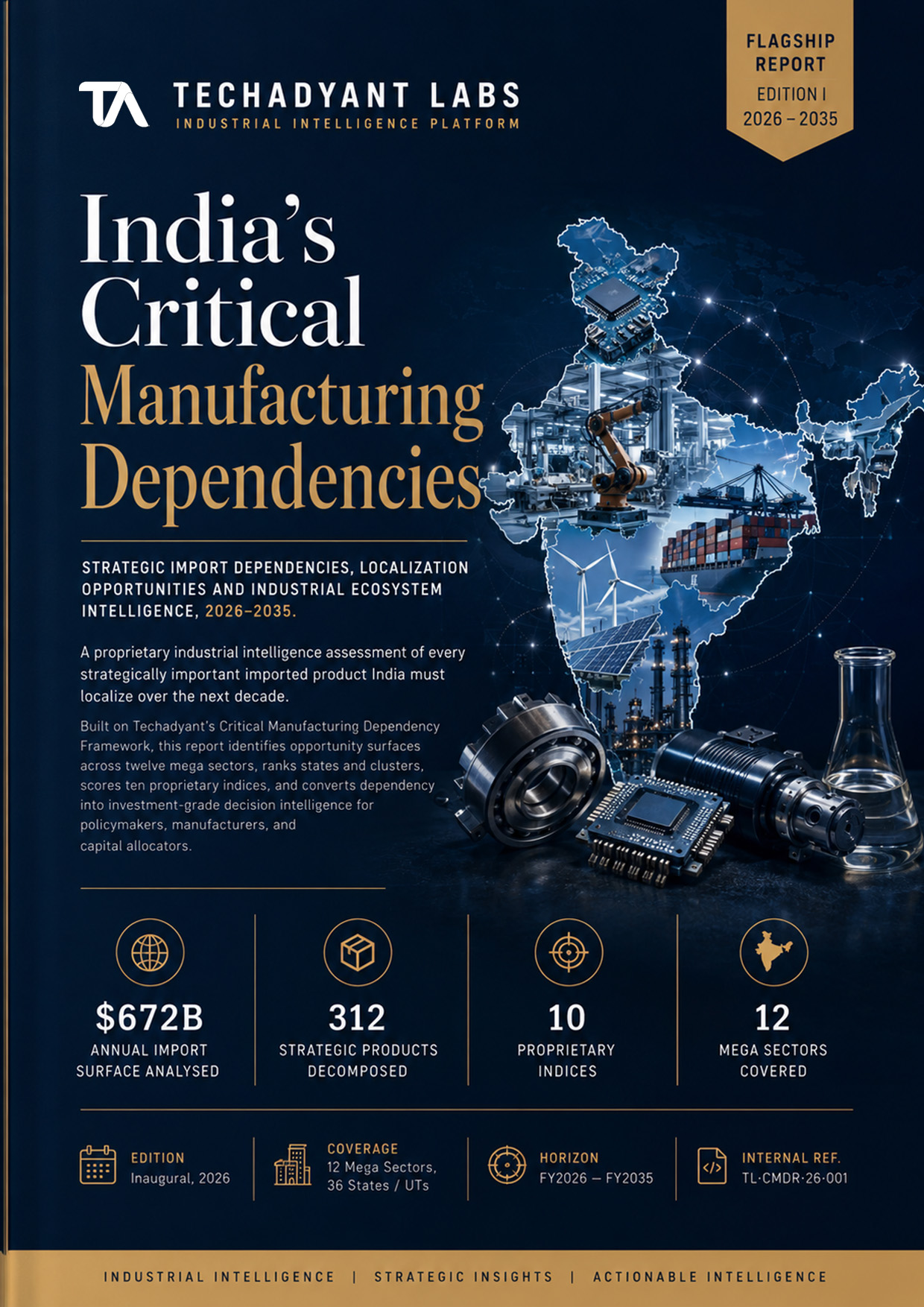
India does not have an import problem. It has an industrial-capability problem disguised as an import problem. This report treats every line in the customs ledger not as an accounting entry to be taxed or restricted, but as a diagnostic signal — the fingerprint of a manufacturing capability that does not yet exist at scale, quality or competitive cost inside the country.
Imports as a diagnostic signal
India imports roughly $672 billion of merchandise a year. About $506 billion of that — three-quarters — is strategic: goods whose absence would stall a factory, a hospital, a power project or a weapons programme. The report identifies, scores and decomposes 312 such opportunity surfaces across twelve mega-sectors, and converts them into investment-grade decision intelligence: what India should make domestically over the next decade, why, where, how, and who should build it.
The scale of the capability gap
The headline is uncomfortable. India’s manufacturing value added is about $470 billion — 2.9% of the global total, less than one-sixth of China’s and under one-fifth of the United States’. A country that aims to be the world’s third-largest economy still manufactures, per head, a fraction of its industrial peers. This is not a trade problem to be managed at the border; it is a capability problem to be built.
Chokepoints before volume
The most strategically dangerous imports are not the largest. India buys about $4.8 billion of leading-edge logic chips a year — small next to $142 billion of crude oil — but every one comes from TSMC, Samsung or SMIC. There is no supplier diversity, no substitute, no domestic option. A single event in the Taiwan Strait would reach Indian electronics, automotive, telecom and defence within ninety days. A $400 million import of EUV photoresist is a more urgent target than a $4 billion commodity, because the commodity has substitutes and the chokepoint does not. Localisation priority must follow supply risk, not import value — which is exactly what the CMDI is built to measure.
Descend the industrial stack
India has spent two decades building final-assembly capacity — phones, appliances, two-wheelers, generic pharmaceuticals — on a base of imported components, imported capital equipment and imported specialty materials. A phone assembled in India captures perhaps 6–8% of its factory-gate value; the rest accrues abroad. The shift the next decade demands is downward: from assembly to components, to sub-components, to specialty materials, to the machinery and the test-and-certification infrastructure beneath them. Each layer descended multiplies the industrial return and unlocks the next.
The CMDI and ten proprietary indices
Every surface is scored on the Critical Manufacturing Dependency Index and nine companion indices — localisation potential, investment attractiveness, supply-chain complexity, technology readiness, export potential, supply risk, industrial multiplier, national-security relevance and capability gap. Each index has a published formula, weightings, limitations and a worked example; every figure carries a confidence tag (Verified, Reasoned estimate or Strategic inference), so a reader can see exactly how much weight each number can bear.
Twelve opportunity zones
The report concentrates capital and policy on twelve executable zones — semiconductor and display in Dholera and Hosur; Li-ion cells in the Chennai–Hosur–Sri City corridor; solar wafers and cells in Mundra and Visakhapatnam; defence aerospace in Bengaluru and Hyderabad; medical devices in Ahmedabad and Hyderabad; specialty chemicals in Ankleshwar–Vadodara; CNC machine tools in Bengaluru and Coimbatore; green-hydrogen electrolysers in Mundra and Paradip; wind-turbine gearboxes; telecom and 5G equipment; EV power electronics; and pharmaceutical API backward-integration. The full localisation envelope is roughly $480 billion of largely private, phased capital over 2026–2035 — set against $5.6 trillion of strategic imports over the same period if nothing changes.
The case against — and its limits
A report that argues in only one direction is advocacy, not intelligence. Four serious objections bound the thesis: comparative advantage (why not import and specialise?), the subsidy trap (India’s licence-raj past), trade-rule and partner constraints, and fiscal opportunity cost. None defeats the case, but each narrows it — which is why every target must clear a cost-parity and subsidy-exit test, why the instruments lean on demand-side incentives and friend-shoring over blunt import bans, and why the report scores 312 surfaces rather than chasing all of them. Localisation that never reaches cost-competitiveness does not remove a dependency; it relocates it onto the exchequer.
What the full report adds
The full Edition I runs to thirteen chapters, 46 tables and 30 figures: the complete five-stage CMD framework and five-level product taxonomy; the ten index definitions with worked examples; deep-dives on 312 products across twelve sectors; six industrial-ecosystem maps; sixteen-nation global benchmarks; fifteen Indian industrial clusters scored; the policy architecture, PLI performance and eight recommended interventions; the investment envelope with plant economics and break-even analysis; state-by-state capability rankings; a company database; and the underlying Critical Manufacturing Dependencies Database (CMDD), from which the live Dependency Monitor draws a curated subset.
Unlock the complete report
You’re reading the free preview. The full analysis continues with six more sections and the downloadable PDF edition.
- 🔒04 · Water, power & land
- 🔒05 · The packaging layer
- 🔒06 · Who captures the value
- 🔒07 · The talent constraint
- 🔒08 · Second-order effects
- 🔒09 · What to watch · references
You’ll be asked to sign in, then complete a one-time secure purchase.