
Platforms are downstream of ecosystems
The decade to 2035 is the most consequential for Indian naval power in a generation, driven by three converging forces: the maturation of autonomous technologies to operational reliability, the acceleration of PLAN capability in the Indian Ocean Region, and the shift of the defence industrial base toward the Indo-Pacific. This report is not a programme audit. Its central argument is that platforms are downstream of ecosystems: the Navy can acquire XLUUVs, swarming USVs and carrier-launched UAVs only if a substrate of autonomy software, marine sensors, semiconductor access, certified test ranges and skilled workforce exists beneath them. That substrate is currently underdeveloped — and the rate at which India builds it, not the next platform decision, is the strategic task of the decade.
The three binding constraints
India's autonomous transformation is technically feasible and strategically necessary; its pace is set by three binding substrate constraints. First, semiconductor access — marine-grade FPGAs, RF integrated circuits and AI-edge NPUs that India does not yet fabricate. Second, test-and-certification throughput— the DGQA and CemILAC frameworks are organised around platform-by-platform certification and lack the continuous-update cadence autonomous software requires. Third, skilled workforce — a projected deficit of 12,000–18,000 engineers and technicians in naval-autonomy disciplines by 2030 under business-as-usual. These three interact: software cannot mature without test infrastructure, teaming cannot deploy without software, and certification cannot keep pace without reform.
What India can field by 2035
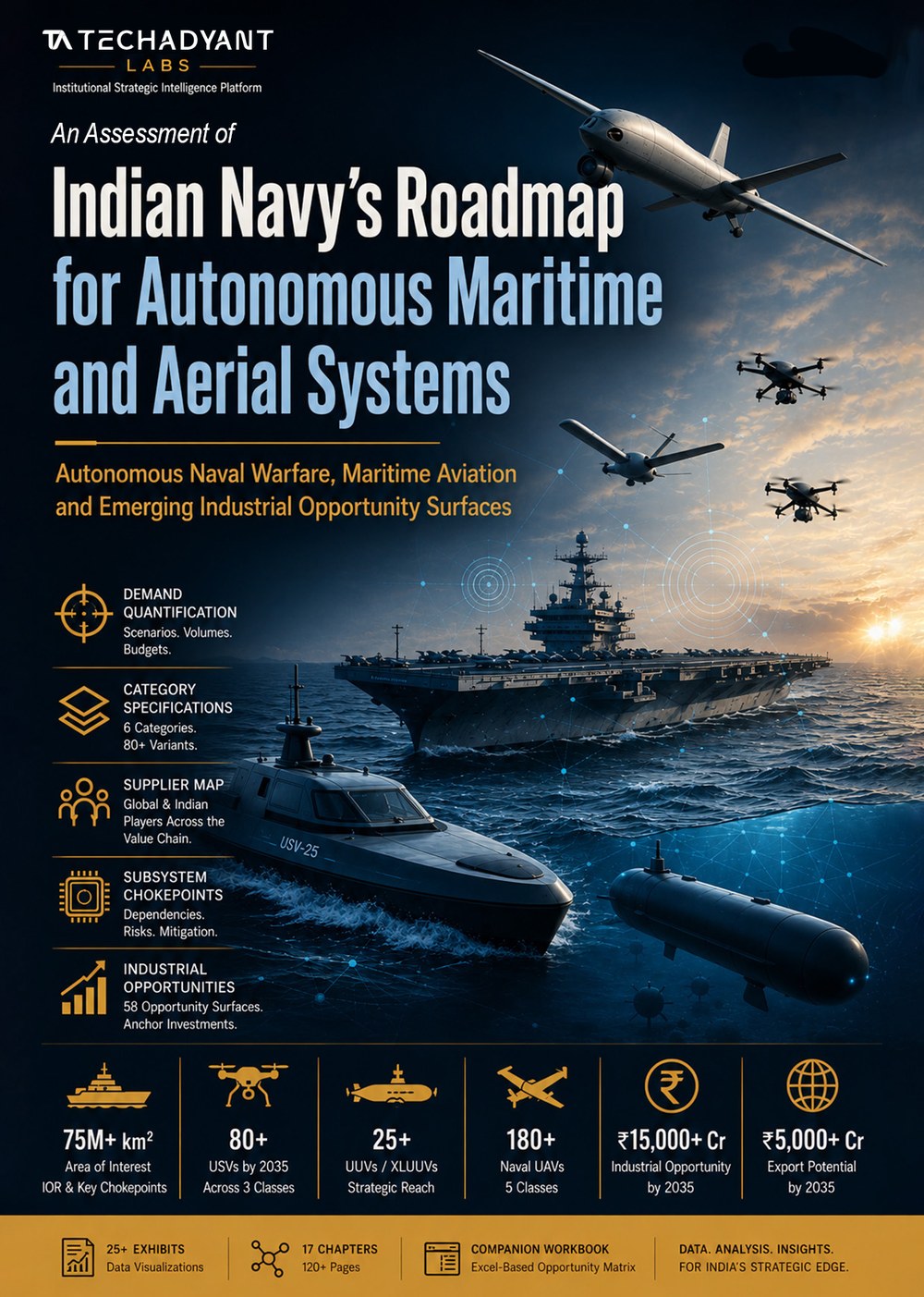
If those constraints are addressed with focus, the Navy can field a credible force posture under the recommended ‘Autonomous Power’ scenario: 80+ unmanned surface vessels, 25+ unmanned underwater vehicles including 4–6 extra-large UUVs, and 180+ naval UAVs including carrier UAVs and swarm squadrons. If they are not, the default trajectory — ‘Indigenous but Inefficient’ — delivers strong indigenisation intent but slow scale-up, cost overruns and limited export traction. The fleet the Navy gets is a function of the substrate the country builds.
The market beneath the fleet
The industrial prize is large. In the recommended scenario Indian industry captures ₹15,000+ crore in annual autonomous-naval revenue by 2035 (₹5,000+ crore of it export), building to a cumulative 2026–2035 market of approximately ₹1.2 lakh crore. But the value does not sit where attention does: the most defensible positions are in the enabling layers — autonomy middleware, marine sensors, energy systems, trusted semiconductors and certification — not in hull fabrication. The report separates annual revenue, cumulative market and addressable potential explicitly, so the three are never conflated.
Where to build: 58 opportunity surfaces
The Maritime Opportunity Surface Matrix™ ranks 58 industrial opportunity surfaces, of which nine are ‘Strategic Anchors’ — opportunities whose strategic importance and localisation potential both score above 8.0. They include quantum inertial navigation, XLUUV hull and energy systems, naval autonomy middleware, sonar transducers and arrays, air-independent-propulsion fuel cells, marine lithium-ion cells and navigation-grade IMUs. The top-30 surfaces alone represent about ₹48,000 crore of 2035 addressable market potential. Each surface is scored for strategic value, localisation potential and time-to-revenue, so a builder can see which are open now and which need the substrate to mature first.
The eight frameworks
The analysis runs on eight reproducible instruments. The Autonomous Maritime Stack™ decomposes the capability into seven layers from sensor to mission. The Naval Industrial Readiness Index™scores the ecosystem; the Naval Technology Dependency Matrix™ grades eight critical dependencies by concentration, impact and mitigation horizon; the Maritime Opportunity Surface Matrix™ ranks the 58 surfaces; and the Strategic Posture Map, Industrial Multiplier Framework™and additional proprietary indices (Naval Sovereignty Index, Maritime AI Readiness Score, Strategic Dependency Index) complete the toolkit. Each is defined once and applied consistently across the twelve chapters.
Four scenarios to 2035
The forecast runs across four scenarios on a two-axis matrix (indigenisation trajectory × scale-up aggressiveness), with probabilities that sum to 100%: Autonomous Power (30%, recommended), Indigenous but Inefficient (35%, the default without intervention), Incremental Importer (20%) and Drift and Dependency (15%). The decision points that move India from the default to the recommended path — DGQA certification reform, semiconductor acceleration, and an iDEX budget shift from breadth to depth — all sit in the 2026–2028 window.
What the full report adds
The full ~153-page edition carries all twelve chapters: future maritime warfare and the IOR threat surface; the Navy's unmanned roadmap and theatre-command architecture; deep dives on USVs, UUVs, XLUUVs and mine-countermeasures; the naval UAV ecosystem; AI-enabled fleet operations and manned-unmanned teaming; the Autonomous Maritime Stack; the DRDO/DPSU/private/startup industrial ecosystem; benchmarking against six comparator navies (US, UK, PLAN, Israel, Japan, Australia); the eight critical dependencies; the 58 opportunity surfaces; and a year-by-year 2026–2035 roadmap with per-stakeholder recommendations. Roughly 35 figures, extensive appendices (strategic-anchor deep-dive cards, entity and programme profiles, ten international case studies, a state-level cluster map and an implementation playbook) and a companion data workbook.
Unlock the complete report
You’re reading the free preview. The full analysis continues with six more sections and the downloadable PDF edition.
- 🔒04 · Water, power & land
- 🔒05 · The packaging layer
- 🔒06 · Who captures the value
- 🔒07 · The talent constraint
- 🔒08 · Second-order effects
- 🔒09 · What to watch · references
You’ll be asked to sign in, then complete a one-time secure purchase.