
Strategic Technology
Techadyant Labs research on strategic technology in India — the dependencies, constraints and opportunity surfaces that decide the real outcome. 3 published reports.
 Free
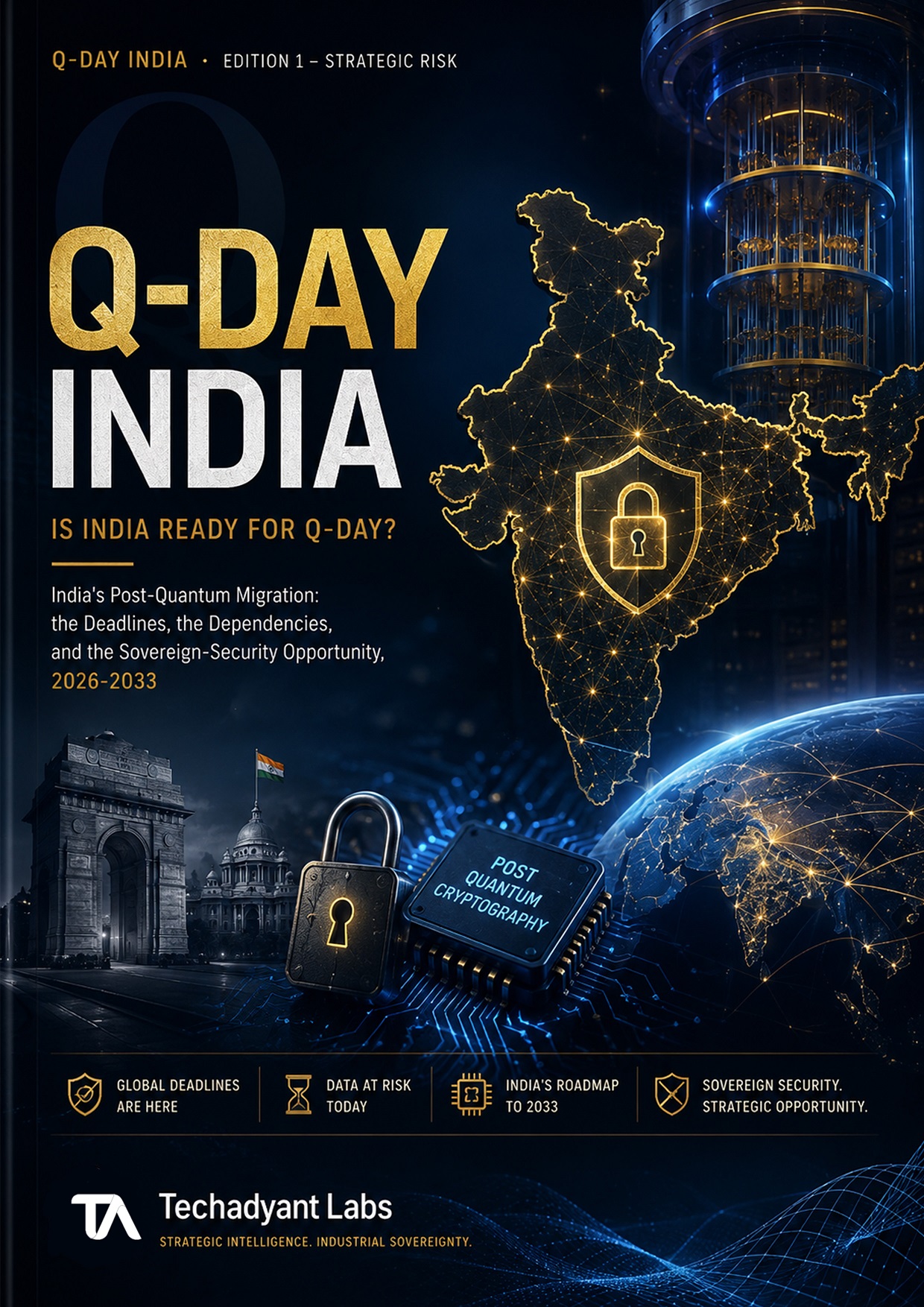
FreeQ-Day India
India’s post-quantum cryptography readiness and migration architectureQ-Day is not a date on a calendar; it is a migration problem. This free strategic-risk report maps how India can inventory cryptography, protect long-life data, build crypto-agility and sequence post-quantum migration across public infrastructure, BFSI, telecom and critical systems — before a cryptographically relevant quantum computer arrives. It covers the harvest-now-decrypt-later threat, the NIST post-quantum standards, global migration mandates, vendor concentration risk, and a five-action agenda for Indian organisations in 2026.
 ₹6,999
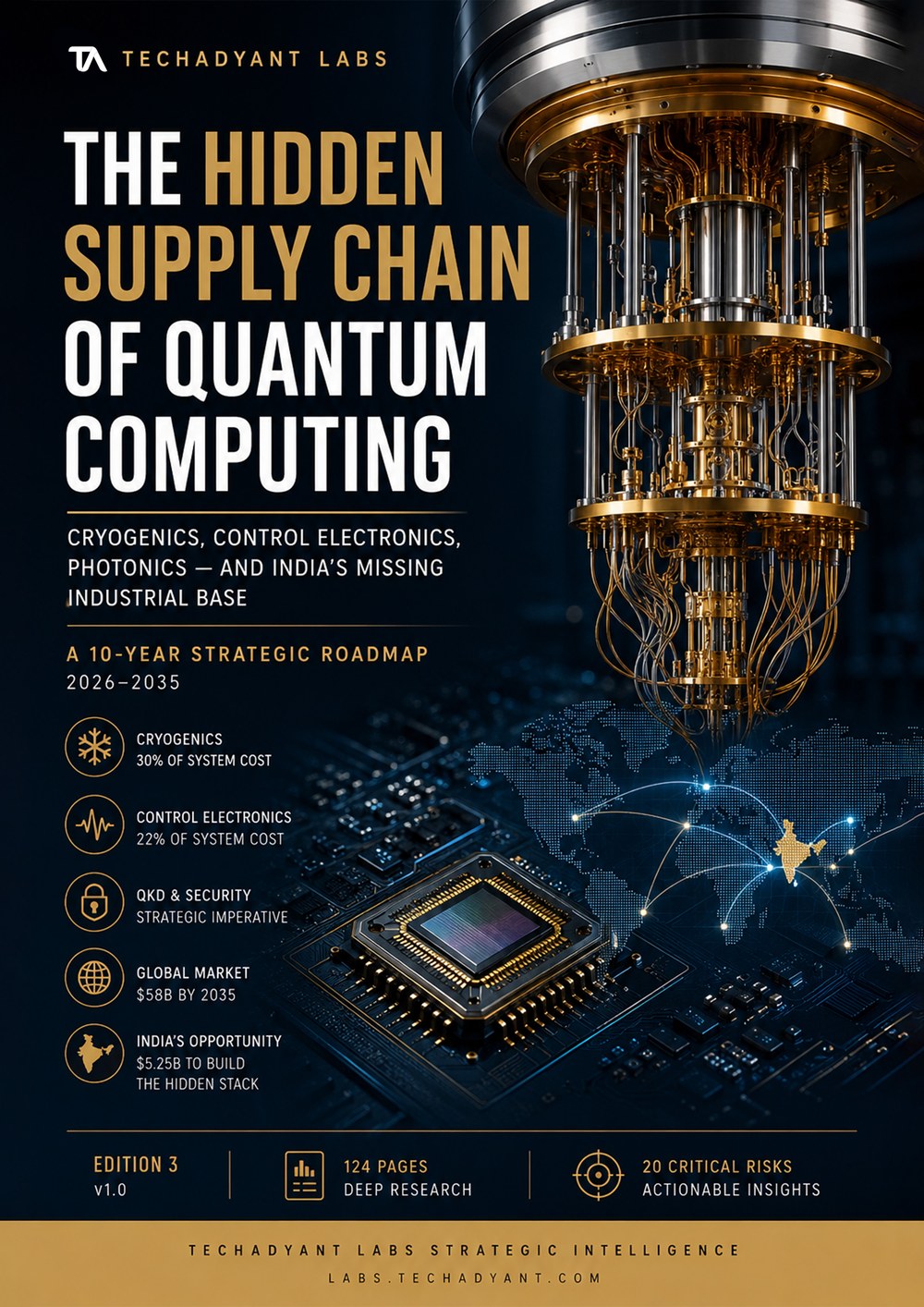
The Hidden Supply Chain of Quantum Computing
Cryogenics, Control Electronics, Photonics and India's Missing Industrial BaseThe world watches the qubit; the value, the margin and the dependency sit everywhere else. This report maps the hidden supply chain beneath quantum computing — cryogenics, control electronics, photonics, packaging and high-purity materials — where a 100-qubit machine's cost actually accrues (the qubit chip is under 8%; the hidden stack is about 63% of a ~$5.15M system). It scores India's capability layer by layer against the global frontier, finds near-total import dependency and single-source chokepoints across every critical component, sizes the patent, funding and talent gaps, and sets out a ten-year, ~$5.25 billion industrial roadmap to build a defensible position. 150+ pages, 100 figures, 20 tables, seven appendices with company, startup, policy and funding databases, and a 17-sheet data workbook.
 ₹4,999
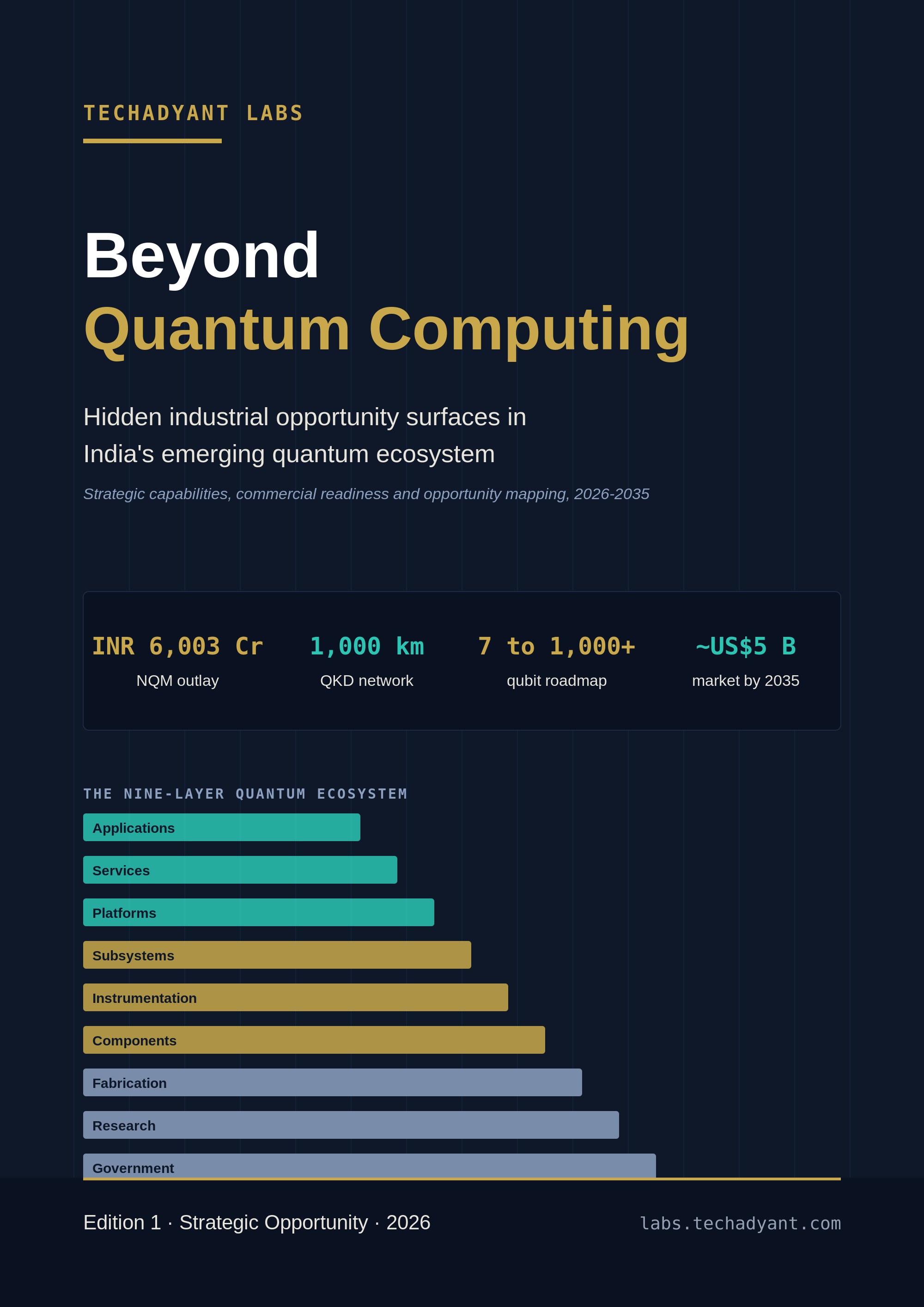
Beyond Quantum Computing
Hidden Industrial Opportunity Surfaces in India's Emerging Quantum EcosystemIndia's quantum conversation is dominated by the race to build a quantum computer. The larger story is the industrial ecosystem forming around it — computing, communication, sensing, cryogenics, photonics and post-quantum security — and where India can actually capture value. Backed by the ₹6,003 crore National Quantum Mission, India leads at the quantum-security and software layers (QKD, QRNG, full-stack systems) yet imports an estimated ~90% of the critical hardware beneath them. This report maps the emerging ecosystem layer by layer, scores the opportunity surfaces, and identifies where India's startups, MSMEs and investors can build beyond the quantum computer itself.
Capital and policy can be assembled quickly. The deep process-engineering and yield-management talent that makes a fab productive cannot — and that asymmetry shapes the realistic ramp curve.
Capital and policy can be assembled in a board meeting. The deep process-engineering and yield-management talent that makes a fab or a hyperscale DC productive cannot. The asymmetry is what sets the realistic ramp curve.
The headlines are about a quantum computer by 2028. The more important development is that the United States has reclassified quantum from a research programme into an industrial and national-security strategy — with procurement deadlines, standards and supply-chain intent attached. The question for India is what its equivalent roadmap looks like.
NASA has invited ISRO to join its Moon Base programme - a permanent south-pole outpost - at the ninth US-India Civil Space Joint Working Group in Bengaluru. The real question is not whether India can reach the Moon (Chandrayaan-3 already did) but whether the invitation is an early demand signal for Indian industry in the lunar infrastructure layer.
ISRO will resume launches in the first week of September 2026 with GISAT-1A aboard a GSLV Mk II, ending a seven-month hiatus caused by two PSLV third-stage failures. A follow-on NavIC satellite, NVS-03, is expected by October-November.
Andhra Pradesh has approved India’s first dedicated university campus for quantum technologies and artificial intelligence at Amaravati, with MeitY releasing ₹730.7 crore for an 8.5-acre net-zero NIELIT facility. Academic programmes begin at a temporary campus in Guntur from September 2026.
India’s technology-sovereignty partnerships are moving beyond the traditional supplier relationship. With Belgium, New Delhi has assembled a multi-sector agenda connecting semiconductor research, critical-mineral recycling, defence co-development, investment facilitation and port infrastructure in one bilateral framework.
At the Paris International Space Summit on 9-10 September, three India-France private-sector deals plugged Indian firms into SBS-III, India's Rs 26,968 crore military-surveillance constellation of 52 satellites. The anchor deal has France's Safran supplying the communication, inertial-navigation and optical subsystems to Dhruva Space - a reminder that India's space privatisation still rides on imported high-value payloads.
On 24 September 2026 DRDO signed its first high-value deep-tech agreement under the Technology Development Fund - with start-up Zero mK India - for indigenous development of a 20 mK dilution refrigerator, the ultra-low-temperature infrastructure that quantum computing platforms cannot run without. It is the first high-value project under the Rs 500 crore TDF deep-tech corpus, and it targets a classic import-dependent chokepoint - though an agreement is not yet a working refrigerator.
Transporter-18 lifted off on 1 October (US time) with three Indian private-space payloads aboard: TakeMe2Space's orbital-computing satellite MOI-1A, SatLeo Labs' thermal-imaging CubeSat TAPAS-1 and Dhruva Space's LEAP-2 hosted-payload mission. The mix shows Indian firms moving into compute, sensing and mission integration, while the chips, star tracker and launcher are still foreign.
QNu Labs, BISAG-N and IIT Gandhinagar report a 5.56 km free-space quantum key distribution (QKD) link run on the night of 27-28 September, with an error rate below 5% and a secure key rate of 230-260 bits per second. The result was announced on 3 October and is described as India's first free-space QKD link. It is a short-range field trial; the performance figures come from the participants and a government statement.
Map this ecosystem
See where India stands across the value chain — players, dependencies and scores — in the free Atlas.