
Technology Sovereignty Opportunity
Techadyant Labs research on technology sovereignty opportunity in India — the dependencies, constraints and opportunity surfaces that decide the real outcome. 2 published reports.
 ₹6,999
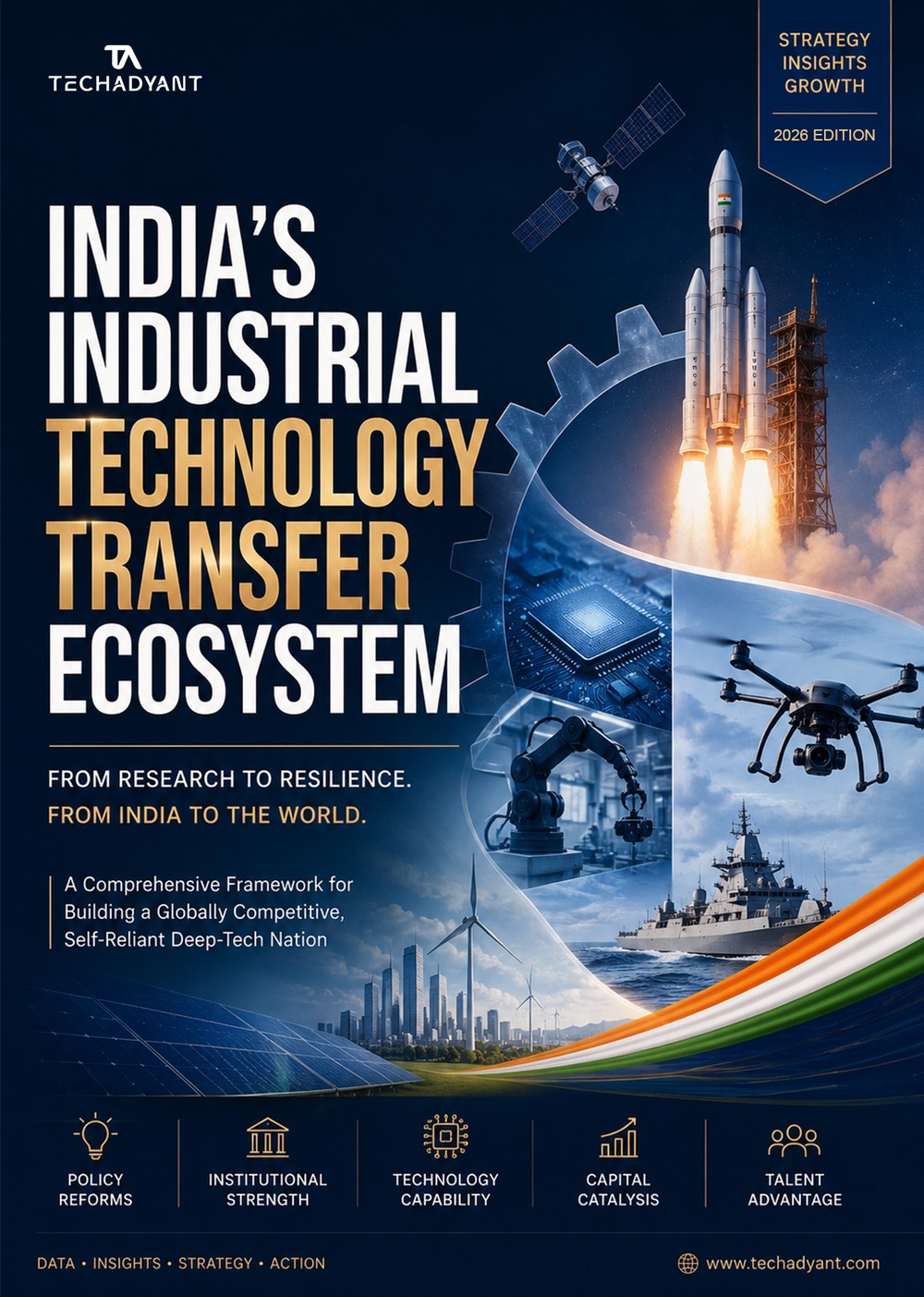
India's Industrial Technology Transfer Ecosystem
52 DRDO labs, 37 CSIR labs, 23 IITs, IISc and nine defence PSUs - why India's public R&D converts only ~1.1% of projects into products, and the five-pillar reform agenda that can move it from 5% to 12% of global deep-tech output.India has built one of the developing world's largest public research apparatuses - 52 DRDO laboratories, 37 CSIR laboratories, 23 IITs, IISc and nine Defence PSUs generating ~₹65,000 crore in revenue - yet converts it poorly: DRDO's project-to-product rate is an estimated ~1.1%, the DPSUs invest 1.4% of revenue in R&D against a 5-8% global benchmark, and the IITs convert ~7.7% of patents into spin-offs. R&D intensity stands at 0.65% of GDP, one-fifth the OECD average. With no Bayh-Dole-equivalent law, under-built technology licensing offices and a TRL 7-9 valley of death, the report maps where value leaks across DRDO, CSIR, IITs/IISc, DPSUs, TLOs, patents and spin-offs - and sets out a five-pillar reform agenda (legislative, institutional, capital, capacity, talent) with a $5 billion National Deep-Tech Fund, moving India from 5% (Incremental) toward 12% of global deep-tech output by 2035 (Accelerated base case).
 ₹6,999
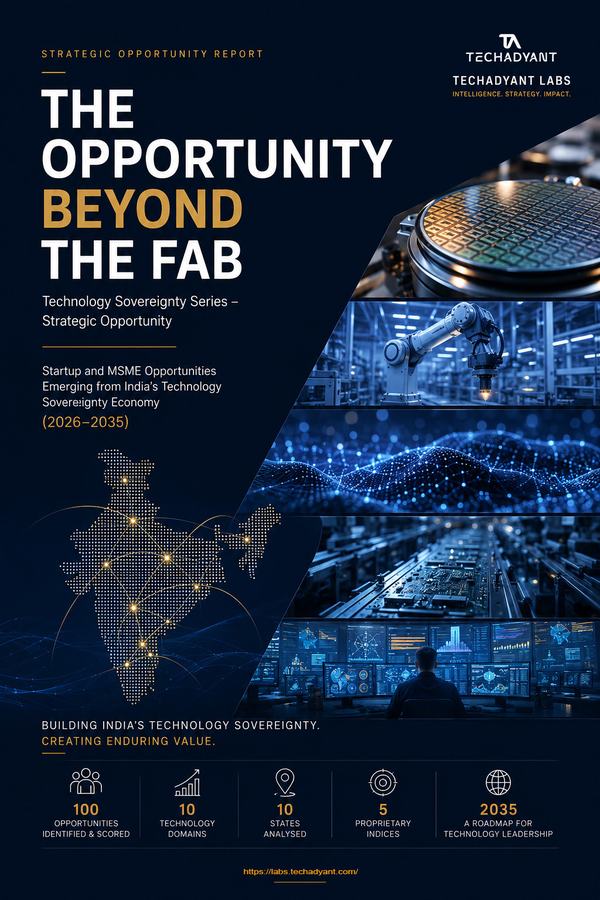
The Opportunity Beyond the Fab
Startup and MSME Opportunities Emerging from India’s Technology Sovereignty Economy (2026–2035)India has committed roughly ₹1.6 lakh crore to semiconductor manufacturing — thirteen projects across seven states. The fab gets the headlines, but it is the visible peak of a ten-layer industrial pyramid, and the layers around it are where most of the capturable value sits and where India’s existing MSME and talent base can actually compete. This report identifies, scores and ranks 100 startup and MSME opportunities across the full technology-sovereignty stack — materials, precision components, industrial software, AI, engineering software, cybersecurity and export — using five proprietary frameworks (TOMI, TSVI, IRR, GEM, SOE). 144 pages, 43 figures, 100 one-page scorecards, 10 state dashboards, a master opportunity map. The opportunity is around the fab, not instead of it.
Map this ecosystem
See where India stands across the value chain — players, dependencies and scores — in the free Atlas.