
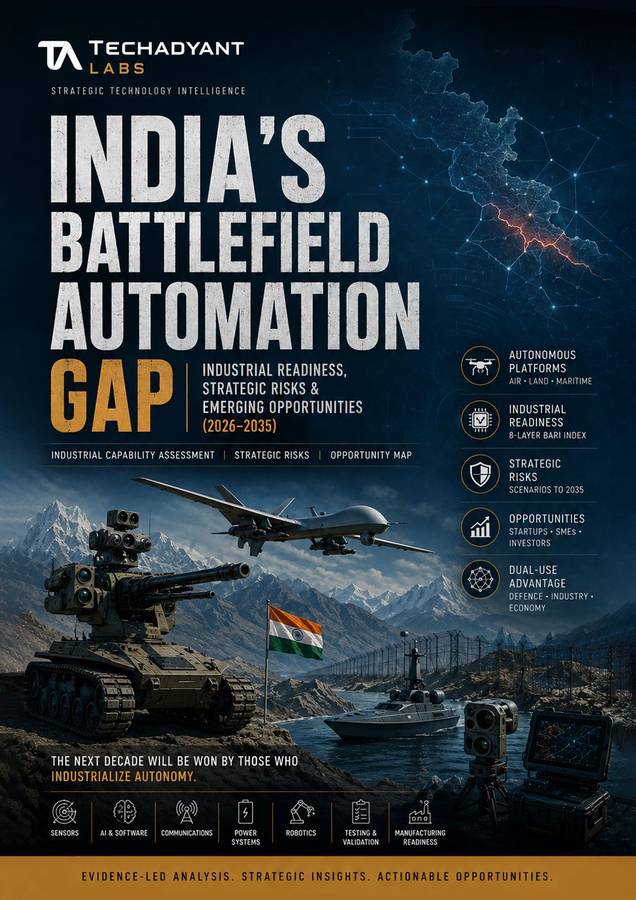
Battlefield automation is usually told as a story about drones and robots. It is better understood as a story about the industrial base beneath them — sensors, batteries, rugged electronics, radios, autonomy software and the test infrastructure that turns a prototype into a fielded system. This is the free, full reading version of the report; the complete 130-page edition is available as a free download below.
The reframe: an industrial race, not a procurement race
India can buy drones, run innovation challenges and field prototypes. But battlefield automation at national scale requires something harder: the ability to integrate seven industrial layers repeatedly and affordably. The countries that win this transition will not be the ones that purchase the most unmanned systems — they will be the ones whose industrial ecosystems can produce, test, upgrade and sustain them under crisis conditions. The gap that matters is therefore not between India and China as militaries, but between two industrial systems of different depth.
This is the fourth great shift in how wars are fought. Each previous era — industrial, mechanised, informational — was defined less by its signature weapons than by the manufacturing base that produced them at scale. Autonomy is no different.
The Battlefield Automation Readiness Index
To make the gap measurable rather than rhetorical, the report introduces the Battlefield Automation Readiness Index (BARI). Each of eight industrial dimensions is scored 1–5 as the weighted average of four sub-indicators — supplier depth, technology control, deployment maturity, and testing & validation — and the same scorecard is applied to India, China and the United States, and to every sector.
The pattern is stable and it is the report's central finding: India is strong at the ends of its value chains and hollow in the middle. Its software score is well ahead of its hardware, sensor and test scores; its defence-production momentum is ahead of its autonomy-specific industrial depth.
Where the gap lives — below the platform layer
Battlefield automation rests on seven layers. The visible top of the stack — platforms and autonomy software — is where India is relatively strong. The decisive weaknesses sit underneath, in the layers a prototype cannot do without: thermal sensors, rugged embedded electronics, military-grade batteries, contested-environment communications, and the test ranges that validate all of it.
Scored input by input, the same shape recurs: the highest strategic importance and import exposure cluster on exactly the layers where domestic maturity is lowest — and those are also where the startup and SME opportunities are richest.
This is why visible prototypes can be misleading. A country can demonstrate impressive autonomous systems while importing the sensors, cells and electronics that make them work — a dependence that is invisible in peacetime and acute under crisis resupply.
The quantified India–China gap
The gap can be anchored in hard numbers. China controls roughly 70% of the global commercial-drone market (through DJI), about 85% of global lithium-ion cell manufacturing, and around 90% of rare-earth processing — the inputs that motors, magnets and power systems depend on. India's defence production reached a record ~₹1.51 lakh crore and exports ₹23,622 crore in FY 2024-25, but those aggregates do not translate into autonomy-critical component depth.
China's industrial edge is institutional
China's advantage is carried by identifiable actors, not an abstraction. Its doctrine of "intelligentized warfare" is a stated national modernisation goal, documented in the US Department of Defense's China Military Power Report — a direction India must assess through industrial trajectory, not episodic platform sightings.
The threat picture for India
Read against India's specific geography and posture, the automation transition shows up as a set of concrete pressures — persistent border surveillance, autonomous logistics, drone swarms, electronic warfare, ISR saturation and supply-chain denial. Most are near-term, and most route back to the same industrial dependencies the stack exposes.
The conversion problem
India's real asset is its software talent and a maturing defence-startup base. But the binding constraint is not the supply of ideas — it is conversion. The iDEX programme has issued hundreds of problem statements and awarded over 400 contracts, yet only a few dozen products have reached production orders.
The leak sits between prototype and scale, where four frictions compound: long acceptance-to-contract cycles that run years against 18–36-month technology cycles; sequential certification through DGQA, CEMILAC and DGAQA; the absence of committed volume that would justify a production line; and unclear requirements at the point of award. For builders and investors, the implication is precise: conversion risk dominates technology risk.
Where India is strong
The opportunities are real and they are modular. India's software and AI talent, its iDEX-backed startup ecosystem, its MSME manufacturing base, and its large dual-use markets let firms earn commercial revenue before defence scale arrives. The investable entry points are not full platforms but subsystems: edge-AI perception, simulation and test services, rugged compute, battery packs and BMS, counter-UAS analytics, and maintenance analytics.
Crucially, the same stack that serves defence serves a wide set of civilian sectors. That dual-use demand — mining, logistics, agriculture, infrastructure inspection, energy — is what lets an Indian autonomy business reach revenue and scale before defence procurement catches up.
Three scenarios to 2035
The report models three futures, distinguished by how far India moves up the middle of the stack. In Slow Adaptation, scattered pilots sit on imported components with weak validation. In Managed Transition (most likely), India builds strong selected layers — drones, edge AI, test services and dual-use robotics. In Autonomous Capability Leader (least likely), it achieves trusted-source control of key components and export-ready systems.
The probability-weighted outcome is a credible regional node, not a peer of China — but, measured against where India sits today, a significant industrial transformation. The differentiator between the paths is execution: coordinated demand, test infrastructure and trusted components, not ambition or talent.
What India should do
The report closes with a sequenced national roadmap built on three tracks: shift the weight of policy from platforms to the middle of the stack; aggregate fragmented demand into a bankable signal; and build the test infrastructure, trusted-source supply and materials-and-process workforce that the midstream cannot run without. The clock starts the moment the investment is committed, because skills and separation capacity take years to build.
The full report
This reading version carries the argument and the framework. The complete 130-page edition — free to download below — carries the evidence the way a decision-maker needs it: all seventeen chapters with per-sector chokepoint scorecards, the full BARI 2.0 methodology with confidence ratings, the quantified India–China indicators, market sizing and procurement economics, the startup, SME and mid-sized-industry roadmaps, a ten-initiative national priority roadmap, and seven appendices — across thirty figures on the Techadyant brand system.