
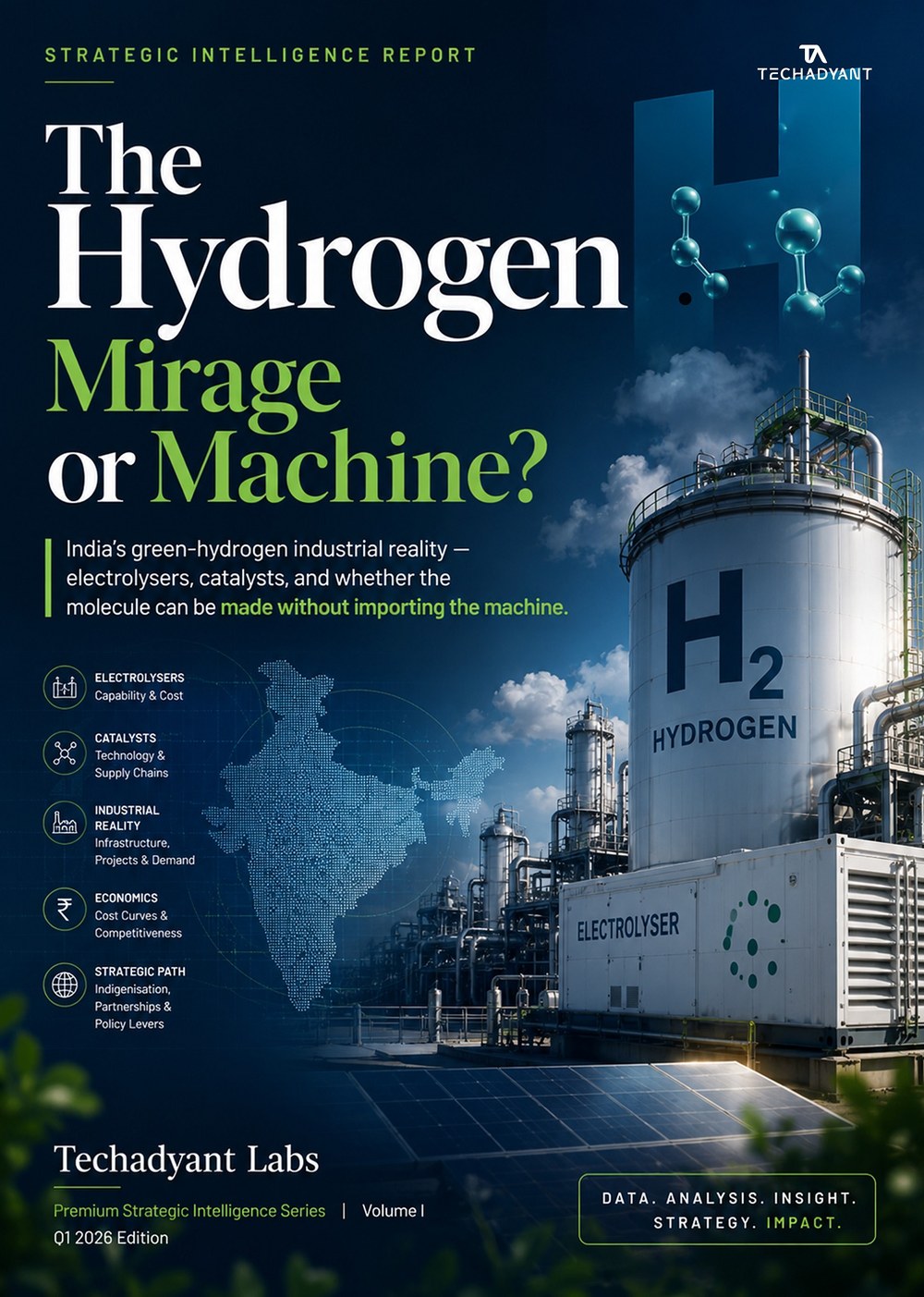
The molecule and the machine
Green hydrogen has moved, in thirty months, from the margins of Indian energy policy to its centre. But there is a distinction at the heart of the programme that policy has not yet reckoned with: green hydrogen is a molecule; the electrolyser is the machine that makes it. India has built a credible programme around the molecule — targets, mission money, offtake ambition. It has not, as yet, built a credible programme around the machine. That gap — in electrolyser manufacturing, catalysts, membranes and critical materials — is what decides whether India makes the molecule at home or imports the machine that makes it.
The money: NGHM and SIGHT
The National Green Hydrogen Mission, notified in January 2023, committed ₹19,744 crore to a single decade-long programme. Its operational core, the SIGHT scheme, is ₹17,490 crore — of which roughly ₹4,440 crore incentivises electrolyser manufacturing (Component I) and about ₹13,050 crore incentivises green-hydrogen production (Component II), alongside ₹1,466 crore for pilots and ₹400 crore for R&D. The targets are a 5 MMT green-hydrogen production and ~60 GW of electrolysers by 2030. On paper, India is doing what every major economy is doing — only more aggressively, with a tighter target and a smaller public outlay.
Six vulnerabilities in the machine
The complication is on the supply side. Six interlocking vulnerabilities define the gap. India's effective electrolyser output is under 1 GW against China's ~45 GW (China holds ~60% of global manufacturing capacity). PEM electrolysers need iridium and platinum, of which India produces zero — global iridium supply is only ~7 tonnes a year, ~85% South-African by-product. The standard PFSA membrane (Nafion) has its IP concentrated in three Western firms. Beyond the platinum-group metals, India processes titanium sponge, zirconium, scandium and rare earths at 0–3%. Capital cost (LCOH ~₹350/kg, 2.3× grey) and an un-operationalised demand-aggregation mechanism complete the six.
When does green hydrogen cross parity?
India's 2025 LCOH for green hydrogen is roughly ₹350 per kilogram — about 2.3× grey hydrogen. The MNRE 2030 target of ₹170/kg requires three things to move together: capex falling from ~USD 700/kW to ~USD 250/kW, capacity factors rising from 50% to 70%, and electricity prices falling from ₹6 to ₹3.5 per kWh. Electricity is 56% of LCOH; capex amortisation is 17%. All three are achievable — but only with the SIGHT production incentive and, critically, mandate-led offtake that makes projects bankable. Without mandates, manufacturers cannot secure contracts, and without contracts they cannot reach final investment decision.
Mirage, Muddle or Machine?
The report models three 2035 scenarios. The base case — Muddle (55% probability) — reaches ~3.5 MMT by 2030, about 30% below target, with 55–65% stack-import dependency. The upside — Machine (25%), contingent on four supply-side interventions executed by 2027 — reaches ~5.5 MMT, 30–40% import dependency, and could make India a net exporter of green ammonia. The downside — Mirage (20%) — reaches ~1.2 MMT and locks India into grey hydrogen and imports. Only the Machine scenario hits the 5 MMT target on time.
Four supply-side interventions
The resolution is not to abandon the molecule but to build the machine, in the next twenty-four months. The report sets out four interventions the current policy under-emphasises: a Critical Materials Reserve (12 months of electrolyser-industry consumption of platinum, iridium, ruthenium, titanium sponge, zirconium and rare earths); a Catalyst R&D programme (three national catalyst centres to cut PGM loading and reach a PGM-free cell); a domestic value-addition mandate (tightening SIGHT eligibility from final assembly to stack components); and demand-side mandates (green-hydrogen blending for refineries and fertiliser, H2-DRI for steel) that convert policy aspiration into bankable offtake.
What the full report adds
The full ~133-page edition carries all eighteen chapters: the NGHM policy architecture; the anatomy of the electrolyser; catalysts and critical materials; India's manufacturing reality; the China vector; LCOH economics; the demand-side architecture across refining, steel, fertiliser and mobility; the SIGHT programme; the strategic control points; supply- chain and geopolitical risk; the investment landscape; a 2025–2035 technology roadmap; international benchmarking; the three scenarios; and stakeholder-by-stakeholder recommendations. Fifty-plus data tables, ~24 figures, fifteen appendices (company/startup/policy/funding databases and directories), a confidence-rating rubric, and a companion 29-sheet data workbook available with the data tier.
Unlock the complete report
You’re reading the free preview. The full analysis continues with six more sections and the downloadable PDF edition.
- 🔒04 · Water, power & land
- 🔒05 · The packaging layer
- 🔒06 · Who captures the value
- 🔒07 · The talent constraint
- 🔒08 · Second-order effects
- 🔒09 · What to watch · references
You’ll be asked to sign in, then complete a one-time secure purchase.