
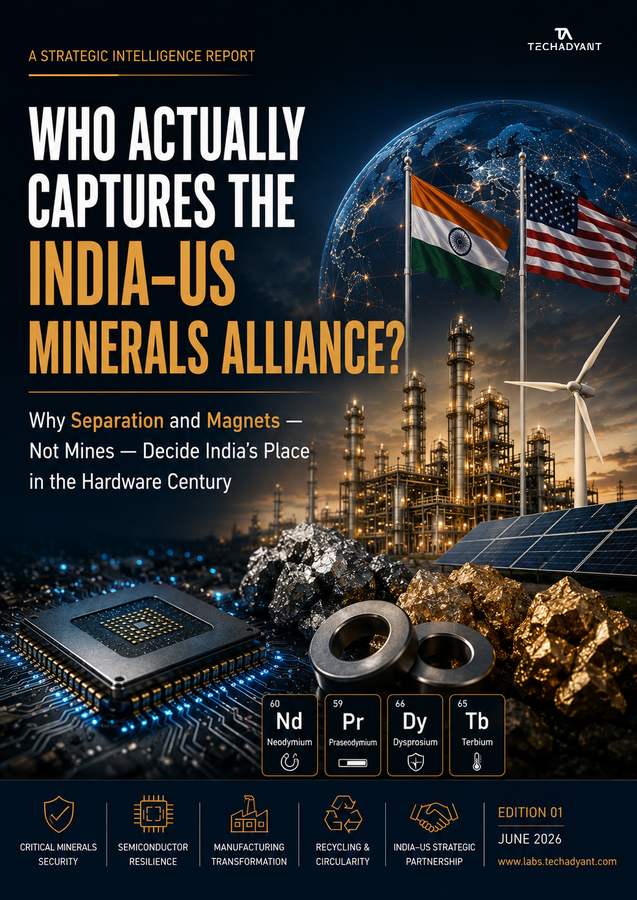
On 26 May 2026 India and the United States signed a critical-minerals framework. Both capitals read it as a supply deal — a way to get minerals out of the ground and away from China. That reading is wrong in a way that matters, and the gap between the two readings is the whole report. This free edition carries the argument, the framework and the headline findings in full; the complete 124-page edition carries the evidence the way a decision-maker needs it.
The reframe: a midstream deal, not a mining deal
The minerals at the centre of this story are not scarce in the earth's crust. India itself sits on roughly 7.23 million tonnes of rare-earth oxide in monazite. They are scarce in refined, separated, magnet-ready form — and that capability is concentrated, deliberately and durably, in China. The economic transformation worth tracking is therefore not whether India mines more ore. It is whether India builds the unglamorous, capital-heavy middle of the value chain it has spent thirty years avoiding.
The achievable and strategically decisive prize is not self-sufficiency. It is to become the credible third or fourth non-China node in a handful of midstream capabilities: separated rare-earth oxides, sintered neodymium magnets, mature-node semiconductors, and the electronic-grade gases and chemicals a fab consumes. The alliance matters only insofar as it moves India up the two chokepoints that actually carry leverage — separation and refining, and magnets and advanced materials — not the two it talks about most, extraction and assembly, where India already has capability and where leverage is lowest.
The Four Chokepoints
The report's organising instrument is the Techadyant Chokepoint Index. Mineral value flows through four sequential chokepoints, and leverage concentrates in the middle two. India is scored 1–5 at each — against installed capability, funded trajectory, and sovereign control — and the same scorecard is applied to every sector, so semiconductors, electronics, defence, electric vehicles, energy and AI infrastructure are measured against one ruler rather than six anecdotes.
The pattern is remarkably stable, and it is the report's central empirical finding: India is strong at the ends of its value chains and hollow in the middle. A score near 2 at C2 and C3 against a 4 at C4 is not a quirk of one sector — it is the shape of nearly every hardware ambition India holds. Once you can see that shape, the alliance stops being a mining story and becomes a test of whether India can do the one thing the shape says it cannot yet do.
Why processing, not reserves
China controls roughly two-thirds of rare-earth mining — a large share, but one others are eroding. Its share of separation and refining is far higher, around nine-tenths, and approaches the entirety of commercial supply for the heavy rare earths that magnets need. It is this processing share, not the mining share, that confers leverage, because a separation plant — unlike a reserve — cannot be quickly relocated or wished into existence. It takes years of capital, chemistry and environmental clearance to stand one up.
The 2024–25 export controls were the proof of where the leverage sits. When China restricted gallium, germanium and antimony, affected prices rose by several hundred per cent and export volumes collapsed toward zero. The squeeze worked precisely because it was applied in the middle of the chain, where there is no fast alternative. A country can hold large reserves and still be a hostage at the refining step — which is exactly India's position today.
The shared dependency
The diverse hardware ambitions India holds — chips, electric motors, guided weapons, batteries, wind turbines, AI servers — reduce to a small set of shared material dependencies. Rare-earth magnets recur in motors, weapons, turbines and the tools that make chips. Because the dependencies are shared, the midstream that serves one sector serves all: it is not a sector-specific cost but shared industrial infrastructure. That is the single strongest argument for building it once, deliberately, at scale — and the reason a minerals framework is really an industrial-policy decision in disguise.
A worked example: the electric-vehicle stack
The framework is only as good as what it reveals when you run a real sector through it. Take electric vehicles — the cleanest case, because the chain is visible end to end: mined oxide becomes separated NdPr, which becomes a sintered NdFeB magnet, which turns a traction motor, which sits inside an assembled vehicle. This is one of the fourteen sectors the full report scores; here is how the method works on it.
At C1 (ore to oxide) India scores a 2. The reserves exist — monazite in the beach sands of Kerala, Odisha and Tamil Nadu — but extraction is throttled by the thorium content of monazite and the regulation that follows from it, so installed capability lags the geology. At C2 (separated NdPr oxide) the score falls to a 1: India has almost no commercial separation of magnet-grade rare earths, and for the heavy rare earths the dependence on China runs to roughly 99%. At C3 (the sintered magnet) India scores a 2 — the ₹7,280 crore permanent-magnet scheme is real and well-aimed, but there is no volume production yet, only a funded intention. Then at C4 (motor and vehicle) the score jumps to a 4: India is a large and fast-growing vehicle assembler with credible electric-motor and pack-integration capability.
Read across the row and the verdict writes itself. India can build the car but cannot yet make the magnet that turns its motor. It will therefore capture assembly value — jobs, GDP, a visible industry — while remaining import-dependent on the one component that carries strategic leverage. The alliance, for EVs, is worth exactly as much as it moves the C2 and C3 scores, and not a rupee more. That single test — does this move the middle? — is the lens the report applies to all six sectors.
Who captures the value
The beneficiaries are not the obvious ones — not primarily miners, and not the marquee chip and EV brands. They are the layer in between: the separation and refining operators (IREL and the private entrants the schemes are designed to attract), the magnet-makers funded by the ₹7,280 crore permanent-magnet scheme, the electronic-gas and specialty-chemical producers any serious base requires, and the recyclers who can shortcut the separation problem entirely. Downstream assemblers benefit too — but they gain security of supply, not cost advantage. Reading the alliance through the beneficiary layer rather than the headline projects is what tells you where the returns, and the policy attention, actually belong.
India against its peers
Benchmarked against the countries that matter — China, Japan, South Korea, Taiwan, Vietnam and Indonesia — India leads its emerging-economy peers on assembly and leads all peers except the East Asian incumbents on chip design. But on separation and refining it trails not only China but Japan, Korea and Taiwan. The relationship is the same one the chokepoint scores describe at the national level: India's relative strength sits where leverage is lowest, and its relative weakness sits where leverage is highest. The full report scores each peer at each chokepoint, which is what turns "India is behind China" into a precise map of where, and by how much.
What the alliance must deliver
The framework's value is not measured in exploration acreage. It is measured in two deliverables: processing-technology transfer (separation chemistry and magnet-sintering know-how, held by a handful of firms worldwide) and guaranteed offtake from allied and defence buyers. The United States needs a non-China defence-magnet source badly enough to underwrite one — its military magnet demand is set to roughly double toward 10,000 tonnes a year by 2030. That mutual dependence is India's leverage. A framework that delivers technology and offtake is transformative; one that delivers acreage is a memorandum.
Three scenarios to 2035
The report models three futures, distinguished by how far India moves up the second and third chokepoints. In the conservative case (highest probability), India builds a real but uneven midstream led by Gujarat and remains dependent on imported leading-edge chips and most precursors. In the accelerated case, magnet capacity reaches bloc-export scale, a second semiconductor cluster emerges, and battery cells finally cross from pilot to volume. In the breakthrough case (least likely), India becomes the global alternate for selected midstream products. The probability-weighted outcome is a credible fourth node, not a China substitute — but, measured against where India sits today, the largest industrial transformation since 1991.
What the full report adds
This free edition gives you the framework and the shape of the findings. The complete 124-page edition gives you the resolution — the numbers, the named companies, and the five sectors this page only sampled:
- Fourteen chapters, each closing with a per-sector chokepoint scorecard — semiconductors, electronics, defence, EVs, energy and AI infrastructure, each scored the way the EV stack was above.
- The quantified 2035 scenario model, with explicit assumptions and probability weights behind the conservative, accelerated and breakthrough paths.
- The capital-stack analysis — who actually pays for the midstream, and the size of the financing gap that has to be closed.
- A dedicated chapter on China's likely counterstrategy — how the incumbent can weaponise price and supply, and how India withstands it.
- Peer benchmarking against China, Japan, Korea, Taiwan, Vietnam and Indonesia, scored chokepoint by chokepoint.
- Company-level beneficiary mapping and the policy roadmap, phased to 2035.
- Seven appendices — glossary, mineral profiles, semiconductor primer, policy timeline, company profiles, methodology, and the full layered bibliography — across thirty figures.
The argument is here. The evidence, sector by sector, is in the full edition below.
Unlock the complete report
You’re reading the free preview. The full analysis continues with six more sections and the downloadable PDF edition.
- 🔒04 · Water, power & land
- 🔒05 · The packaging layer
- 🔒06 · Who captures the value
- 🔒07 · The talent constraint
- 🔒08 · Second-order effects
- 🔒09 · What to watch · references
You’ll be asked to sign in, then complete a one-time secure purchase.