
AI Infrastructure
Techadyant Labs research on ai infrastructure in India — the dependencies, constraints and opportunity surfaces that decide the real outcome. 2 published reports.
 Free
FreeWho Captures Computing When the Application Disappears?
The End of the Application Era — How Agentic AI Forces the First Operating-System Redesign Since the Cloud, and Where India Can Capture the Next LayerEvery fifteen-to-twenty years the operating system is redesigned, and agentic AI is the trigger for the next one. As work shifts from applications a human opens to goals an agent pursues, the three foundations of the modern OS — CPU-centric scheduling, human-login security and application-siloed state — break at once. This report argues that value migrates down from the application layer into four control primitives — accelerated inference, identity, memory and scheduling (AIMS) — and scores who is positioned to own them on a proprietary Agent-Native Capture Index (ANCI): in 2026 there is no Primitive Owner, and the leaders win on breadth, not depth. It maps the Post-Application Stack layer by layer, traces the hardware chokepoints (advanced packaging, HBM, export policy), and sets out where India — strong in public digital infrastructure and sovereign compute, dependent on the AIMS primitives — can capture the next layer rather than the last one. Eight parts, twenty-six chapters, eighteen figures and the PAS / AIMS / ANCI framework family. Free, and readable in full on this page.
 Free
FreeIndia’s AI Industrial Transition and Infrastructure Transformation
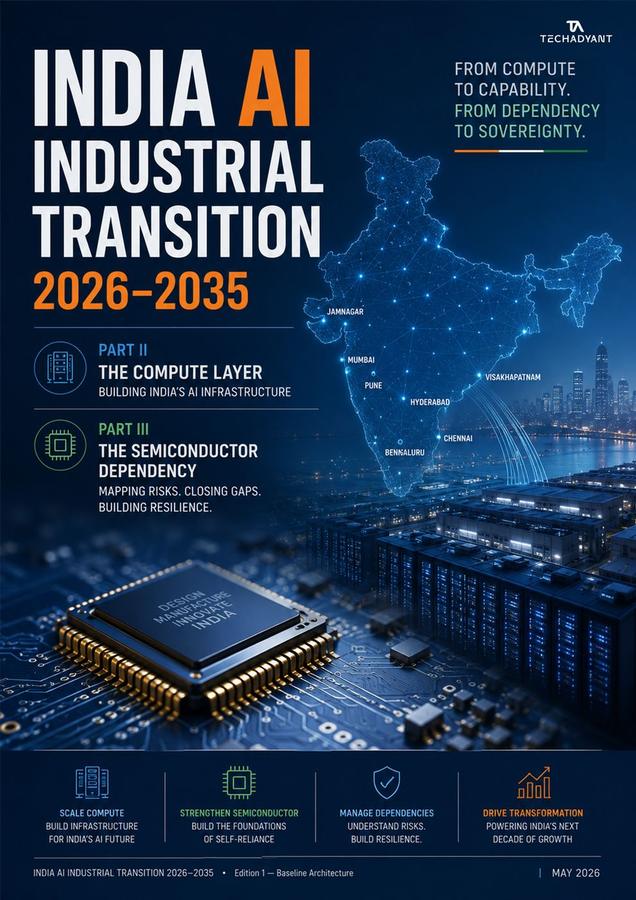
A strategic-intelligence map of compute, semiconductors, power, water, regional corridors, and the second-order industrial reshaping of IndiaA baseline architecture for India’s 2026–2035 AI industrial transition: ten anchor numbers, six theses, nine analytical frameworks, seven regional corridors, three scenarios, and eight failure-mode stress tests. The transition is treated as a re-layering of compute, semiconductors, power, water, fibre, real-estate and skilled labour — not as a workforce or careers story.
The 71% concentration of India’s submarine-cable capacity at Mumbai and Chennai is the single largest geographic risk to Indian AI infrastructure. Visakhapatnam is the one project that materially diversifies it.
The unit of competition for India’s AI build-out is the corridor, not the state. Seven corridors are competing for the next decade of hyperscaler and semiconductor capital; their endowments and binding constraints differ sharply.
India’s AI infrastructure cycle creates a ₹80,000–150,000 crore aggregate Indian-vendor opportunity through 2030. ₹28,000–60,000 crore of it is addressable to SMEs. Eight industrial segments capture most of it.
India has built or is building twelve semiconductor projects worth ₹1.65 lakh crore. None of them produces the chips that AI accelerators are made from — because the binding constraint is not the fab, it is advanced packaging.
Not capital, not policy, not aggregate talent supply. The binding constraint on India’s 4.5–9 GW DC trajectory is local: transmission, water rights, fibre right-of-way and DISCOM-level interconnection-queue execution at the level of seven specific districts.
The government expanded AI compute under the IndiaAI Mission by 15,916 GPUs - taking the empanelled national pool to 34,333 - and ordered a ~1.1 EFLOPS high-performance system, deepening India's push for sovereign compute.
India's operational data-centre capacity has risen more than four-fold - from about 375 MW in 2020 to roughly 1,575 MW - on AI and high-performance-computing demand, per a Lok Sabha reply. The scale-up advances sovereign compute but concentrates power and water demand in corridors already classified as stressed.
L&T, through its subsidiary LTN Compute (Vyoma.AI), secured an order worth Rs 10,000–15,000 crore from US-based Together AI to deploy 10,000 NVIDIA B300 GPUs at its Chennai data centre campus — India's largest single-cluster AI infrastructure deployment.
India’s AI sovereignty debate is moving from models and applications to the physical infrastructure that makes advanced computing possible. TCS subsidiary HyperVault has secured land in Hyderabad for a phased AI data-centre campus that could reach 1 GW and attract up to ₹70,000 crore in investment.
India's data-centre capacity has grown from about 375 MW in 2020 to 1.57 GW by August 2026, with the government projecting nearly 8 GW by 2030 against roughly 17 GW of demand by 2031-32. A MeitY stocktake pairs about USD 70 billion invested and USD 90 billion announced with a new 2026-27 budget tax holiday for foreign cloud providers to 2047 - the scarce inputs are now power, land and water, not demand.
The National Supercomputing Mission now reports 40 deployed systems with a combined 68 petaflops as of September 2026, up from 37 systems and 40 petaflops reported in December 2025. Thirteen systems exceed one petaflop, and the mission is working towards 50 systems and over 123 petaflops, alongside indigenous servers, interconnects and cooling.
Map this ecosystem
See where India stands across the value chain — players, dependencies and scores — in the free Atlas.