
Defence & Dual-Use
Techadyant Labs research on defence & dual-use in India — the dependencies, constraints and opportunity surfaces that decide the real outcome. 13 published reports.
 ₹6,999
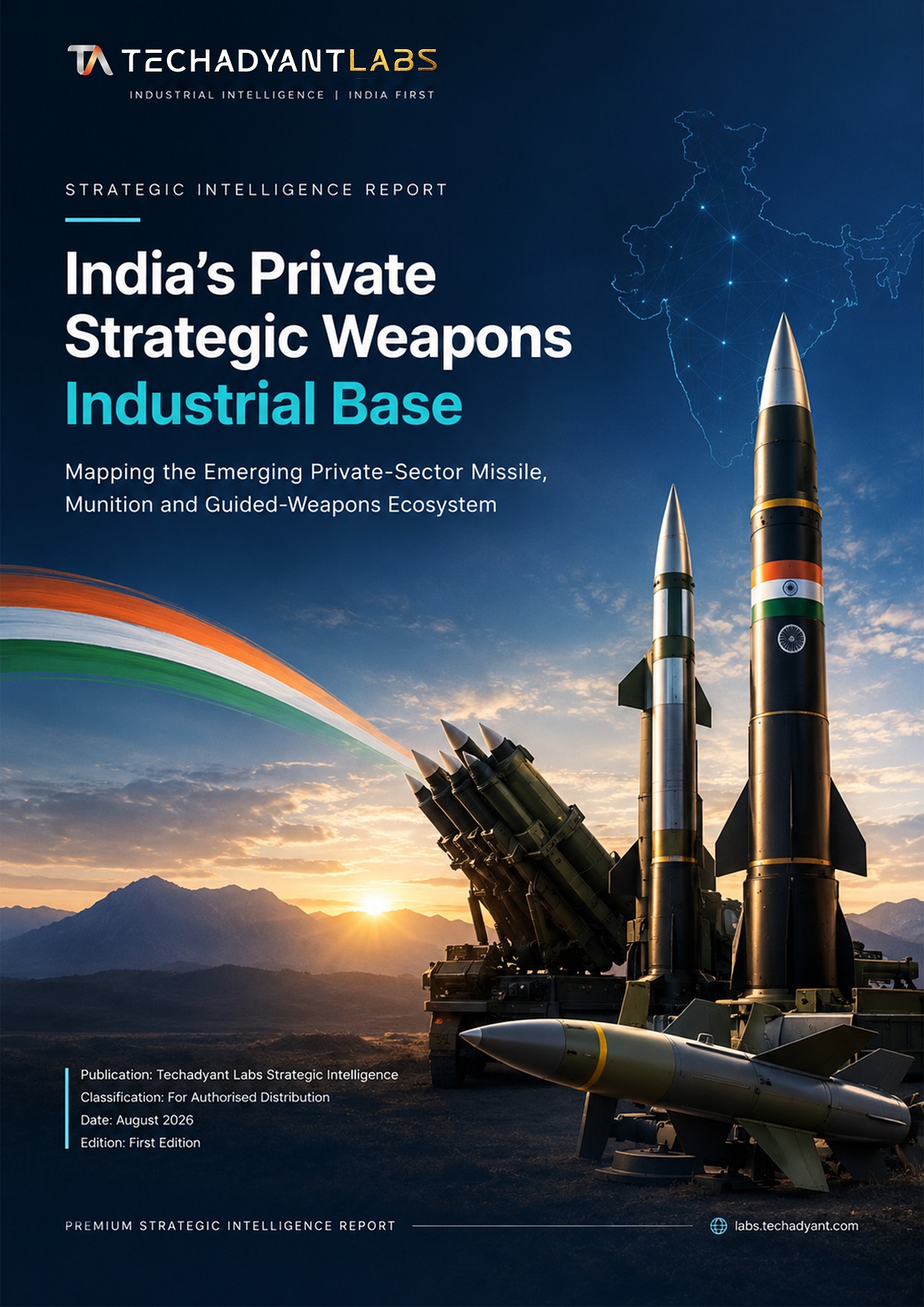
India’s Private Strategic Weapons Industrial Base
Market intelligence, technology sovereignty, and commercial capability across the missile, rocket, and precision-munitions ecosystem — 2026–2035.India’s strategic weapons industrial base has shifted structurally from a state monopoly to a distributed public–private ecosystem. A ₹2.45 lakh crore decadal addressable market (2026–2035) and DRDO’s Development-cum-Production Partner (DcPP) framework have pulled private primes to 24% of national defence production, with five industrial houses — L&T, Tata Advanced Systems, Kalyani, Adani and Solar — now holding end-to-end integration or critical prime sub-assembly capability. The transition is real but uneven: an 85–90% import dependency for terminal missile seekers and zero private-sector dynamic testing ranges remain the chokepoints that decide how much of the opportunity Indian industry captures. This 78-page report maps the capability matrix, the localisation-gap and value-chain structure, the industrial-corridor and geographic build-out, and three 2030–2035 scenarios — every exhibit carrying a [V] / [V1] / [Modelled] verification label.
 ₹6,999
Beyond Sea Drones: India's Autonomous Maritime Systems Ecosystem 2026-2035
Technologies, supply chains and industrial opportunities in India's USV/UUV ecosystem — three market scenarios to 2035, a 12-country Maritime Autonomy Readiness Index, 100 ranked opportunities and a 2026-2035 industrial roadmap.India's autonomous maritime systems (USV/UUV) market is projected to grow from a INR 2,200 crore 2026 baseline to INR 11,500 crore (Constrained), INR 35,000 crore (Baseline) or INR 55,000 crore (Accelerated) by 2035. This strategic intelligence report maps the ecosystem from primary sources, with every major claim numbered and verification-labelled [IN-XXX]. India ranks 9/12 on the proprietary Maritime Autonomy Readiness Index with a composite 4.5/10: fourteen active programmes and eight iDEX awards exist, but the subsystem base is only 15-70% indigenous (AI silicon ~15%, battery cells ~35%) and there is no certification authority. The report reframes the debate from platforms to subsystems, quantifies the MDA and ASW coverage gaps, benchmarks six countries (US, China, UK, Israel, South Korea, Singapore) with reconstructed 2024 budgets, and scores 100 opportunities on the 9-dimension Opportunity Priority Index (OPI) — 24 "Star" opportunities score 80+, led by an 11-metre ASW USV at 88. It closes with a three-phase 2026-2035 roadmap (INR 14,600 crore Phase I, 8-12x return on capital) and 45 recommendations across government (12), the Indian Navy (10), industry (10), startups (10) and investors (8). 136 pages, 29 chapters, 53 figures, 15 tables, 125 numbered sources and full appendices A-L, mirrored in a 17-sheet data workbook.
 ₹5,900
IAF Autonomous Air Power Roadmap 2026–2035
What industrial substrate must India build for autonomous air power — and how the IAF closes a 34/100 readiness gap against the USAF's 88 benchmark by 2035.India enters 2026–2035 with an assessed Air Autonomy Readiness Index of 34/100 — less than half the USAF benchmark of 88 — and the gap is concentrated in the AI software stack (-56 vs USAF) rather than aircraft. This strategic-intelligence assessment argues that the decade's defining task is the industrial substrate beneath autonomous air power: four critical-risk dependencies — semiconductors, AI compute, jet engines and carbon fibre — each scored 20/25 on the Strategic Dependency Matrix, none fully mitigable before 2030. The cost-exchange ratio has flipped nearly three orders of magnitude (1.5:1 in 1990 to a projected ~750:1 for autonomous swarms vs exquisite SAMs by 2035), making exquisite-heavy air defence structurally unaffordable against autonomous mass. If India holds the intervention path, the report models AARI 58–62 by 2035 (42–46 under no intervention); a 31-squadron IAF in MUM-T configuration delivers the combat mass of a 60+ squadron legacy force. The IOSM ranks 75 opportunity surfaces; recommendation R2 proposes a $5B/10-year Autonomous Aerospace Fund. Twelve chapters, six appendices, six proprietary frameworks.
 ₹5,900
The Indian Navy’s Autonomous Maritime Transformation 2026–2035
Platforms are downstream of ecosystems. What industrial substrate must India build to field an autonomous fleet — and who captures the ₹1.2 lakh crore market beneath USVs, UUVs, XLUUVs and naval UAVs?India’s naval autonomous transformation over 2026–2035 is technically feasible and strategically necessary — but its pace will be set less by platform decisions than by the maturation of the underlying industrial substrate. This strategic-intelligence assessment argues that platforms are downstream of ecosystems, and identifies three binding constraints: semiconductor access (marine-grade FPGAs, RF integrated circuits, AI-edge NPUs), test-and-certification throughput (DGQA and CemILAC capacity), and a projected 12,000–18,000-engineer workforce deficit by 2030. If those are addressed, the Navy can field a credible force posture under the recommended ‘Autonomous Power’ scenario — 80+ USVs, 25+ UUVs including XLUUVs, and 180+ naval UAVs by 2035 — and Indian industry can capture ₹15,000+ crore in annual revenue by 2035 (₹5,000+ crore export), building to a cumulative 2026–2035 market of approximately ₹1.2 lakh crore. The report ranks 58 industrial opportunity surfaces (nine Strategic Anchors), scores India against six comparator navies, maps the DRDO/DPSU/private/startup ecosystem, and models four scenarios to 2035. Twelve chapters, ~35 figures, eight proprietary frameworks and full appendices.
 ₹4,999
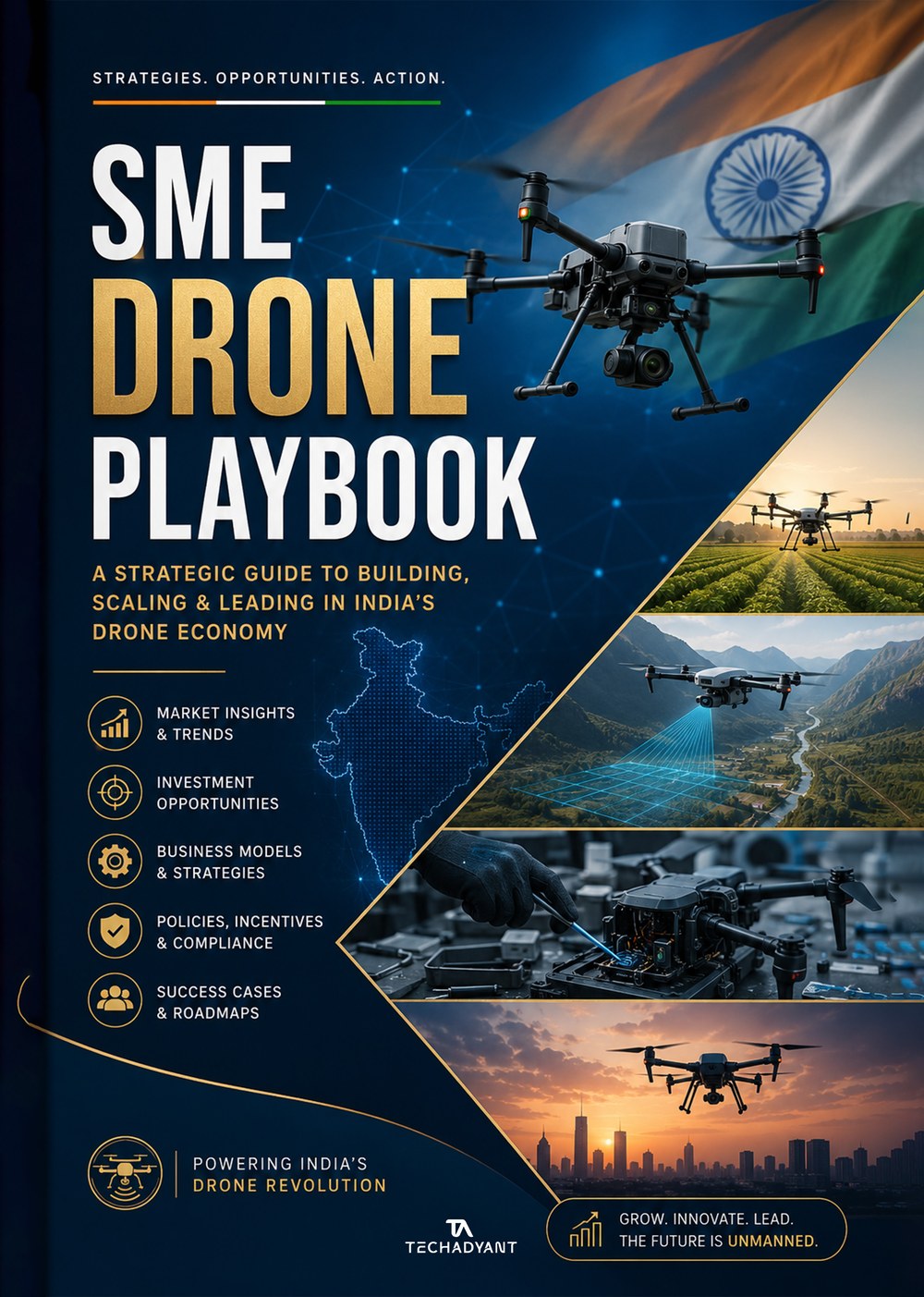
The SME Playbook for India's Drone Economy
A commercially actionable guide for investors with ₹50 lakh–₹5 crore. Eight opportunity segments scored on investment, gross margin, payback and SME suitability — from MRO and training to software, inspection and component manufacturing — plus a decision matrix, per-segment entry roadmaps and 24-month action agenda.India's drone economy has matured into a regulated, commercially viable industry — 38,500+ registered drones, 39,890 certified pilots, 244 DGCA-approved RPTOs. This playbook is written for the ₹50 lakh–₹5 crore investor: it scores eight business segments on capital, gross margin, payback and SME suitability, identifies where value actually accrues (components not assembly; the aftermarket and services layer over the airframe), and gives each segment a step-by-step entry roadmap, an investment decision matrix and a 24-month action agenda.
 ₹6,999
India’s Loitering Munitions Market Intelligence 2026–2035
Who arms India’s loitering-munition decade? Demand quantification, category specifications, the supplier map, and the subsystem chokepoints that decide sovereignty.India has entered a ten-year window in which loitering munitions move to the centre of its land-warfare doctrine. Operation Sindoor in 2025 turned the shift into a procurement fact — ₹9,100 crore of emergency powers, roughly 80% of the field-formation tranche directed to loitering and kamikaze systems, and a December-2025 DAC clearance of about ₹79,000 crore that named a Loiter Munition System for Artillery Regiments. This market-intelligence report argues India has a sovereignty problem, not a capability one: it can build world-class systems — Nagastra, ALS-50, SkyStriker, ULPGM-V3 — but depends on China for roughly 90% of its flight controllers and rare-earth magnets and about 84% of its lithium-ion cells. It models the ten-year demand bottom-up, maps the domestic and foreign supplier base, scores subsystem sovereignty across the value stack, and sets out a datable path to 2035 — with the Budget FY26-27 earmark of ₹1.39 lakh crore (75% of capital acquisition) for domestic procurement as the protected runway. Six parts, seventeen chapters, twenty-five figures and full appendices.
 ₹7,499
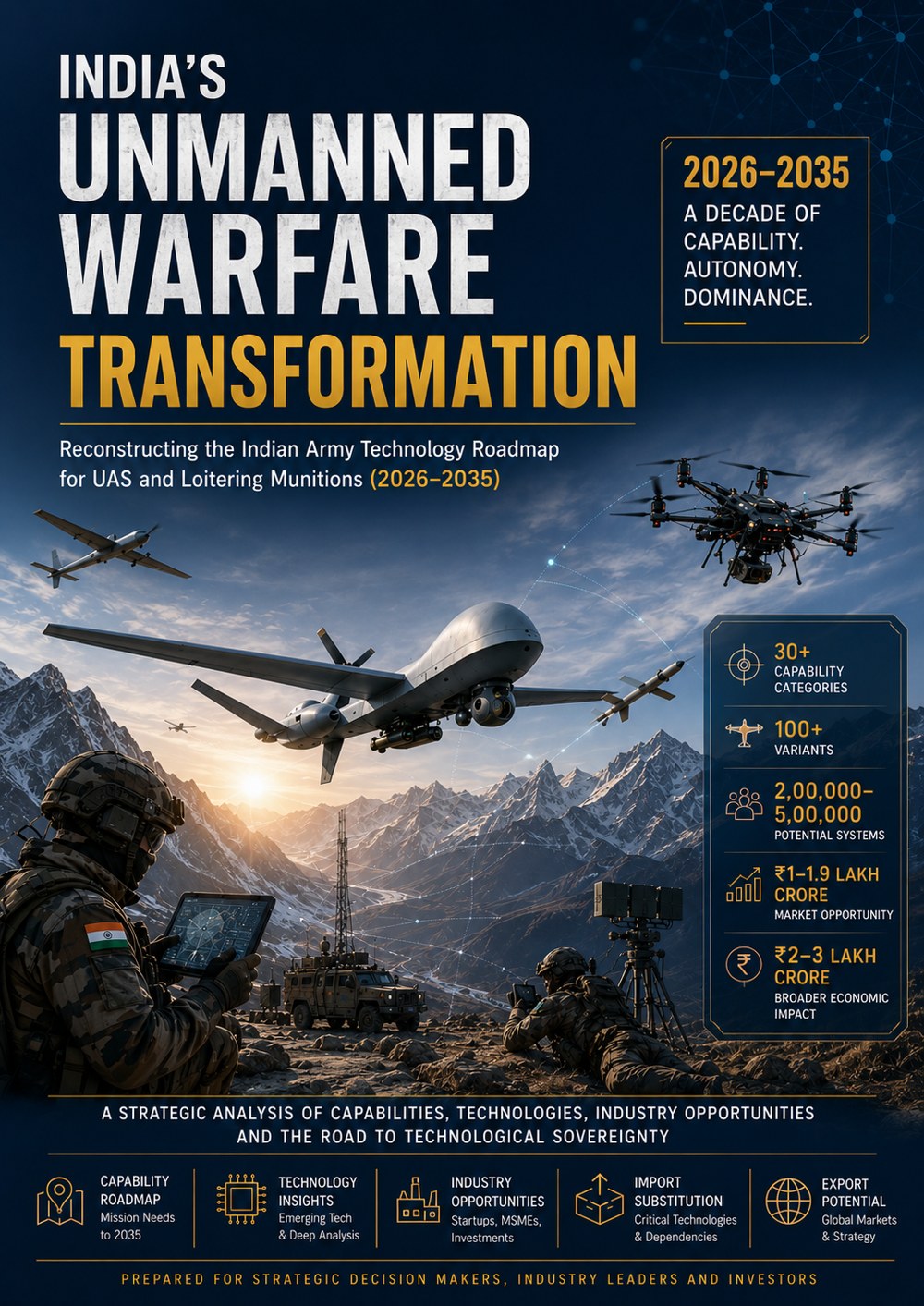
India’s Unmanned Warfare Transformation
Reconstructing the Indian Army Roadmap for Unmanned Aerial Systems and Loitering Munitions, 2026–2035 — and Pricing the Industrial Opportunity Beneath ItIndia’s Army is not buying drones — it is rebuilding the architecture of land warfare around unmanned, autonomous and attritable systems, a procurement signal of INR 1.0–1.9 lakh crore through 2035 against a INR 2–3 lakh crore economic footprint. This report reconstructs that roadmap and prices the opportunity beneath it, and its central finding is uncomfortable for an industry organised around airframes: the money, the margin and the sovereignty sit not in the platform the Army buys but in the subsystems it buys again with every unit — a roughly INR 40,000 crore import-substitution prize in sensors, seekers, propulsion, RF and silicon. Eighteen chapters, thirty-one figures and fifty-three tables; three proprietary frameworks (the Autonomous Warfare Stack, the Attritable Warfare Index and the Drone Industrial Sovereignty Matrix); a full market model (TAM/SAM/SOM, a procurement-wave model and an indigenous-content model); the competitive landscape and capability-gap map; strategic implications with playbooks for startups, MSMEs, large firms and venture investors; three quantified scenarios and a risk heat map. Every purchase includes a twenty-five-slide investor briefing deck (editable).
 ₹6,999
Who Controls India’s Drones?
Flight Controllers, AI Autonomy, and India’s Strategic Dependency in the Drone Control StackIndia assembles drones it cannot fully control. Official data placed before the Lok Sabha in April 2025 record 39% of flight controllers in DGCA-certified small drones as Chinese-sourced; across the whole fleet the effective figure is 70–80%, and the processors and MEMS inertial sensors at the base of the stack are roughly 100% imported. This report maps that control-stack dependency layer by layer and scores it on four proprietary frameworks — the Drone Autonomy Value Chain, the Strategic Vulnerability Index, the Import Vulnerability Matrix and a five-level Autonomy Maturity Model. It sizes the domestic substitution opportunity the new INR 2,000 crore PLI scheme unlocks (USD 500 million+ a year in addressable value), names the winners and losers across four policy levers (PLI, the Army 515 model, BVLOS and procurement preference), and sets out five costed recommendations and a selective-sovereignty path to 2035. Seventeen chapters, thirty-five figures, the Strategic Vulnerability Index and the Drone Autonomy Opportunity Map.
 ₹4,900
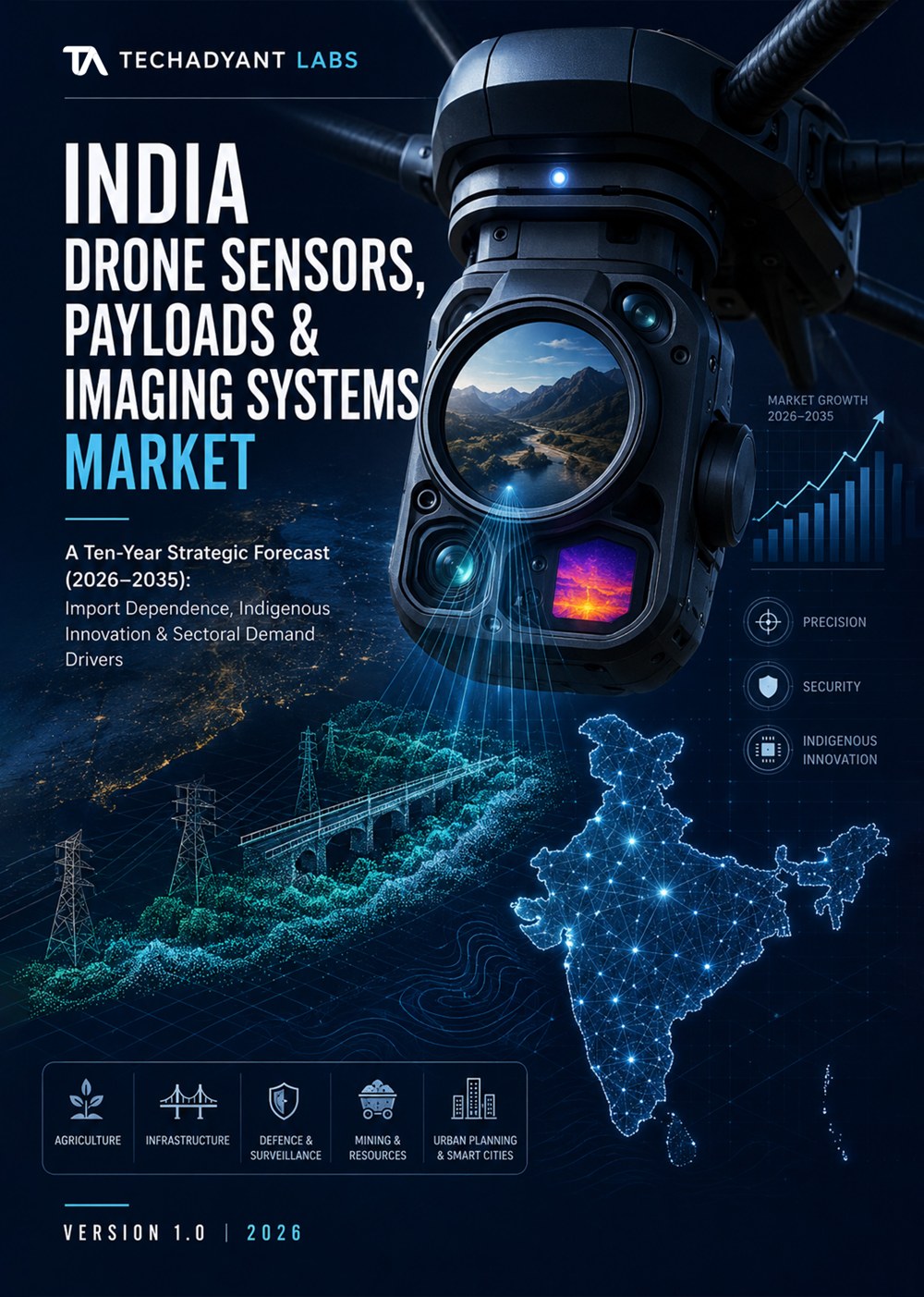
India Drone Sensors, Payloads & Imaging Systems Market
Market Size, Segmentation, Supply-Chain Dependence and 2026–2035 Forecast for the Sensing Layer Inside India’s DronesA drone is only as capable as what it can sense, and India imports most of that capability. The market for drone sensors, payloads and imaging systems is valued at roughly US$190–210 million in 2026 and modelled to reach US$1.1–1.5 billion by 2035 at a 22–26% CAGR — but 70–80% of high-grade sensor demand is met by imports: LiDAR is about 85% imported, thermal about 80%, and inertial measurement units about 70%, sourced mainly from China, Taiwan and the United States. This report sizes the market segment by segment (sensor type, end-use sector, UAV class, component tier and region), maps the import-dependence and localisation roadmap, profiles the competitive landscape — ideaForge, Eon Space Labs, Garuda Aerospace, BEL and the international suppliers — and runs a ten-year forecast across three scenarios. It tracks the structural shifts now reshaping value capture: the move from discrete sensors to integrated, pre-calibrated payloads, the rise of Drone-as-a-Service and data monetisation over hardware, and indigenous breakthroughs such as Eon Space Labs’ germanium-free thermal imaging that cuts system cost 60–70%. Thirteen chapters, 50 figures, 137 tables, and a full segmentation and forecast model.
 ₹4,999
India’s Drone Propulsion Opportunity
How Domestic Manufacturing, Defence Demand and Policy Tailwinds Are Building a $1 Billion Market for Motors, ESCs and Jet Propulsion by 2036India has localised drone assembly faster than almost any advanced-manufacturing sector — drone-component imports fell from over 80% in 2020 to below 40% by 2025 — but the dependency moved upstream rather than disappearing. This report puts the propulsion stack (motors, ESCs, propellers and the emerging jet/hybrid segment) under the lens: a US$95M market in 2025 growing to US$350M by 2030 at a 29.8% CAGR, where motors and ESCs are now assembled in India while the rare-earth magnets and ESC microcontrollers inside them remain 80–100% imported. It maps the supply chain layer by layer, scores margins and the competitive landscape, models defence demand (15,650+ propulsion units to 2030) and landed costs, and runs a ten-year forecast with three scenarios. Fifteen chapters, 45+ figures and tables, and a companion Excel data pack with a 50+ supplier directory and technical-specifications database.
 ₹6,999
India’s Drone Battery Ecosystem
Flight Risk — Securing India’s Drone Battery Ecosystem from Strategic Dependencies to an Industrial OpportunityIndia is building a world-class drone industry on an imported energy core. Of every ₹100 of value an Indian drone OEM earns, more than ₹50 leaves the country for a concentrated, overwhelmingly Chinese, battery supply chain; India scores just 30/100 on the Drone Battery Sovereignty Index. The report maps the dependency layer by layer, quantifies the ~US$10.8bn opportunity by 2030, and shows why the fastest route to value is the intelligent layer — BMS, analytics, certification and recycling — where capture jumps from ~5% to 35–40% without first solving cell manufacturing. Two proprietary frameworks (the DBSI and the five-level Readiness Model), thirty-plus figures, a ten-chart CXO dashboard, four 2035 scenarios, six appendices and a companion Excel data pack.
 ₹6,999
Who Builds India’s Drones?
India’s Drone Manufacturing Ecosystem — Strategic Dependencies, Supply-Chain Gaps, and the Opportunity Surfaces Beyond AssemblyIndia has built a drone assembly industry, not a drone manufacturing one — and its own customs data prove it: in FY2025-26 India imported about US$8 million of finished drones but roughly US$767 million of drone and aircraft parts. The 2022 import ban relocated the dependency upstream rather than removing it, into the rare-earth magnets, lithium-ion cells and flight-controller silicon that are 78–90% Chinese. This report maps that dependency layer by layer, scores 100 opportunity surfaces and 50 components on six proprietary frameworks (DLI, DSCDM, DCS, DIRM, DCRI, DOSF), quantifies the value India leaves on the table (≈43% captured today, ≈66% achievable — a reshoring prize of ~US$1.1bn a year by 2030), and sets out a selective-sovereignty path to 2035. Thirteen chapters, sixteen figures, a 100-opportunity registry, a 50-component Drone Sovereignty Index and thirteen reference appendices.
 Free
FreeIndia’s Battlefield Automation Gap
Industrial Readiness, Strategic Risks & Emerging Opportunities (2026–2035)Battlefield automation is an industrial-capability race, not a procurement race. Using a proprietary Battlefield Automation Readiness Index (BARI), this report scores India against China and the United States across eight industrial layers — sensors, rugged electronics, batteries, tactical communications, autonomy software, testing and manufacturing — maps where the gap concentrates, reads it sector by sector, and identifies the startup, SME and policy opportunities that would close it. Published free, given its relevance to government-led initiatives.
DRDO's first indigenous 350 kg thrust-class expendable turbojet closes a propulsion chokepoint that had capped the range and payload of India's cruise missiles and loitering munitions.
At Farnborough, India and the UK launched an industry-led working group on autonomous and uncrewed systems — a structural shift from buying platforms to building them together.
The Ministry of Defence has issued a Request for Information (RFI) for 2,715 logistic drones, marking the largest single procurement of its kind to resupply high-altitude border posts along the LAC and LoC.
Larsen & Toubro's Precision Engineering and Systems division - about 3% of the conglomerate's Rs 2.86 trillion revenue - expects to triple its revenue over five years, driven by indigenous drone development including the Vedh Mk1 and Chanakya systems shown at Manthan Drone Demo Day in Bengaluru.
India has begun efforts to co-join the French-led Future Combat Air System (FCAS), a sixth-generation fighter programme, as disclosed in the Parliamentary Standing Committee on Defence's report tabled on 7 August 2026. The move follows Germany's exit from FCAS and positions India alongside France in next-generation combat aviation - though the form of participation is not yet defined.
IIT Madras-incubated startup D-Propulse has hot-fired India's first indigenous 5 kN air-breathing Rotating Detonation Engine, with an aerospike nozzle, to Technology Readiness Level 5 at DRDO's DRDL in Hyderabad - targeting a flight-ready engine by December 2027 for cruise missiles, target drones and high-speed UAVs.
The Ministry of Defence has issued a Request for Information for ship-launched loitering munitions with a strike range of at least 1,000 km and nine hours of loiter endurance - reportedly valued at Rs 15,000-18,000 crore - routed to Indian industry under Buy (Indian-IDDM) preference.
The Indian Air Force will hold a dedicated Unmanned Systems Capability Demonstration at the Pokhran Firing Range on 14-16 September 2026, facilitated by SIDM, to evaluate indigenous one-way attack drones, swarm drones and logistics UAVs with ranges exceeding 1,000 km.
Bhopal-based IZI demonstrated its indigenous VANA multi-role UAV to the Indian Army - a sub-4.5 kg system deployable in under 60 seconds, with thermal sensors that spot a person at ~800 m and vehicles at ~2.4 km - as the Army runs an RFI for 5,000 tethered drone systems for frontier surveillance.
Bharat Electronics Limited (BEL) has proposed a Rs 600+ crore investment (initial outlay Rs 562.5 crore) for a defence manufacturing and MRO facility at the Chitrakoot node of the UP Defence Industrial Corridor. The state High-Level Empowered Committee approved a Letter of Comfort on 11 August, with the proposal now advancing through state approval.
The Ministry of Defence signed two contracts worth Rs 1,577 crore with Tata Advanced Systems Ltd and Nibe Pvt Ltd on 14 August for 840 loitering munitions capable of striking targets beyond 100 km in jammed and spoofed environments. Delivery is expected within 12 months under the Buy Indian (IDDM) fast-track procedure.
Kawa UAV Pvt. Ltd. (HoverIt), headquartered in the Uttar Pradesh Defence Industrial Corridor, conducted the maiden flight of Divyastra Mk3 on 11 August 2026 — the first flight of a 100% indigenously designed, developed and manufactured jet-powered loitering munition in India.
India has signed a roughly Rs 1,943 crore (about US$203 million) contract with General Atomics to lease two MQ-9B SeaGuardian HALE RPAS for the Indian Navy for 30 months - immediate maritime domain awareness over the Indian Ocean Region, ahead of the larger 31-drone purchase.
Government agencies have ordered the Indrajaal Ranger - India's only ARDTC-approved mobile anti-drone patrol vehicle - in orders totalling about Rs 155 crore, from a consortium of Indrajaal Autonomous Defense Systems and Sigma Advanced Systems. Unlike fixed counter-UAS defences, the Ranger detects, tracks and neutralises drones - including hijacking them mid-flight - while on the move.
India and Japan signed a maritime-security Memorandum of Arrangement on 20 August 2026 and agreed to assess joint naval shipbuilding, with the shipborne UNICORN mast confirmed as their flagship defence technology transfer.
India is in advanced cost negotiations to supply Armenia with more than 50 Pralay tactical ballistic missiles - a deal that, if signed, would be India's first export of a ballistic-strike system.
The Department of Defence Production notified the sixth Positive Indigenisation List on 18 August, covering 405 strategically important items with an estimated business potential of Rs 3,070 crore. The list reaches below complete platforms into the components, sub-systems, spares, raw materials and defence electronics that determine whether a domestic supply chain is genuinely sovereign.
Bharat Electronics and Ananth Technologies have signed an MoU to jointly develop and manufacture advanced electronics across missiles, radars, satellites and navigation systems - a pairing that adds a private-sector route into India's defence-electronics stack, though no funded programme is attached yet.
CSIR-NAL unveiled the NJ-05, NJ-50 and NJ-100 micro and small gas-turbine engines on 25 August 2026, with thrust capacities of 5 kg, 50 kg and 100 kg. The engines are intended for tactical UAVs, drone interceptors and compact missile systems, creating a domestic propulsion option for small unmanned and defence platforms.
Defence Minister Rajnath Singh approved the transfer of DRDO-developed technologies for all conventional missile systems to Indian defence manufacturers. The policy could move more missile programmes from state-led production into a broader industrial base, subject to qualification, certification and regulatory requirements.
Paras Defence & Space Technologies has secured exclusive Indian manufacturing rights to the U.S.-origin Powerus Guardian counter-drone interceptor family, placing foreign kinetic hard-kill technology into India’s defence manufacturing chain as the Army and Air Force separately seek scalable physical interception systems.
India’s defence-industrial challenge is no longer just whether it can manufacture more. After recording approximately ₹1.8 lakh crore in defence production in FY2025–26, the government is now pressing its 16 Defence Public Sector Undertakings to deliver faster, reduce imported content, convert R&D into deployable technology and maintain production through prolonged conflict.
The counter-drone problem is becoming a race against time: low-cost loitering munitions can compress the defender’s reaction window to seconds. Hyderabad-based Apollyon Dynamics says its Ahuti Mk II electric multirotor interceptor has reached a certified 498 km/h, signalling an indigenous attempt to build speed into the physical defeat layer.
India’s defence diplomacy is being recast as an industrial and security instrument, not only a channel for military-to-military engagement. The new RAKSHA framework sets a ten-year direction linking strategic partnerships and capacity building with indigenous defence exports and India’s role in the Indian Ocean Region.
The Defence Acquisition Council has opened the door to roughly ₹1.1 lakh crore of military procurement, with the Ministry of Defence saying 98% will be sourced from Indian industry. The headline is large. The more consequential story is underneath it: India is pairing near-term capability acquisition with an indigenous radar replacement and a design-and-development pathway for marine gas turbines—the kind of propulsion technology that determines whether a navy can build and sustain major warships without a foreign bottleneck.
The most consequential line in the Defence Acquisition Council’s ₹1.1 lakh crore package is not a vehicle, helicopter or radar. It is the quiet approval to design and develop marine gas turbines. If India can move from importing propulsion systems to designing, testing, producing and overhauling them at home, it will remove one of the least visible—and most important—foreign dependencies in its surface fleet.
The Indian Army has established AASHVAST, a New Delhi facility that examines military drones for hidden credentials, remote-access paths, unauthorised firmware, risky foreign components and behaviour under GPS spoofing or jamming. The important shift is not another drone platform. It is the attempt to make software provenance and electronic integrity part of defence acceptance and sustainment.
India's missile programmes have long demonstrated design capability. The new ToT Scale Node at DRDO's Hyderabad cluster is an attempt to solve the harder problem: converting a qualified design into a repeatable, supplier-deep, export-ready production line. The shift is from proving a missile works to proving the industrial ecosystem can build it at scale.
India has finally signed for a small initial batch of US Javelin anti-tank missiles. The more consequential development came two days later: Tata Advanced Systems was selected to explore final assembly and component production in India. The strategic question is not whether India can buy the weapon. It is how much of the missile's industrial and technological chain will actually move into India.
India's counter-UAS build-out is entering a directed-energy phase. Reporting indicates the Defence Ministry is close to approving DRDO's upgraded Integrated Drone Detection and Interdiction System (IDDS Mark-II), with the Army and Air Force positioned to order multiple indigenous systems. Public figures describe a higher-power laser class with roughly double the hard-kill range of the earlier generation—shifting the industrial question from detection alone to production-ready DEW.
Airframe headlines do not deliver fifth-generation sovereignty. Reporting on a Reliance Industries–Rolls-Royce partnership to design, develop, manufacture, test and produce an indigenous engine for India's Advanced Medium Combat Aircraft—and to build an Aerospace Gas Turbine Complex—puts the real chokepoint in view: fighter propulsion, not only the platform outline.
Karnataka is adding a physical test-and-certification layer to India's drone ecosystem, but the sovereignty value will depend on whether the proposed ₹42.8–42.9 crore, 19.26-acre site becomes funded, built and actually used by manufacturers and defence users.
Bharat Forge and Pratt & Whitney Canada will study integrating advanced turboprop engines into DRDO High-Altitude Long-Endurance UAV programme. It is an evaluation, not a contract - but propulsion is where India large-UAV ambitions have repeatedly stalled.
The Ministry of Defence signed a Rs 586 crore Make-II contract on 21 September 2026 with Accurate Industrial Controls for indigenous Auxiliary Power Units on T-72 and T-90 tanks - the alternate onboard power source for the fire-control system, firing circuit and gun stabilisation. It is a subsystem-level indigenisation move, not a platform headline; the test is delivery at fleet scale.
The Ministry of Defence signed a Rs 810.79 crore contract on 23 September 2026 with Bharat Dynamics for 160 DRDO-designed SAT-SAAW precision glide bombs for the IAF, under the Buy (Indian-IDDM) category at 60% indigenous content. It converts a DRDO design into a repeatable production order - a harder signal than a demonstrator or an import buy; the residual exposure sits in the remaining 40% and three subsystems still being localised.
Private firm IG Defence completed trials at Pokhran of the KAL, reported as India's first indigenous long-range one-way ("kamikaze") attack drone, with a strike range put at up to 1,000 km. It moves India's long-range loitering-munition ambition from RFIs and orders (Signals S-049, S-053) toward a demonstrated home-grown system - though a successful trial is a capability milestone, not a fielded, series-produced weapon.
The indigenous Kaveri dry engine has reportedly achieved about 48.5 kN thrust in trials in Russia, clearing a key mark on its path to power the Ghatak stealth UCAV, per defence media. Jet propulsion is India''s deepest and longest-standing chokepoint; a dry-engine milestone for an unmanned platform is real progress at the hardest layer - but CEMILAC certification, installed-condition and flight trials, and series manufacturing still stand between a test result and a fielded indigenous engine.
As the eighth Drone Expo ran at Yashobhoomi, New Delhi (28-30 September 2026), showcasing Indian UAV makers and component suppliers, customs at Delhi airport announced the seizure of 10 professional-grade drones worth Rs 1.03 crore, fitted with thermal imaging and laser range finders and flown in from Hong Kong via Vietnam. The juxtaposition is the signal: India can assemble airframes at scale, but demand for high-end sensor payloads is still being met through grey imports.
A Hyderabad drone maker has reportedly delivered its first batch of 41 surveillance drones to the Army and signed a loitering-munition MoU with a defence PSU, while an IIT Kanpur spin-out has gained an industrial backer. Private Indian UAV firms are moving from demonstration to delivery; what is inside their platforms remains undisclosed.
India's AMCA programme has moved from propulsion partnerships and design ambition to an industrial deadline. Three private-sector formations are competing to build the first prototypes, final bids are due by 30 October, and the programme is targeting a September 2028 maiden flight, backed by a new flight-test centre in Andhra Pradesh.
On 1 October Mahindra and Embraer named Nagpur as the proposed site for a C-390 Millennium final assembly line, contingent on the aircraft winning the Indian Air Force's Medium Transport Aircraft (MTA) competition. There is no contract, investment figure or timeline yet, so the signal is where a transport-aircraft industrial base would sit if the bid succeeds.
Noida-based IG Defence says it test-fired two solid rocket motors for JWALA, a private micro-missile meant as a lower-cost hard-kill layer against drones. It is a real propulsion step, but the company has shown no guided flight, intercept or user evaluation yet, and the performance figures in circulation are concept claims.
On 6 October Defence Minister Rajnath Singh is to mark HAL Koraput's 2,000th aero-engine delivery and lay the foundation stone for a Rs 218 crore second production line for the Shakti helicopter engine. The line is planned, not built, and Shakti is a joint design with Safran, so it adds Indian capacity for a licensed engine rather than a fully indigenous one.
Map this ecosystem
See where India stands across the value chain — players, dependencies and scores — in the free Atlas.